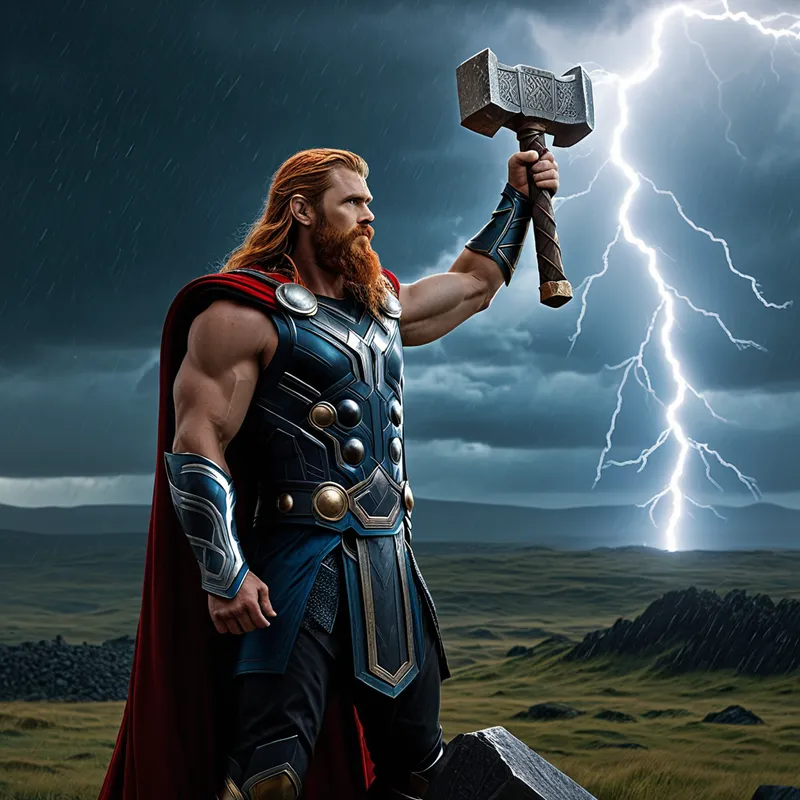
Thor's hammer Mjölnir in Norse Myth Meaning & Symbolism
The story of the god Thor's quest to reclaim his stolen hammer, a cosmic tool of creation and destruction, from the land of the giants.
The Tale of Thor's hammer Mjölnir in Norse
Listen, and hear the tale of the Thunderer’s woe, a story of loss and cunning, where the fate of the worlds hung on a trick and a bride’s veil.
In the high halls of Asgard, the air hummed with unease. Thor, son of Odin, whose laughter shook the rafters and whose rage summoned storms, was bereft. His mighty hammer, Mjölnir, forged in the heart of a dying star by the cunning dwarven brothers, was gone. Stolen in the deep of night by the frost-giant Thrym, who coveted its world-shattering power. Without it, the protector of gods and mortals was a lion without claws, a storm without wind. The giants grew bold, their laughter a cold wind from Jotunheim, threatening to spill over the walls of creation.
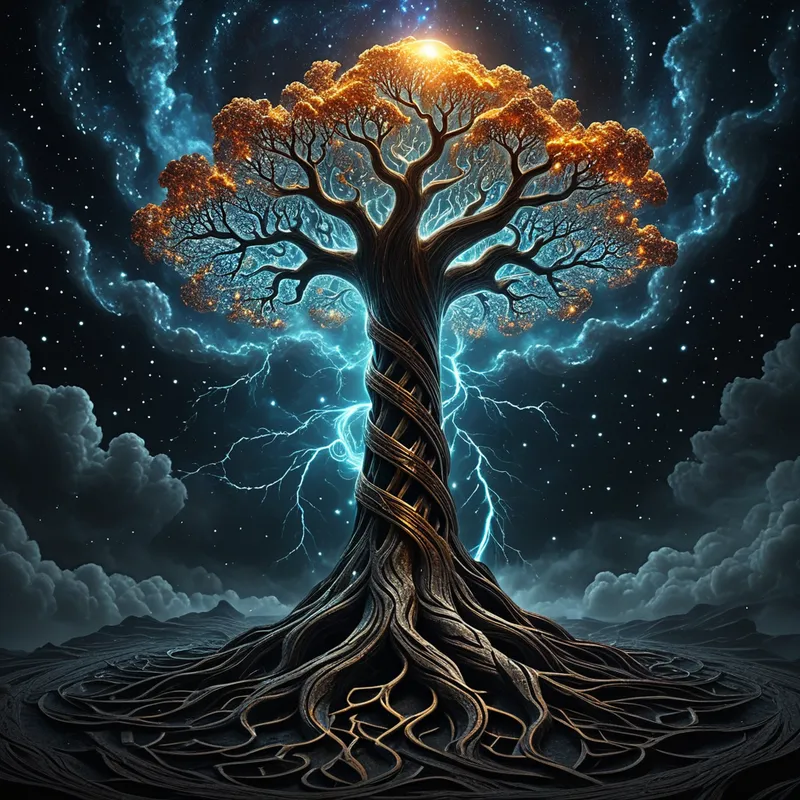
The gods gathered beneath the branches of Yggdrasil, their faces grim. Heimdall, the watchman who sees all, spoke: Thrym would return the hammer only if given the goddess Freyja as his bride. The hall fell silent. Freyja, whose tears are gold and whose chariot is drawn by cats, refused with a fury that made the silver plates tremble. Despair, cold and heavy, settled upon them.
Then Loki, the shape-shifter, the weaver of schemes, spoke with a sly smile. “Let Thor go as the bride.” Laughter, sharp and disbelieving, echoed, but Loki’s eyes held a glint of desperate genius. “Dress him in Freyja’s finest gown, veil his fierce face and red beard. I will go as his handmaiden. We will go to Jotunheim and take back what is ours.”
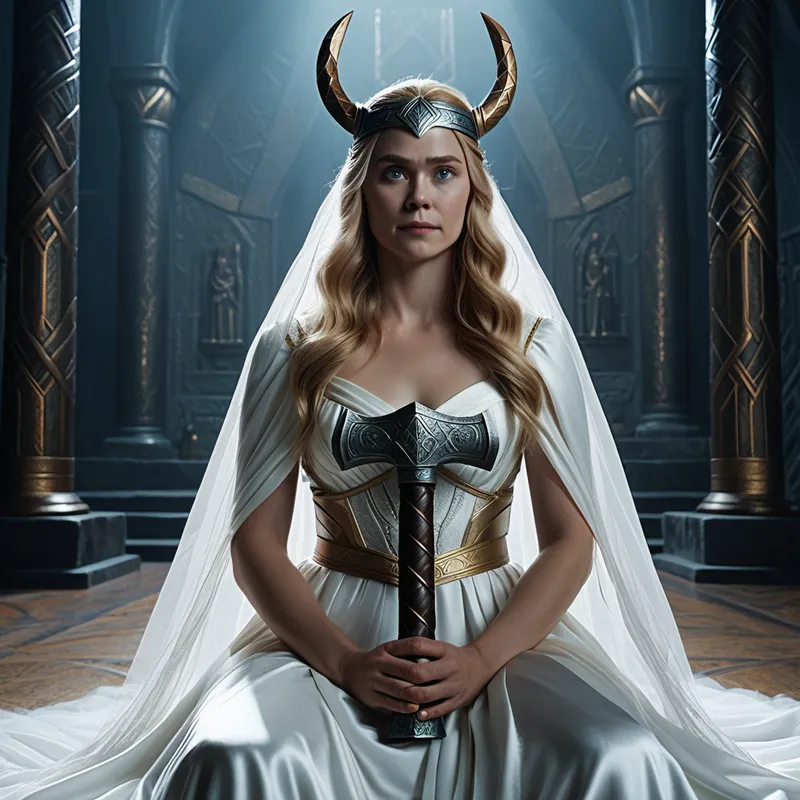
And so it was. Thor, the god of thunder, was girded in linen and silk, a heavy bridal headdress hiding his brow, a veil of finest weave obscuring his scowling visage. The great hammer’s absence was a phantom limb, an itch in his soul. Loki, clad as a simple maid, accompanied him. They rode in Thor’s goat-drawn chariot to the land of the giants, where the very stones were ice and the mountains frowned.
In Thrym’s hall, a cavern of glittering frost and roaring fires, the giant king rejoiced. “Behold my Freyja!” he bellowed. Yet, at the wedding feast, the “bride” devoured an entire ox, eight salmon, and drained three barrels of mead. Thrym stared, bewildered. Loki, quick as thought, whispered, “Freyja has not eaten for eight days, so great was her longing for Jotunheim.” The giant was appeased.
Overcome, Thrym leaned to lift his bride’s veil for a kiss. He recoiled at the sight of Thor’s burning, wrathful eyes that glittered like lightning behind the lace. Again, Loki whispered: “Freyja has not slept for eight nights, so great was her longing.”
Then Thrym commanded the hammer be brought forth to hallow the union. His servants strained to carry the massive, short-handled weapon into the hall and lay it upon the “bride’s” lap. The moment the familiar, terrible weight settled on his knees, Thor’s heart roared back to life. His fingers closed around the worn haft. The veil was torn away. The hall erupted not in wedding joy, but in the cataclysm of the god’s restored might. Lightning flashed from the hammer, thunder broke the roof, and Thrym and his kin were returned to the silent ice from whence they came. And Mjölnir was home, its thunder once again the guardian of order.
Cultural Origins & Context
This myth, preserved primarily in the Poetic Edda (in the poem Thrymskvida) and the Prose Edda of Snorri Sturluson, is a narrative jewel from the Viking Age. It was not scripture, but living story, performed by skalds (poets) in mead halls. Its function was multifaceted: it was entertainment, a cosmological anchor, and a societal mirror.
The tale operates on the fundamental Norse axis of conflict: Asgard versus Jotunheim. The giants represent the chaotic, destructive, and overwhelming forces of nature and the unconscious. Thor, as the defender of the human realm (Midgard), is the personification of the cultural will to impose order, to protect the hearth from the storm. The theft of Mjölnir is thus a cosmic crisis—the failure of the protective principle. The story’s resolution through cunning (Loki) and disguised force (Thor) reflects a pragmatic worldview where brute strength alone is insufficient; survival and restoration require wit, adaptability, and even the temporary humiliation of the proud.
Symbolic Architecture
Mjölnir is far more than a weapon; it is a sacred object, a hierophany. Its theft represents a profound dislocation of the Self. Thor without his hammer is a god stripped of his defining function, his raison d'être. He is identity in crisis.
The tool that defines us, when lost, reveals the void we feared was always there.
The hammer itself is a symbol of tremendous creative and destructive potential. It shapes worlds and shatters skulls. It hallows (as seen in blessings and weddings) and it destroys. This duality mirrors the psyche’s need for both structure (the hammer that builds the ego) and deconstruction (the hammer that smashes outdated complexes). The dwarven forgers, sons of the earth, remind us that such potent tools of the soul are born in the dark, subterranean workshops of the unconscious, through effort, sacrifice, and craft.
Thor’s cross-dressing is not mere farce but a profound ritual of descent and necessity. To reclaim his masculine, assertive power (the hammer), he must first fully embody its apparent opposite: the disguised, receptive, “feminine” role. This is a sacred humiliation, a necessary ego-deflation that makes the recovery of true power possible. He must sit in the seat of the bride, passive and veiled, before he can act as the thunderer.
The Dreamer's Resonance
When this myth stirs in the modern dreamer, it signals a profound process of reclamation. To dream of a lost, powerful tool or weapon—be it a hammer, a key, a sword—often points to a felt sense of disempowerment in waking life. The dream-ego has “lost its Mjölnir.”
The somatic experience is one of vulnerability and frustration. One may feel exposed, ineffective, unable to “strike” or “make an impact” in their world. The giants in such dreams may appear as overwhelming bosses, faceless bureaucracies, or deep-seated anxieties that have “stolen” one’s confidence or agency. The dream may compel the dreamer into awkward, humiliating, or seemingly ill-fitting situations—the modern equivalent of Thor’s bridal gown. This is the psyche’s ingenious, if uncomfortable, strategy. It is forcing the conscious personality into a new posture, a necessary disguise, to navigate the territory where its power is held captive. The recovery of the object in the dream often brings a tremendous surge of relief and strength, a somatic release indicating the reintegration of a lost aspect of the Self.
Alchemical Translation
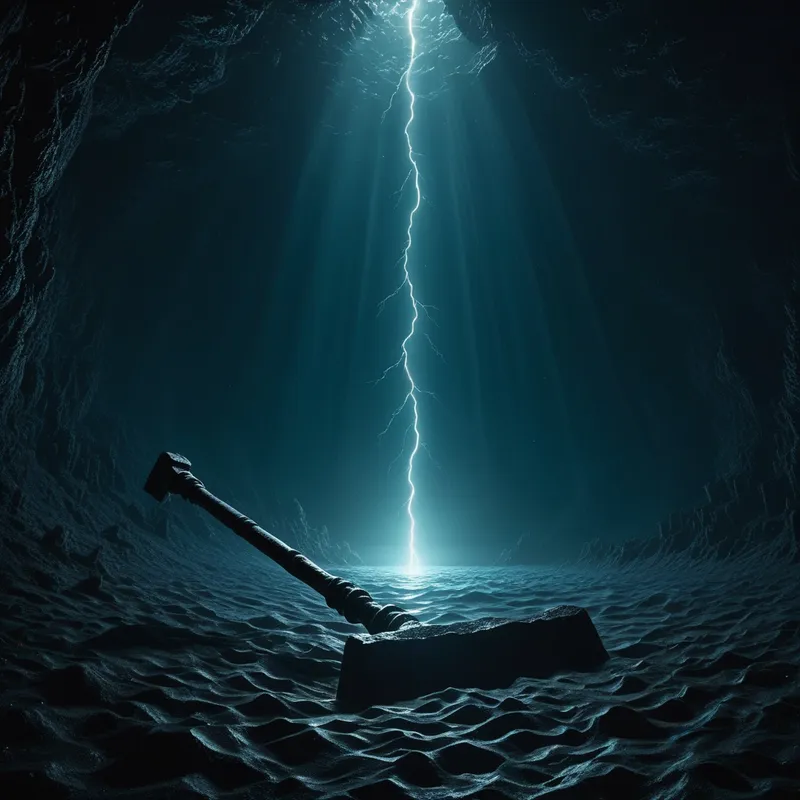
The journey of the myth is a perfect map for the alchemical process of individuation, specifically the stage of recovery following a nigredo, or dark night of the soul.
First is The Theft (Separatio): A core element of the personality—our confidence, our creativity, our will—is seized by the unconscious (the giants). We feel fragmented, less than whole. This is a necessary crisis, for it forces movement.
Second is The Descent and Disguise (Mortificatio): The conscious ego (Thor) must abandon its proud, habitual stance. It must “put on the dress,” endure the humiliation, and travel into the shadowy realm (Jotunheim/the unconscious). This is the death of the old, rigid self-image. We must become what we are not to recover what we are.
Third is The Cunning Guide (The Mercurial Spirit): Loki represents the trickster function of the psyche, the flexible intelligence that finds unorthodox paths. In our own process, this is intuition, sudden insight, or a willingness to try a radically new approach.
We do not fight our way back to wholeness on our own terms; we must accept the terms of the journey, however strange.
Finally, The Seizing and Return (Coniunctio): The power is not given; it is taken the moment it is within reach. The restored Mjölnir represents the coniunctio oppositorum—the union of opposites. The god has integrated the “bride”; the assertive power is now tempered by the experience of receptivity and cunning. The hammer is reclaimed, but the god who wields it is transformed. He knows the taste of powerlessness and the strategy of disguise. His thunder now carries the wisdom of the veil. For the modern individual, this is the triumph of retrieving a lost vitality, not as the brash youth who first owned it, but as a more complex, resilient, and complete human being.
Associated Symbols
Explore related symbols from the CaleaDream lexicon: