Theseus' Labyrinth Myth Meaning & Symbolism
A hero enters a monstrous maze to slay a beast, guided by love and a thread, emerging transformed by his confrontation with the monstrous self.
The Tale of Theseus' Labyrinth
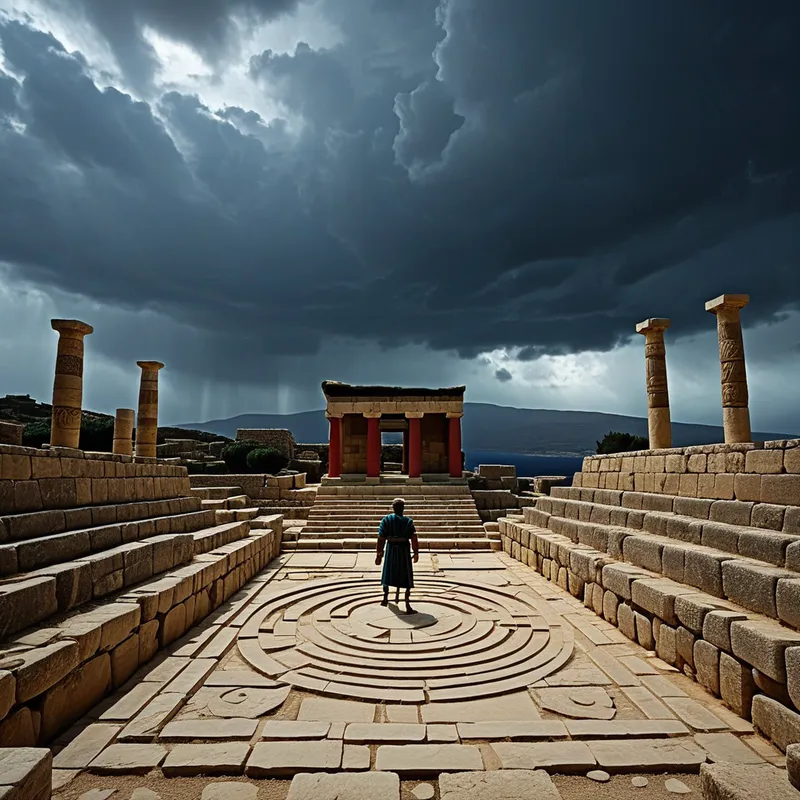
Hear now the tale of the maze beneath the earth, and the hero who walked its impossible paths. It begins not with a man, but with a king’s shame and a god’s curse. In the great palace of Minos, a queen, Pasiphaë, was gripped by a desire so unnatural it shook the pillars of the world. From her union with a magnificent white bull sent by the sea god Poseidon, a creature was born—a monster with the body of a man and the head and tail of a bull. They named it the Minotaur.
King Minos, cloaking his horror in cunning, commanded the genius Daedalus to build a prison from which the beast could never escape. And so Daedalus conceived the Labyrinth. Not merely a cage of walls, but a living puzzle of stone, a twisting, turning, ever-changing confusion where a man might wander until his bones turned to dust, his mind unraveled by the sheer geometry of despair. Here, in its stony heart, the Minotaur raged.
And here, the tribute was paid. For Minos’s wrath had fallen upon Athens for the death of his son. Every nine years, seven Athenian youths and seven maidens were sent across the wine-dark sea, cast into the Labyrinth’s maw as a feast for the monster. The very soul of Athens wept.
Until a prince with sand in his veins and the favor of the gods stood forth. Theseus, son of Aegeus, vowed to be among the tribute. He would go to Crete, he declared, and end the bloody debt. His father, stricken with fear, made him promise: if he triumphed, he would change the black sails of mourning on his ship to white.
On Crete, in the court of Minos, fate spun its thread. Ariadne, the king’s daughter, saw Theseus and her heart was ensnared. She could not bear for him to be lost. In secret, she went to Daedalus, the maze’s architect, and learned its one secret. She brought Theseus a ball of thread and a sword. “Tie this end to the stone at the entrance,” she whispered, her voice a tremor in the palace night. “Unravel it as you go in. It will be your path back through the living stone, when the deed is done.”
Into the darkness Theseus descended. The air grew cold and thick. The only sound was the scuff of his sandals and the whisper of the thread spooling behind him. The walls seemed to breathe, to shift in the corner of his eye. He walked for what felt like ages, the dread a cold stone in his gut. Then he heard it—a low, guttural snort, the scrape of a hoof on stone, the smell of wet fur and old blood.
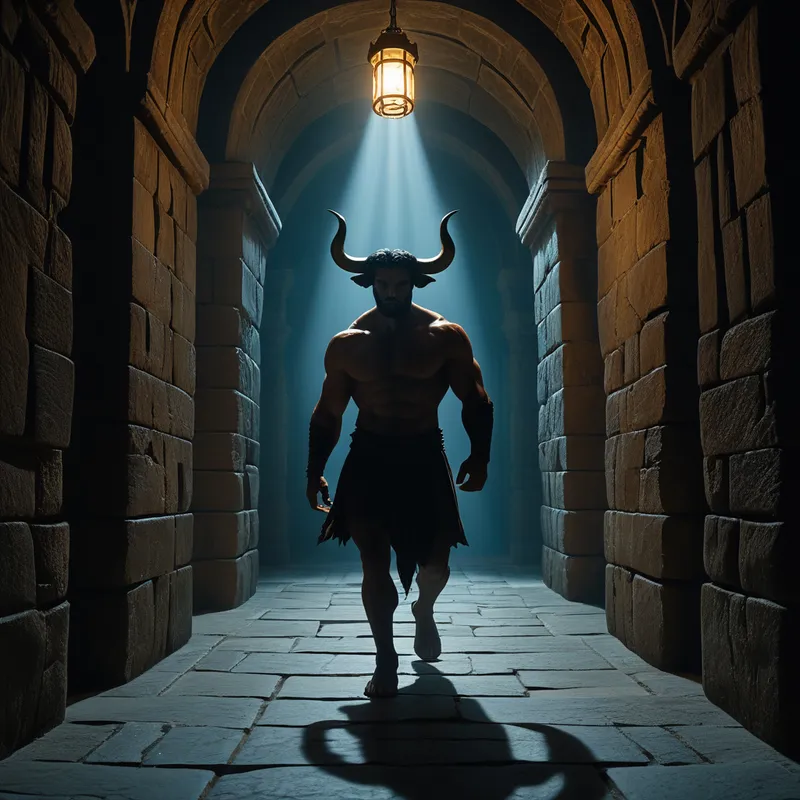
In the central chamber, the Minotaur awaited. It was not just a beast; it was a tragedy given form, all rage and confusion and pain. With a roar that shook dust from the ceiling, it charged. Theseus stood his ground. It was not a long fight, but a desperate, brutal dance in the dark. When it was over, the hero stood panting over the fallen monster, his sword dark, his own breath the loudest sound in the sudden silence.
Then came the greater test: to not become lost in his victory. He turned, found the slender, miraculous thread, and began to wind his way back, following the lifeline through the madness of the maze. He emerged, blinking, into the light, the spool now full in his hand, the monster dead behind him. With Ariadne and the spared Athenians, he fled Crete. But in the triumph of his return, a tragic oversight: he forgot his father’s command. The ship sailed into the harbor of Athens flying black sails. King Aegeus, watching from the cliffs, saw the sign of death and in his grief, threw himself into the sea that bears his name to this day.
Cultural Origins & Context
This is a foundational myth of Athenian identity, emerging from the rich oral traditions of the Bronze and Early Iron Ages. It was not a singular text but a living story, told and retold by bards, depicted on pottery, and performed in rituals. Its most famous literary renditions come from later authors like Plutarch in his Life of Theseus, and the Roman poet Ovid.
The myth functioned as a powerful political and cultural narrative for Athens. It positioned Athens (the hero) in triumphant opposition to the earlier, more mysterious Minoan civilization of Crete (the tyrannical Minos and his monstrous legacy). The slaying of the Minotaur symbolized Athens throwing off a burdensome, archaic tribute and asserting its own heroic, rational order over chaotic, bestial forces. The story of Theseus became a charter myth for Athenian hegemony and the idealized virtues of courage, cunning, and civic duty. It was a tale told to define what it meant to be Athenian: to confront the monstrous "other" and, through intelligence and bravery, navigate the path to freedom and self-determination.
Symbolic Architecture
At its core, the Labyrinth is not a place, but a state of being. It is the convoluted, often terrifying architecture of the unconscious psyche. The winding paths that double back on themselves represent the complex, repetitive patterns of our neuroses, traumas, and hidden fears. To enter willingly is to embark on the journey of self-discovery, a descent into the personal underworld.
The hero is not the one who never feels fear, but the one who ties a thread of consciousness to the doorpost of the known world and steps into the dark.
The Minotaur is the ultimate shadow. It is the incarnate result of a denied instinct (Pasiphaë’s desire), a royal shame locked away in a psychic dungeon. It represents the untamed, animalistic, and "monstrous" aspect of the self that we refuse to acknowledge, which nonetheless demands a bloody tribute of our vitality and wholeness. Theseus’s battle is the essential, inevitable confrontation with this repressed content.
Ariadne’s thread is the symbol of divine guidance, intuition, or the connecting principle of Eros. It is the thin, fragile, but unbreakable link to consciousness, memory, and love that prevents the ego from being utterly dissolved in the chaos of the unconscious. It is not brute force that saves the hero, but the capacity to remember his way, to maintain a connection to his purpose and origin.
The Dreamer's Resonance
When the Labyrinth appears in modern dreams, it signals a profound process of inner navigation. The dreamer is likely feeling trapped in a complex life situation—a career maze, a tangled relationship, or a recursive pattern of thought from which there seems no exit. Somatic sensations often accompany these dreams: a tightening in the chest, a feeling of being compressed by walls, the frantic heartbeat of a chase where the pursuer and the pursued feel intimately connected.
Dreaming of being lost in a maze without a thread speaks to a state of disorientation in one’s own psyche, where instinct and consciousness have lost their connection. To dream of finding or holding a thread, however, suggests the nascent emergence of a guiding insight—a therapy session, a creative idea, a moment of clarity that provides a direction through the confusion. Dreaming of the Minotaur is a direct encounter with the shadow. This can be terrifying, but it is a critical moment. The monster in the dream is not an external enemy, but a disowned part of the dreamer’s own power, rage, passion, or primal need, now grown fearsome through neglect and projection.

Alchemical Translation
The myth of Theseus is a perfect allegory for the Jungian process of individuation. The journey is one of psychic transmutation, where the base material of the shadow (the Minotaur) is confronted and integrated, leading to a more complete self.
The first alchemical stage, the Nigredo or blackening, is the descent into the Labyrinth—the conscious entry into depression, confusion, and the "dark night of the soul." This is a necessary dissolution. The hero’s victory is not the annihilation of the beast, but its subjugation and recognition. In psychological terms, this is the integration of the shadow: acknowledging one’s capacity for rage, selfishness, or primal desire without being ruled by it.
The gold is not found by avoiding the dark, but by forging the self within it. The thread is the promise that consciousness can survive its own depths.
Ariadne’s thread represents the Coniunctio, the sacred marriage of opposites—the logical, strategic mind (Theseus) with the connective, intuitive principle (Ariadne). This union makes the entire operation possible. The final stage, however, holds a poignant warning in the forgotten white sails. Even in triumph, the process is imperfect. Theseus, now a king, bears the guilt of his father’s death—a reminder that individuation is not about achieving perfection, but about bearing the full weight of one’s actions and history. One emerges from the Labyrinth forever changed, carrying both the glory of the conquered monster and the scars of the cost. The true triumph is not the slaying, but the return—the hard-won ability to navigate the complexities of the self and the world with the earned wisdom of one who has seen the center and survived.
Associated Symbols
Explore related symbols from the CaleaDream lexicon: