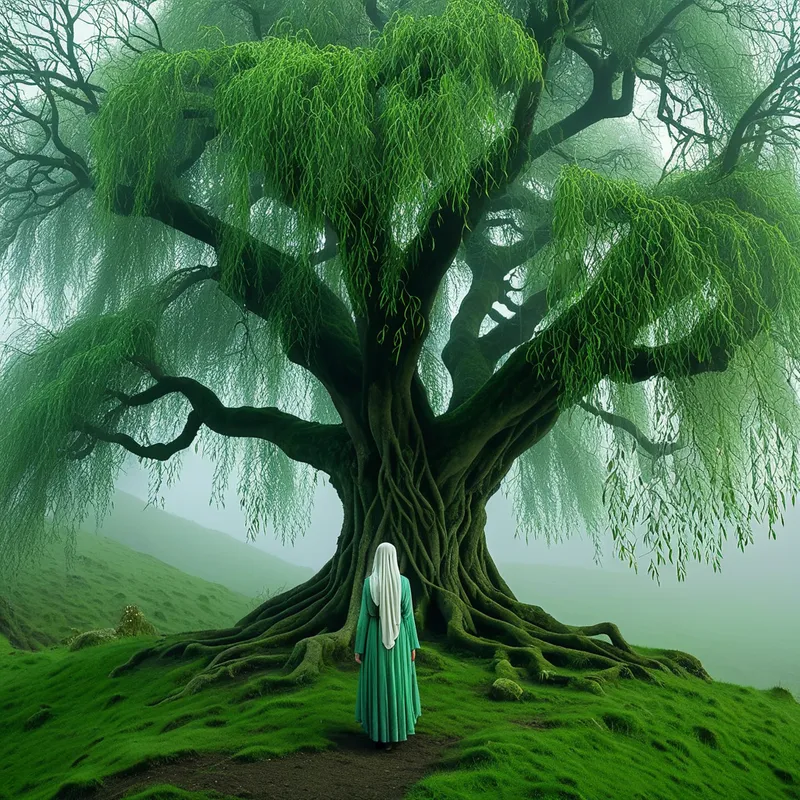
The Willow Myth Meaning & Symbolism
A myth of a goddess's grief so deep it births a sacred tree, teaching the wisdom of yielding to survive the storm.
The Tale of The Willow
Listen. The wind in the branches is not just wind. It is a memory, a sigh older than the standing stones. In the time before the cross, when the world was woven from song and story, there lived a goddess of the river and the green earth. Her name is lost to the whispering reeds, but her nature was clear: she was the Flaitheas, the very sovereignty of the land made flesh. She walked where the hazel grew thick and the salmon swam deep.
Her joy was the land's joy. When she laughed, the meadows bloomed with clover. When she danced, the rivers ran clear and full. And she loved. She loved a mortal king, a man of strength and honor, whose heart beat in time with the drum of the soil. For a season, the island knew perfect peace. The king ruled justly, the goddess blessed the harvest, and the people prospered.
But the Otherworld is jealous of such perfect unions. A blight came from the north, not of pestilence, but of iron and a cold, foreign god. The king, in his duty, took up his spear to defend the sacred tuath. The battle was fierce, fought at a ford where the water ran red. The king fell, his lifeblood seeping into the very earth he was sworn to protect.
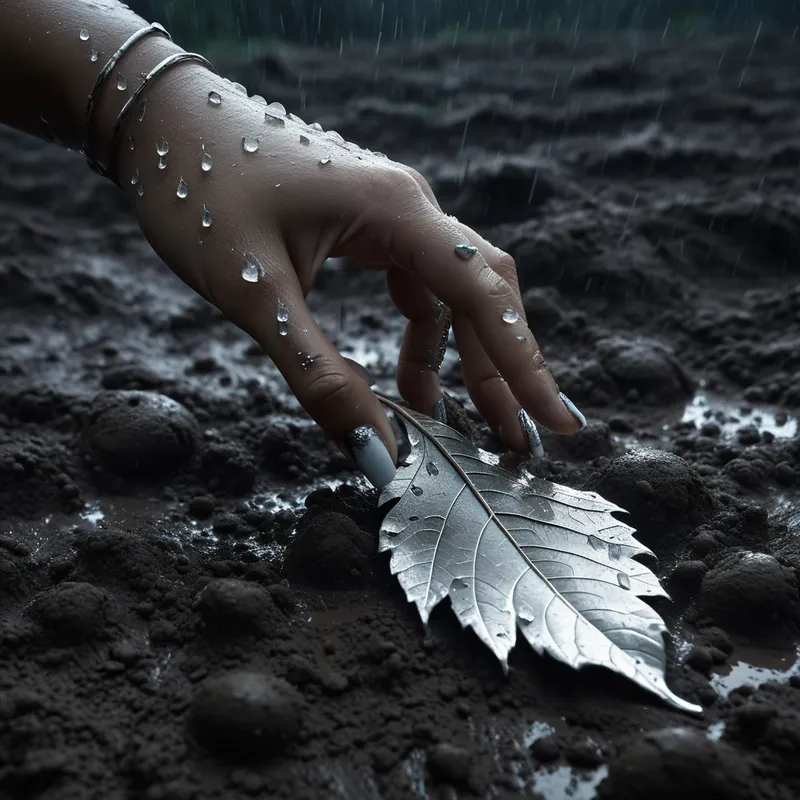
The goddess felt it—a tearing in her soul as sharp as a sickle. She ran to the ford, but found only his cold form and the silence of the crows. Her grief was not a human grief. It was elemental. She did not wail; the world wailed for her. The sky cracked with thunder, and a rain began to fall, not of water, but of a soft, silver sorrow. She knelt in the mud by the riverbank, cradling his head, and her tears fell upon the earth where his blood had soaked.
She wept for three days and three nights. On the first day, her tears were salt, and the river beside her grew brackish. On the second day, her tears were of light, and the ground around her glowed with a faint, moonlit radiance. On the third day, her tears became sap—thick, silver, and vital. Where each tear fell into the churned, bloodied earth, a slender shoot pierced the mud.
Exhausted, her form began to dissolve, not into death, but into a different kind of life. Her skin became bark, smooth and grey. Her hair lengthened, flowing down in countless strands of silver-green. Her arms stretched out and then curved gracefully down, until they touched the earth, where they took root anew. Where she had knelt, a great tree now stood, its branches a cascading veil, its roots drinking deeply from the river of her sorrow and his blood. The wind moved through it, and the sound was a sigh, a lullaby, a whispered promise: I bend, but I do not break. I weep, and from weeping, grow.
Cultural Origins & Context
The willow, or saille (pronounced sahl-yeh), held a profound place in the Celtic world-view, particularly within the Gaelic traditions of Ireland and Scotland. This myth, while not preserved in a single, canonical text like the Mythological Cycle, is a reconstruction from fragments of folklore, poetic kennings, and the tree's role in the Brehon Law tracts.
In the ancient Ogham alphabet, the willow is represented by the letter Saille, the fifth feda or few. It was considered a "peasant" tree, not a noble one like the oak, but its value was in its profound, feminine, and lunar magic. This story would have been told by the fili, not as mere entertainment, but as a dindshenchas—a "lore of place" explaining why a particular willow by a particular ford was considered sacred. Its function was to encode a fundamental truth about the relationship between the people, their rulers, and the land: sovereignty is not about rigid control, but a deep, sometimes tragic, bond that requires the resilience of yielding. The goddess's transformation into the tree provided a tangible, living connection to the divine feminine and the cycles of loss and regeneration that govern all life.
Symbolic Architecture
At its heart, the myth of The Willow is an allegory for the intelligence of softness. The willow does not resist the storm; it surrenders to it, bending its flexible limbs to avoid being shattered. This is the core psychological truth embedded in the tale.
The greatest strength is not found in unyielding stone, but in the resilient branch that knows how to grieve, to bend, and in bending, to find a new form of standing.
The goddess represents the archetypal Anima in its most raw and powerful form: the capacity for deep feeling. Her mortal king is the Animus, the structuring principle that brings her joy into manifestation in the world. His death is the inevitable trauma, the crisis that shatters the ego's illusion of control. Her transformation is not a defeat, but a sublime integration. She does not die; she becomes. She internalizes the loss, metabolizes it through her tears (the sap of feeling), and emerges as a new, rooted, and protective entity. The willow is thus the symbol of the psyche that has learned to process emotion not as a weakness, but as the very substrate of growth. Its roots in the river connect it to the unconscious, while its branches touch the earth, creating a sacred, enclosed space—a natural vas or temenos for healing.
The Dreamer's Resonance
When this myth pattern stirs in the modern dreamer, it often announces a profound encounter with grief, loss, or a necessary surrender. To dream of a willow, especially one by water, is to touch this ancient archetype.
The somatic experience might be one of heaviness, of tears that feel both personal and vast, or a sensation of being "rooted" in sadness. Psychologically, the dreamer is in the process the goddess underwent: the dissolution of an old identity (the joyful, partnered self) and the painful, slow birth of a new one. A dream of sheltering under a willow's branches suggests the psyche is creating a necessary, protected space for this inner work. A dream of planting a willow shoot indicates the conscious beginning of this process—choosing to root into one's pain to grow something new. If the willow in the dream is damaged or cut, it may reflect a cultural or personal devaluation of this yielding, feminine resilience, a warning against becoming too rigid in one's coping. The dream is an invitation to weep the silver tears, to allow the old form to dissolve, and to trust the mysterious alchemy that turns sorrow into sustaining sap.

Alchemical Translation
The journey of the goddess is a perfect map of the individuation process. It begins in the unio mentalis, the blessed union of conscious and unconscious, represented by her joyful partnership with the king. The invasion and his death are the nigredo—the devastating dark night of the soul where all seems lost.
Her kneeling and weeping by the ford is the critical phase. This is not passive suffering; it is the active solutio, performed not by fire but by water (tears). She dissolves her divine, anthropomorphic form back into the primal materia of the earth and her own emotion.
The alchemical vessel is not a flask of glass, but the heart that can hold its own breaking.
From this dissolution comes the albedo, symbolized by the silver glow of her tears and the pale bark of the newborn tree. A new, subtler consciousness emerges—one that is interconnected, rooted in the depths, and flexible. The final tree is the rubedo and the lapis for this myth. The philosopher's stone here is not a conquering hero, but a nurturing, protective presence. The integrated Self is the Willow: strong through its connection, wise through its suffering, and life-giving through its deep, unbreakable roots in the dark, moist truths of existence. For the modern individual, the myth teaches that our deepest transformations are not achieved by force of will, but by the courage to fully yield to the processes that break us, trusting they will remake us into something more deeply, resiliently alive.
Associated Symbols
Explore related symbols from the CaleaDream lexicon: