The War of Ogun and Shango
A legendary Yoruba myth depicting the fierce conflict between the gods of iron and thunder, exploring themes of power, justice, and divine rivalry.
The Tale of The War of Ogun and Shango
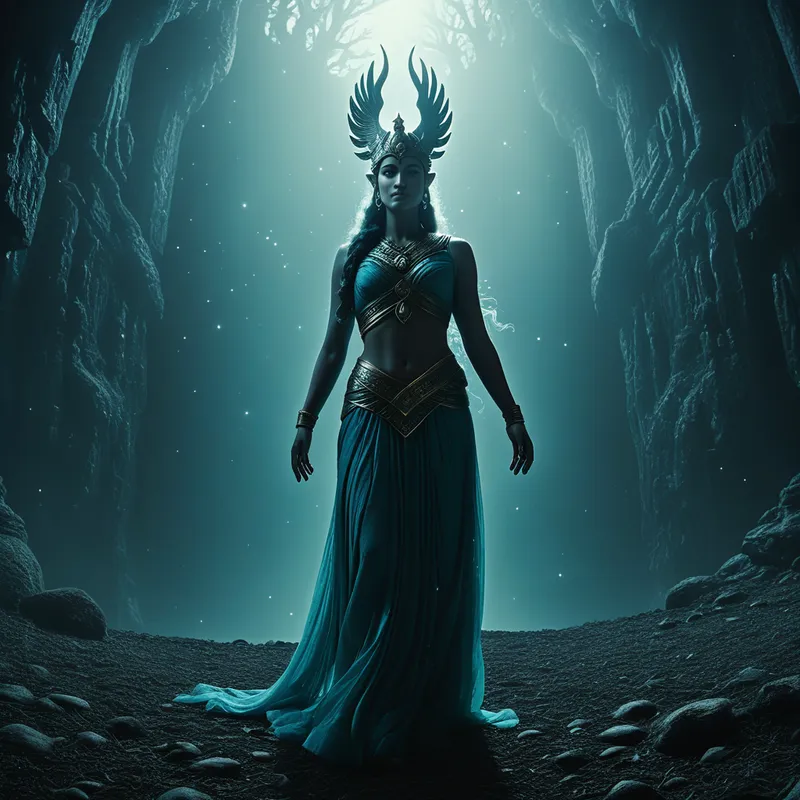
In the beginning, there was a profound and necessary harmony. Ogun, the god of iron, war, and the forge, was the first king of Ile-Ife. His rule was one of stern order, carved from the raw earth with his own iron tools. He cleared the primordial forests, paved the first roads, and established the laws of civilization. His power was in the silent, enduring strength of [the earth](/myths/the-earth “Myth from Hindu culture.”/), in the patient shaping of metal, in the relentless forward march of progress. He was the spine of [the world](/myths/the-world “Myth from Tarot culture.”/), unyielding and absolute.
But the spirit of the age shifted. The people, perhaps weary of Ogun’s unflinching, metallic [justice](/myths/justice “Myth from Tarot culture.”/), yearned for a different kind of power—one that was visible, dramatic, and resonant in the heavens. They turned to [Shango](/myths/shango “Myth from African Diaspora culture.”/), the god of thunder, lightning, and fire. Where Ogun’s strength was in the deep soil and the hidden ore, Shango’s was in the dazzling, terrifying spectacle of the storm. He was charismatic, a master of dance and drum, his voice the crack of lightning, his anger the rolling thunder that shook the very foundations of [the sky](/myths/the-sky “Myth from Persian culture.”/). The people crowned [Shango](/myths/shango “Myth from African Diaspora culture.”/) king, and Ogun, in a fury of wounded pride, retreated from the city into the depths of [the wilderness](/myths/the-wilderness “Myth from Biblical culture.”/), into the forge of his own rage.
The war was not declared with armies, but with essence. It was a clash of fundamental principles. Shango, from his palace, sought to consolidate his rule through awe and irresistible force. Yet, he soon discovered a terrible vulnerability. His great power, the thunderstone (edun ara), required a handle of iron to be wielded effectively. Iron, the sole domain of his forsaken brother. In his need, Shango sent messengers to Ogun’s forest domain, pleading for the tools of iron. But Ogun, his heart hardened like the metal he mastered, refused. The one who had taken his throne would receive no aid from his hand. The king of thunder was rendered incomplete, his most potent symbol powerless without the substance of his rival.
The conflict escalated from silence into a cataclysm. Shango, in his frustration, unleashed his storms upon the world, but they were wild, untempered, causing [chaos](/myths/chaos “Myth from Greek culture.”/) without purpose. Ogun, from his forge, answered not with sky-fire but with a chilling, pervasive resistance. He withdrew the principle of iron from the world. Tools broke. Weapons shattered. Civilization itself, built upon Ogun’s gift, began to crumble. The people suffered, caught between the unchecked fury of the sky and the terrifying absence of the earth’s strength. It was a divine stalemate of catastrophic proportions, revealing that their powers, in opposition, were mutually destructive forces of chaos.
Resolution came not through the victory of one over the other, but through a painful, humbling recognition of their intrinsic bond. The world could not endure their eternal strife. A profound truth emerged: Shango’s lightning needed Ogun’s iron to be grounded and given form; Ogun’s iron needed Shango’s fire to be smelted and purified. They were not merely rivals; they were the necessary poles of a single cycle of power. Justice without the fire of passion is cold tyranny; passionate force without the structure of justice is mere destruction. In the end, a sacred pact was forged. Ogun would provide the iron—the handle, the blade, the structure—and Shango would wield the sovereign, fiery authority. They would be forever linked, a duality essential for the balance of the world. Ogun remained the hidden foundation, the silent strength, while Shango became the visible king, the dynamic executor. The war ended not with a surrender, but with a sacred integration.
Cultural Origins & Context
This myth originates from the Yoruba people of West Africa, particularly southwestern Nigeria and Benin. It is not merely a story of petty squabbles among immortals, but a foundational narrative deeply embedded in the social, political, and spiritual understanding of the Yoruba world. The story reflects historical realities of kingship and succession, where the transfer of power was often fraught with tension between the old order and the new, between the established ruler and the charismatic challenger.
Culturally, Ogun and Shango represent complementary yet often competing spheres of influence. Ogun is the patron of all who work with iron: blacksmiths, hunters, soldiers, surgeons, and drivers. His domain is technology, civilization, and the hard, practical work of building and enforcing order. Shango, historically linked to a deified king of the Oyo Empire, is the patron of justice, but a fiery, immediate justice. He is associated with male vitality, dance (the bata drums are his), and the awe-inspiring power of nature. The myth explains their distinct priesthoods, rituals, and their simultaneous, vital presence in the Yoruba [pantheon](/myths/pantheon “Myth from Roman culture.”/). It teaches that both the methodical, structural power of the forge and the transformative, disruptive power of the storm are necessary for a complete society.
Symbolic Architecture
The myth constructs a [universe](/symbols/universe “Symbol: The universe symbolizes vastness, interconnectedness, and the mysteries of existence beyond the individual self.”/) where core [human](/symbols/human “Symbol: The symbol of a human represents individuality, complexity of emotions, and social relationships.”/) dilemmas are personified in [landscape](/symbols/landscape “Symbol: Landscapes in dreams are powerful symbols representing the dreamer’s emotional state, personal journey, and the broader context of life situations.”/) and element. Ogun is the [Forest](/symbols/forest “Symbol: The forest symbolizes a complex domain of the unconscious mind, representing both mystery and potential for personal growth.”/), the dense, primal [realm](/symbols/realm “Symbol: The symbol of ‘Realm’ often signifies the boundaries of one’s consciousness, experiences, or emotional states, suggesting aspects of reality that are either explored or ignored.”/) of raw materials and hidden potential. He is the [Mountain](/symbols/mountain “Symbol: Mountains often symbolize challenges, aspirations, and the journey toward self-discovery and enlightenment.”/), immovable and foundational. His [symbol](/symbols/symbol “Symbol: A symbol can represent an idea, concept, or belief, serving as a powerful tool for communication and understanding.”/) is the iron Tool or [Weapon](/symbols/weapon “Symbol: A weapon in dreams often symbolizes power, aggression, and the need for protection or defense.”/), an extension of will that shapes [reality](/symbols/reality “Symbol: Reality signifies the state of existence and perception, often reflecting one’s understanding of truth and life experiences.”/). Shango is the Sky, the [realm](/symbols/realm “Symbol: The symbol of ‘Realm’ often signifies the boundaries of one’s consciousness, experiences, or emotional states, suggesting aspects of reality that are either explored or ignored.”/) of sudden change and transcendent power. He is the Fire that descends from [heaven](/symbols/heaven “Symbol: A symbolic journey toward ultimate fulfillment, spiritual transcendence, or connection with the divine, often representing life’s highest aspirations.”/), the [Thunder](/symbols/thunder “Symbol: A powerful natural sound symbolizing divine communication, sudden change, or emotional release in arts and music contexts.”/) that communicates divine displeasure or [authority](/symbols/authority “Symbol: A symbol representing power structures, rules, and control, often reflecting one’s relationship with societal or personal governance.”/). The Thunderstone (edun ara) is his quintessential [symbol](/symbols/symbol “Symbol: A symbol can represent an idea, concept, or belief, serving as a powerful tool for communication and understanding.”/), a meteoritic [fusion](/symbols/fusion “Symbol: The merging of separate elements into a unified whole, often representing integration of self, relationships, or conflicting aspects of identity.”/) of [heaven](/symbols/heaven “Symbol: A symbolic journey toward ultimate fulfillment, spiritual transcendence, or connection with the divine, often representing life’s highest aspirations.”/) and [earth](/symbols/earth “Symbol: The symbol of Earth often represents grounding, stability, and the physical realm, embodying a connection to nature and the innate support it provides.”/), which itself becomes a symbol of the conflict, as it is useless without its iron component.
The war between Ogun and Shango is the psyche’s civil war between structure and impulse, between the slow, sure building of the ego and the lightning-flash of transformative insight or overwhelming emotion. Neither can claim sovereignty without acknowledging its debt to the other.
Their conflict maps onto the human experience of internal [division](/symbols/division “Symbol: Represents internal conflict, separation of self, or unresolved emotional splits. Often indicates a need for integration or decision-making.”/): the part of us that builds, plans, and controls (Ogun) at odds with the part that feels, erupts, and revolutionizes (Shango). The [resolution](/symbols/resolution “Symbol: In arts and music, resolution refers to the movement from dissonance to consonance, creating a sense of completion, release, or finality in a composition.”/) is the ultimate goal of individuation: not the eradication of one by the other, but the establishment of a conscious [relationship](/symbols/relationship “Symbol: A representation of connections we have with others in our lives, often reflecting our emotional state.”/) where each serves the whole.
The Dreamer’s Resonance
For the dreamer or the modern [psyche](/myths/psyche “Myth from Greek culture.”/) engaging with this myth, the conflict echoes in daily life. The “Ogun” within is the capacity for discipline, focus, and perseverance—the part that goes to work, maintains routines, and builds a life. The “Shango” within is the capacity for passion, creativity, and righteous anger—the part that falls in love, has inspired ideas, or rebels against injustice. When these forces are at war, we experience inner turmoil: rigid control stifling our vitality, or chaotic emotions destroying our carefully built structures.
The myth’s resonance lies in its depiction of the suffering that occurs when these archetypes are split. The individual feels incomplete, their power either brittle and isolating (like Ogun in the forest) or flashy and ineffective (like Shango with a powerless thunderstone). The dreamer is invited to ask: Where in my life have I exiled my “Ogun” in favor of charismatic but ungrounded power? Where have I suppressed my “Shango” under a weight of sterile order? The healing begins with recognizing that true strength is a dialectic—the fire needs the anvil, the vision needs the craft.
Alchemical Translation
Psychologically, the myth describes the alchemical process of conjunctio oppositorum—[the sacred marriage](/myths/the-sacred-marriage “Myth from Various culture.”/) of opposites. Ogun represents lead: the dense, heavy, earthly material. Shango represents sulphur: the volatile, fiery, transformative spirit. Their war is the initial chaotic [nigredo](/myths/nigredo “Myth from Alchemical culture.”/) stage, the blackening of despair and conflict. The resolution is the [albedo](/myths/albedo “Myth from Alchemical culture.”/) and [rubedo](/myths/rubedo “Myth from Alchemical culture.”/)—the whitening and reddening—where a new, integrated consciousness is born.
The iron handle fitted to the thunderstone is the perfect symbol of psychological integration. It is the ego (iron, structure, will) becoming the necessary vessel for the transformative power of the Self (lightning, spirit, destiny). Without the handle, the lightning is a random, destructive force. Without the lightning, the iron is inert potential.
This alchemy translates into the process of maturity. The youthful, Shango-like fury for justice must eventually learn the Ogun-like disciplines of strategy and enduring commitment. Conversely, the older, Ogun-like rigidity must learn to be tempered and reshaped by the occasional necessary fire of Shango-like revolution. The goal is not a bland compromise, but a dynamic, living tension that generates authentic power.
Associated Symbols
Explore related symbols from the CaleaDream lexicon:
- Thunder — The audible manifestation of divine power and righteous anger, a voice from the heavens that shakes the foundations of the earthly realm.
- Fire — The element of purification, transformation, and sudden, consuming energy that can both create and destroy.
- Forest — The primal, untamed realm of raw materials, secrets, and the place of retreat for wounded or introverted power.
- Tool — An extension of human will and ingenuity, representing the application of focused effort to shape the raw world into purposeful form.
- Justice — The principle of moral rightness and fairness, often depicted as a balance between forceful action and structured law.
- Conflict — The necessary friction between opposing forces that, when engaged consciously, leads to differentiation, growth, and eventual synthesis.
- Power — The fundamental capacity to act or exert influence, which exists in both raw, untamed forms and refined, structured applications.
- Hero — The archetypal figure who navigates great conflict, often integrating opposing forces within themselves to achieve a boon for the community.
- Mountain — A symbol of enduring strength, immovable resolve, and the foundational, silent power that supports all life.
- Sky — The realm of possibility, spirit, and sudden change, representing the expansive and often unpredictable aspects of power.
- Rage — An intense, often destructive emotion that, like a storm, can clear away stagnant structures but must be channeled to avoid sheer devastation.
- Crown — The symbol of sovereign authority and visible kingship, which carries weight only if supported by unseen foundations and rightful power.