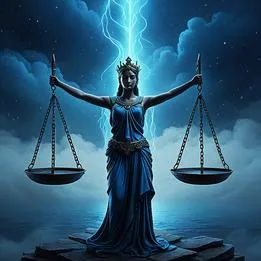
Justice
The Oracle's Essence
A symbol representing fairness, moral rightness, and the administration of law. Often embodies balance, accountability, and societal order.
Interpretive Themes
✧ Archetypal Essence
Sage
Dominant Influence ( 85%)
Justice is the scales held in the mind's eye, weighing evidence with the cold, clear light of reason.
The Light
Justice is the scales held in the mind's eye, weighing evidence with the cold, clear light of reason.
The Shadow
Justice is the scales held in the mind's eye, weighing evidence with the cold, clear light of reason.
Modern Visibility
In modern contexts, justice is often associated with legal systems, social equity movements, and debates about fairness in institutions. It can symbolize both ideal order and systemic critique.
◈ Mythological Resonance
Themis Myth Meaning & Symbolism
Global/Universal traditionThe Titaness of divine law, order, and prophecy, often depicted blindfolded with scales and a sword, representing impartial, foundational justice that precedes even the Olympian gods.
Ma'at Myth Meaning & Symbolism
Egyptian traditionThe goddess of truth, balance, order, and cosmic law, whose feather was weighed against the heart of the deceased in the Hall of Judgment to determine their fate in the afterlife.
Chunhyang Myth Meaning & Symbolism
Korean traditionEmbodied by Mongryong's return as the Secret Royal Inspector, it symbolizes the psyche's inherent drive to correct inner and outer tyranny and restore balance.
Maman Brigitte Myth Meaning & Symbolism
African Diaspora traditionMaman Brigitte's core function as the divine arbiter who ensures the dead are remembered and the living fulfill their sacred duties, representing a moral order based on reciprocity.
Nyame the Sky God Myth Meaning & Symbolism
West African traditionThe divine law and moral order brought down to humanity, providing structure, fairness, and the foundation for community.
Ogbunabali God of Death Igbo Myth Meaning & Symbolism
African traditionThe impersonal, inevitable force enacted by Ogbunabali, which is divine rather than human, concerned with cosmic balance over mortal notions of fairness.
Ogou Ferraille Myth Meaning & Symbolism
African Diaspora traditionThe ultimate principle served by Ogou Ferraille, representing the right ordering of things, fairness, and the use of forged power to correct imbalance and oppression.
Oro Society Ritual Myth Meaning & Symbolism
Yoruba traditionThe core purpose of Oro's descent; an impersonal, ancestral law that restores balance through a verdict that is final and transformative.
Salih and the She-Camel Myth Meaning & Symbolism
Islamic traditionThe core theme of the myth; the cataclysmic punishment is portrayed not as vengeance, but as the inevitable, structural consequence of violating a divine law.
Shamash the Sun God Myth Meaning & Symbolism
Babylonian traditionThe core domain of Shamash, representing the cosmic and psychological principle of balance, right measure, truth, and moral order emerging from clear sight.
Shu'ayb and the People of Midian Myth Meaning & Symbolism
Islamic traditionThe overarching theme and divine attribute sought by Shu'ayb, representing the immutable law of consequence and the necessary restoration of balance that the myth dramatizes.
The Dybbuk Possessing Spirit Myth Meaning & Symbolism
Hebrew traditionThe driving force behind the Dybbuk's return and the ultimate goal of the exorcism; it signifies the soul's deep, non-negotiable need for moral equilibrium and truth.
The Legend of Arang Myth Meaning & Symbolism
Korean traditionThe deep psychic need for balance and moral order, the restoration of truth that allows fragmented parts of the self to integrate.
The Poem of the Righteous Sufferer Ludlul Myth Meaning & Symbolism
Babylonian traditionThe central questioned concept; the myth challenges simplistic notions of cosmic justice, proposing a deeper, more paradoxical order that operates on a level beyond human morality.
The Sword of Ali Myth Meaning & Symbolism
Arabian traditionThe core principle enacted by the sword, representing the cosmic law that demands truth be separated from falsehood and balance be restored.
Utu the Sun God Myth Meaning & Symbolism
Sumerian traditionThe core function of Utu as divine judge, symbolizing the psyche's innate drive for moral order, truth, and karmic balance.
Xango in Candomble Myth Meaning & Symbolism
African Diaspora traditionThe central theme of Xango's domain, a complex justice informed by the memory of error, balancing power with accountability.
Inanna and Shukaletuda
Sumerian traditionNot a passive law, but an active, relentless force of rebalancing that pursues truth across all realms, restoring moral and cosmic equilibrium after a transgression.
Lei Gong Thunder God
Taoist traditionThe impersonal, cosmic principle of moral equilibrium that Lei Gong serves, demanding that action and consequence, crime and punishment, exist in perfect balance.
Ochosi the Hunter Tracker
Yoruba traditionThe principle of cosmic and moral balance, the natural law that ensures every action finds its appropriate consequence.
Shango of the Akan
West African traditionThe principle of cosmic moral balance, enacted not through slow deliberation but through direct, transformative retribution and restoration.
Shango and the Thunder Axe
Yoruba traditionThe core principle of moral order and retribution that Shango’s axe serves to enforce, representing cosmic and social balance.
Sumpa the Oath Deity
Filipino traditionThe impersonal, balancing principle of the cosmos that ensures equilibrium is restored following a breach of sacred law.
The Forty Thieves
Islamic traditionThe moral principle of fairness and retribution, achieved here not by law but by cunning and the violent rebalancing of scales.
The Sword of Damocles Hebrew
Jewish traditionThe principle of moral rightness and equity, here experienced not as an abstract ideal but as a living, dynamic force with which one must engage.
The Three Apples
Arabian traditionThe complex, active pursuit of equilibrium and truth, embodied by the seeking ruler, which must discern between crime, error, and tragic folly.
The War of Ogun and Shango
Yoruba traditionThe principle of moral rightness and fairness, often depicted as a balance between forceful action and structured law.
Zhong Kui Demon Slayer
Taoist traditionThe driving principle of Zhong Kui’s posthumous existence, a cosmic rectification that operates beyond and in spite of flawed human systems of judgment.
Cultural Lenses
Jungian
Learn More →Represents the Self archetype integrating opposites. The scales symbolize balancing conscious/unconscious, while the sword cuts through illusion. Modernly, it indicates individuation and moral development.
Freudian
Learn More →Symbolizes superego's moral demands and repressed guilt. The scales may represent parental judgment internalized. In modern therapy, it relates to conscience conflicts and punishment fantasies.
Gestalt
Learn More →Represents unfinished business requiring resolution. Each part (scales, sword, blindfold) projects aspects of self needing integration. Modern interpretation focuses on present awareness of imbalances.
Cognitive
Learn More →Reflects schemas about fairness and threat detection. The brain processes social contracts during sleep. Modern view connects to cognitive distortions about justice in waking life.
Evolutionary
Learn More →Rooted in reciprocal altruism and social hierarchy navigation. Scales represent cost-benefit analysis for group survival. Modern manifestations include workplace fairness concerns.
Global/Universal
Learn More →Cross-cultural symbol of moral order. Historically appears in Egyptian Ma'at, Greek Themis, and countless legal systems. Modernly represents human rights aspirations worldwide.
East Asian
Learn More →In Confucian tradition, emphasizes social harmony over individual rights. Historically tied to imperial mandate. Modernly blends legal reform with collectivist values in societies like Japan and China.
South Asian
Learn More →Dharma concept emphasizing cosmic and social duty. Historically in Arthashastra texts. Modern Indian context combines Western legal systems with traditional caste/community justice practices.
Middle Eastern
Learn More →In Islamic tradition, 'Adl' (divine justice) balances mercy. Historically in Sharia courts. Modernly navigates between religious law and secular legal systems across the region.
European
Learn More →From Roman Justitia to Enlightenment ideals. Historically tied to church and state authority. Modern European Union emphasizes human rights courts and social justice welfare systems.
African
Learn More →Ubuntu philosophy emphasizing community restoration over punishment. Historically in tribal councils. Modernly blends traditional reconciliation practices with post-colonial legal systems.
North American
Learn More →Tension between individual rights and systemic equity. Historically rooted in constitutional ideals. Modernly reflects social justice movements and legal activism debates.
✦ The Oracle's Prediction
A hidden ethical dilemma at work will come to light.
An old grievance will resurface, demanding resolution.
Contextual Nuances
Courtroom scene
Fear of judgment.
Receiving verdict
Vindication achieved.
Scales balancing
Life equilibrium restored.
Being judged unfairly
Perceived injustice.
Administering justice
Taking control.
Integrative Mantra
"Affirmation"
Integration Ritual
Ritual Practice
Draw a simple scale on a piece of paper. On one side, write a current situation where you feel wronged. On the other, write an action you've taken that may have wronged another. Light a candle. Hold the paper and say, "For every weight, a counterweight." Carefully burn the paper in a ceramic bowl. As it smolders, blow out the candle with a single, firm breath.
Questions for Reflection
- "Where in your life do you feel things are unbalanced?"
- "What personal 'laws' or principles are you currently judging yourself or others by?"
- "When have you recently experienced or witnessed injustice, and how did it affect you?"
Related Weavings
The Portal is Always Open
Every dream is a personalized dispatch from the deep. Don't let yours fade into static.
Interpret Full Dream