The Village of Hidden Leaves Myth Meaning & Symbolism
A sacred village, hidden by divine magic, is guarded by a chosen mortal who must protect its secret from a world that has forgotten wonder.
The Tale of The Village of Hidden Leaves
Listen, and let the wind through the pines carry you back. In an age when the gods still walked the earth in the guise of mountain and stream, there existed a place untouched by time’s relentless river. It was not on any map, for it was woven from the very breath of kami. They called it Kakure-zato, the Village of Hidden Leaves.
Its story begins with a sorrow that shook the heavens. The world of men grew loud, its ambitions sharp as forged steel, its forests falling to clear the way for rice and rule. The gentle spirits of the groves and the shy deities of the springs found no rest. Their songs were drowned by axes and industry. In their grief, they gathered in a secret council deep within the heart of Shinrin, the primordial forest. The great Yama-no-Kami spoke with a voice like shifting stones: “We shall make a sanctuary. A fold in the world where the old ways are preserved, where the dance of seasons is the only law.”
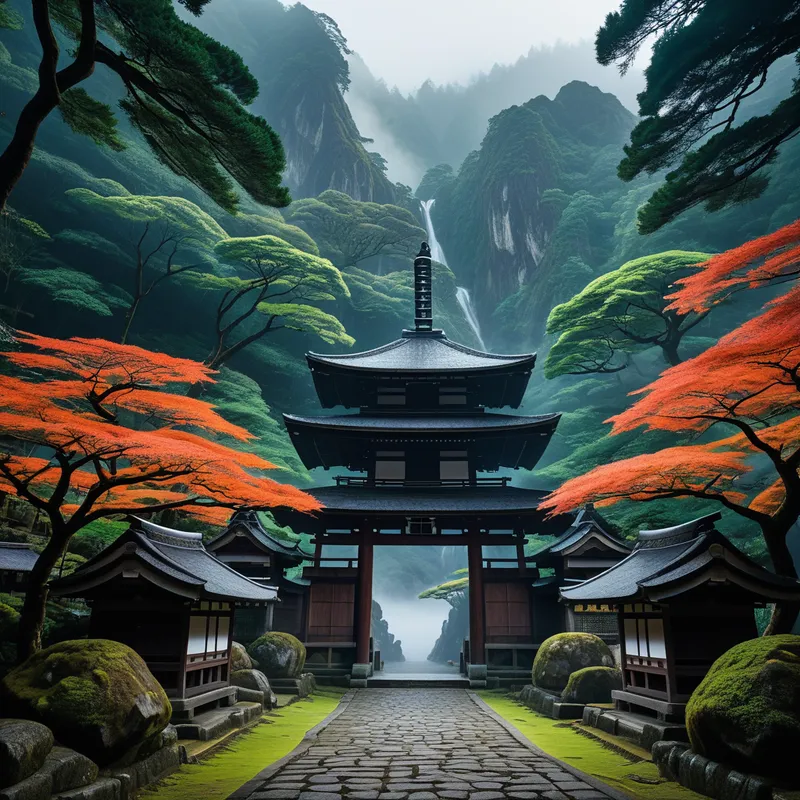
And so, with a collective sigh that became the morning mist, the kami poured their essence into a secluded valley. They spun threads of moonlight into shimmering barriers and taught the ancient cedars to grow in labyrinthine patterns. The village that appeared was one of perfect harmony: thatched roofs nestled against mossy stones, a clear stream laughing over rounded rocks, and gardens where wild and cultivated plants embraced. At its center stood a single, colossal sakaki tree, its leaves whispering with the voices of all the kami who had given it life. To enter, one needed not a path, but a pure heart and a quiet mind. The world forgot it, as it was meant to.
Yet, a sanctuary must have a guardian. The kami chose not a warrior or a priest, but a humble woodcutter named Takeo. A man of few words, whose hands were calloused from honest labor and whose soul was as clear as the mountain air he breathed. He stumbled upon the shimmering veil one autumn evening, drawn by the scent of unseen blossoms. The leaves parted for him, not as a barrier, but as a curtain. He beheld Kakure-zato, and in that moment, his old life fell away like a discarded shell.
The kami gave him his charge: to live at the threshold. To tend the outer forest, to turn away the curious and the greedy with subtle misdirection—a fallen log here, a sudden fog there—and to ensure the sacred secret remained inviolate. For generations, Takeo and his descendants held this silent vigil. They became the Moribito, the boundary-keepers. Their greatest weapon was forgetfulness; their greatest shield, the world’s disbelief.
The conflict arose not with a storm, but with a whisper. A powerful local lord, hungry for new lands and legendary treasures, heard a drunken traveler’s tale of a “valley of eternal autumn.” He sent his most determined samurai, a man named Kenshin, to find it. Kenshin was relentless, a man who saw the world as a puzzle to be solved. For weeks, he combed the mountains, his logic and maps useless against the kami’s art.
The rising action was a dance of perception. Kenshin would see a path; Takeo, now an old man with eyes like still water, would be there, offering a drink and speaking of a dangerous landslide further ahead. Kenshin would hear strange music; Takeo would speak of the wind in a peculiar gorge. Yet, Kenshin was not corrupt, only dutiful. His persistence began to wear at the veil itself; his focused, seeking energy was a dissonant note in the forest’s symphony. The leaves of the great sakaki began to tremble.
The resolution came not in battle, but in revelation. Exhausted and lost in a sudden, magical downpour, Kenshin collapsed at the root of a great pine. Takeo found him, not as a foe, but as a suffering man. He brought him to his own humble hut at the forest’s edge, not into the village. That night, as the storm raged, Kenshin awoke to see Takeo sitting in meditation, a single, glowing maple leaf floating in his palm—a leaf from the sacred tree. In its gentle light, Kenshin did not see a secret to plunder, but a truth to behold: a vision of perfect, fragile harmony. He saw the village not with his eyes, but with his kokoro.
At dawn, Kenshin bowed deeply to Takeo. He returned to his lord and reported, with utter conviction, that the valley was a myth, a trick of the mountain mist. His duty was fulfilled, but his heart had been remade. He became a quiet protector in his own right, diverting others who sought the legend. The veil held, stronger now, for it had been reinforced not by force, but by the conscious choice of one who saw and understood. The Village of Hidden Leaves remained, a breath held safe within the world’s forgetfulness, guarded by seen and unseen hands.
Cultural Origins & Context
The myth of the Village of Hidden Leaves is not a single, codified tale from a specific text like the Kojiki or Nihon Shoki. Instead, it is a folkloric motif, a mukashibanashi (old tale) archetype that permeates Japanese spiritual geography. It finds its roots in the animistic heart of Shinto, where every mountain (yama), forest (mori), and rock (iwa) possesses a spirit, a kami. The concept of kakuriyo (the hidden world) and arakisho (the rough, wild places where spirits dwell) is central.
These stories were told by villagers, farmers, and mountain ascetics (yamabushi). They served multiple societal functions: they explained the eerie, profound silence of certain valleys; they enforced ecological respect by rendering certain areas taboo (kin); and they preserved a sense of the sacred in an increasingly human-dominated landscape. The tale is a narrative embodiment of the Shinto ideal of kegare (impurity/ pollution) and harae (purification). The outside world, with its greed and noise, represents kegare, while the hidden village is a state of pristine harae, protected by a ritual boundary (shime). The guardian, often a commoner, represents the human role as a steward, a mediator between the mundane and the sacred realms.
Symbolic Architecture
At its core, the myth is a profound map of the psyche. The Village of Hidden Leaves symbolizes the Self—the innermost sanctuary of the psyche where our deepest essence, our original nature (hongaku), resides in undisturbed harmony. It is the place of psychic integrity, untouched by the persona’s adaptations and the trauma of the outer world.
The sanctuary is not found by seeking, but by becoming the kind of place where it can reveal itself.
The surrounding, labyrinthine forest represents the personal unconscious—dense, protective, and confusing to the untrained, logical mind (the samurai Kenshin). The various kami are the archetypal forces and innate potentials of the psyche that have withdrawn from a hostile conscious attitude. The shimmering veil is the threshold of consciousness itself, permeable only under certain conditions: receptivity, humility, and a cessation of egoic striving.
The woodcutter guardian, the Moribito, is the archetype of the Ego in its highest, most mature function: not as ruler, but as steward. His duty is not to live in the sanctuary (identification with the Self leads to inflation), but to live at its border, protecting it from unconscious incursions (neuroses, complexes) and conscious exploitation (the ego’s desire to possess and claim the numinous for itself).
The conflict with the samurai is the inevitable confrontation between the ego’s old, rigid, goal-oriented attitude (the lord’s command) and the needs of the deeper Self. The resolution—conversion, not conquest—models the alchemical coniunctio, where a previously opposing force is integrated and becomes part of the protective structure.

The Dreamer's Resonance
When this myth pattern arises in modern dreams, it signals a critical phase of inner work. Dreaming of a hidden, idyllic place—a secluded garden, a secret room in one’s house, a valley accessible only through a forgotten path—points to the nascent emergence of the Self. The dreamer is often in a state of exhaustion from the “noise” of outer life; the dream sanctuary offers somatic relief, a feeling of profound peace and rightness.
Conversely, dreams of searching for such a place but being blocked by natural barriers (thick fog, winding paths that lead nowhere) indicate that the conscious mind is approaching the unconscious with the wrong attitude—perhaps with analytical aggression or a desire to “fix” oneself. The guardian figure may appear as a quiet stranger, an animal, or even a knowing version of the dreamer themselves, offering a cryptic clue or simply a calming presence.
If the dream features a threat to the hidden place (developers, invaders, a storm), it reflects the dreamer’s acute awareness of external pressures or internal psychic forces (anxieties, old traumas) that are destabilizing their hard-won inner equilibrium. The psychological process is one of boundary-setting and discernment—learning what influences, relationships, or internal narratives must be gently but firmly turned away at the veil to preserve the soul’s integrity.
Alchemical Translation
The myth of Kakure-zato is a perfect allegory for the Jungian process of individuation. It begins with a withdrawal. The psyche, overwhelmed by the demands of adaptation (the noisy world), consciously or unconsciously pulls its most sacred contents into a protected inner space. This is not escapism, but a necessary incubation.
The appointment of the guardian marks the beginning of active engagement with this process. The ego must shift from being the protagonist of its own drama to becoming the humble servant of a larger totality. This is the mortificatio of the ego’s imperial ambitions.
The goal is not to dwell forever in the hidden village, but to learn its governance, so that its harmony may subtly inform every step taken in the outer world.
The samurai’s pursuit represents the inevitable nigredo, the darkening, where the shadow aspects of one’s ambition, curiosity, and worldly duty confront the need for sacred secrecy. The struggle is internal: between the part of us that wants to exploit our own depth for personal gain (status, spiritual glamour) and the part that knows it must be protected.
The alchemical gold, the lapis, is produced in the resolution. Kenshin does not destroy the village nor does he abandon his duty. He is transformed by a vision of the whole. His conscious attitude is altered, and he integrates his strength into a new, protective function. This is the albedo and rubedo—the whitening and reddening—where the conflict is transcended, and the individual operates from a unified center. The outer life (Kenshin’s return to the world) is now secretly nourished and guided by the values of the inner sanctuary (reverence, harmony, protection). The individual becomes a living bridge, and the once-hidden wholeness begins, quietly, to heal the world.
Associated Symbols
Explore related symbols from the CaleaDream lexicon: