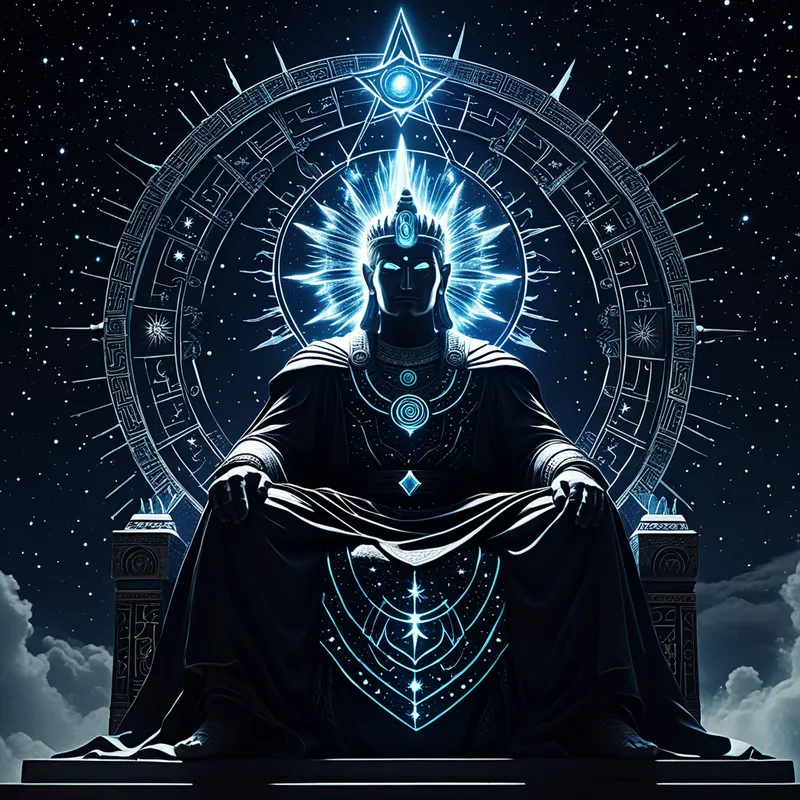
The True Name Myth Meaning & Symbolism
A universal tale of a hidden, sacred name that holds ultimate power, its discovery, and the profound consequences of knowing or being known.
The Tale of The True Name
Listen. In the time before time, when the world was still wet with the breath of creation, the gods walked with a secret held close to their hearts. It was not a weapon of fire or a shield of adamant. It was a sound, a vibration, a secret whispered only in the silence of their own essence: their True Name.
Among them was Ra, the sun god, whose barque sailed the sky, bringing light and life. Yet, with each passing aeon, Ra grew weary. His limbs ached with the weight of the day, and a deep, unsettling fear crept into his divine mind—a fear of the creeping dark, of the chaos that nibbled at the edges of his ordered world. His power, vast as it was, could not soothe this primordial dread.
This vulnerability did not go unnoticed. Isis, the great sorceress, whose knowledge ran as deep as the roots of the world, watched. She desired not to overthrow, but to know. To know the source, the core, the very engine of the sun’s journey. She understood that to heal the god—or to command him—one must know the word that spun his soul into being.
So, she waited. She watched the path where Ra walked, and she saw it: a trickle of divine spittle, fallen from the god’s tired lips as he groaned against his age. Where it touched the dust of the earth, the earth convulsed and gave form to mud. With hands that knew the art of formation, Isis gathered this sacred clay. She did not sculpt a beast of burden or a warrior, but a serpent—a creature of the earth, of hidden places, of silent, piercing truth. She breathed upon it not life, but a singular purpose: to hold the secret.
She placed the serpent upon the path where Ra would pass. And as the sun god’s golden procession came, weary and magnificent, the serpent struck. Not a mortal bite, but a divine one. A fire that was ice, a poison that was revelation, flooded Ra’s veins. He cried out, a sound that shook the pillars of heaven, but no healing magic answered. The pain was of a kind unknown, a sickness of the source.
The gods gathered, their faces etched with terror. The light of the world was failing. Isis came among them, her face a mask of concern. “Great Ra,” she said, her voice a balm and a blade. “I am a healer. My magic is potent. But this poison is cunning. To draw it out, I must speak to it. I must command it in the tongue of its origin. I must know… the name that holds your power. The name that began you.”
Ra groaned. He listed the many names by which he was known: Lord of the Horizon, Khepri the Becoming, Atum the Complete. But with each title, Isis only shook her head gently, the pain in Ra’s body flaring in agreement. These were garments, she said. She needed the flesh beneath. The agony became a sea, drowning him. The darkness he feared lapped at his vision.
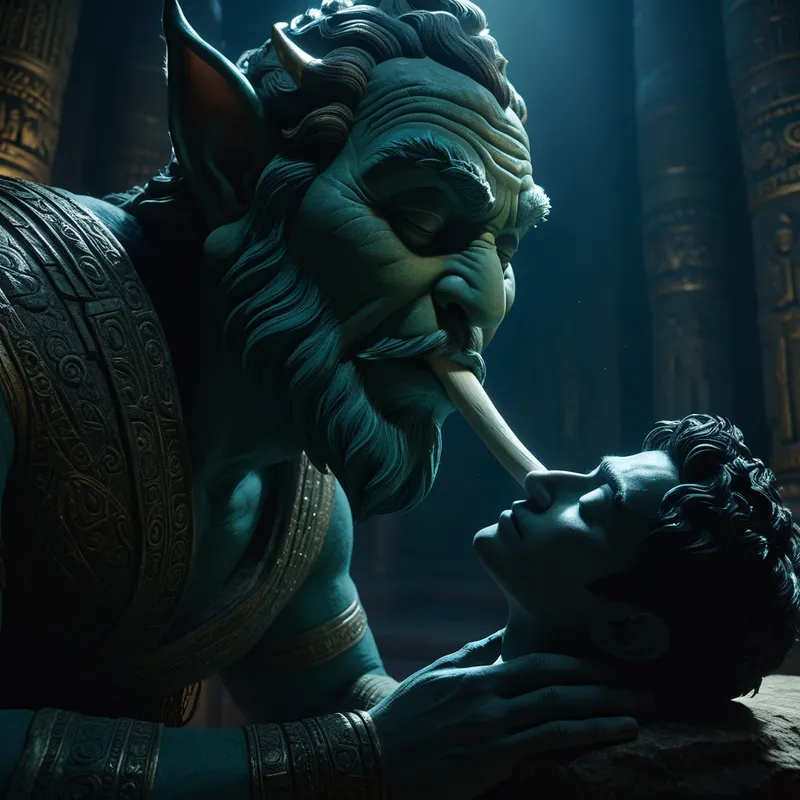
Finally, broken by the pain that attacked his very essence, the sun god relented. He beckoned Isis closer. The other gods turned away, for some knowledge is too terrible to witness. Ra whispered it. Not a word for the air to carry, but a sound that passed from his secret heart to her waiting ear alone—the True Name, the sound of his own creation.
And in that moment, the balance of the universe shifted. The poison receded, drawn out by Isis’s now-absolute command. Ra was healed, the sun restored. But he walked thereafter with a subtle diminishment, a sovereignty shared. Isis possessed the foundational note of his being, and with it, a power that echoed in the deepest spells ever after. The secret was out, and nothing would ever be wholly hidden again.
Cultural Origins & Context
The story of the True Name is not the property of a single culture, but a profound archetypal pattern found across the globe. Its most famous articulation is in the mythology of ancient Egypt, recorded in texts like the Book of the Dead and other cosmological papyri. Here, it was not mere folklore but a principle embedded in the sacred science of Maat. To know the true name of a demon, a god, or a force of nature was to have direct magical authority over it, a concept applied in temple rituals and funerary spells to protect the soul in the afterlife.
This motif echoes in the Hebrew mystical tradition of the Tetragrammaton, the unpronounceable name of God that holds creative power. It whispers through European folktales like Rumpelstiltskin, where the miller’s daughter must discover the creature’s name to break its claim on her child. In countless indigenous traditions, individuals have sacred names revealed in visions, names that are not for public use but hold the key to their spiritual identity and power. The myth was transmitted by priests, shamans, storytellers, and elders—its function was to teach about the nature of power (it is rooted in identity), the sanctity of the self (to be guarded), and the double-edged sword of intimate knowledge (which can heal or enslave).
Symbolic Architecture
At its core, the myth of the True Name is about the relationship between essence and manifestation, between the irreducible core of a being and the persona it projects into the world.
The True Name is the soul’s own signature in the fabric of reality; to know it is to hold the pen that wrote it.
The True Name symbolizes the authentic Self, the totality of the psyche in its raw, unmediated state—what Carl Jung might term the Self. It is pre-verbal, potent, and vulnerable. Ra, in his aging and fear, represents the conscious ego, the ruling principle that grows weary from maintaining its identity against the pressures of the unconscious (the creeping dark, the chaos). His public titles are the Persona, the acceptable faces we wear.
Isis is the archetype of the Anima (in a man’s psyche) or the embodiment of deep, intuitive consciousness. She is not inherently destructive; she seeks integration, wholeness, but her method is ruthless. The serpent she creates from Ra’s own substance is a perfect symbol of the Shadow—born from the god’s ignored fatigue and fear (his spittle), it turns and attacks him. The crisis it provokes is necessary. One cannot integrate what one does not first feel acutely.
The “poison” is thus the symptom of a dis-integrated Self, the suffering that forces the ego to confront its own foundational ignorance. The whispering of the Name is the ultimate act of vulnerability and revelation, where the ego surrenders its secret sovereignty to the deeper, knowing psyche. The resulting “healing” is not a return to the old order, but an initiation into a new, more complex wholeness where power is conscious and shared.
The Dreamer's Resonance
When this myth stirs in the modern dreamer, it signals a profound psychological process: the approach of the authentic Self. One may dream of desperately searching for a lost password, a keycode, or a specific word that will unlock a door or stop a catastrophic event. Another may dream of being pursued by an entity that demands to know “who you really are,” or of whispering a secret into someone’s ear that immediately changes the fabric of the dream.
Somatically, this can accompany feelings of anxiety around exposure, a “gut feeling” that one’s core identity is under threat, or conversely, a thrilling sense of nearing a monumental personal discovery. Psychologically, the dreamer is in the grip of what James Hollis calls the “swampland of the soul”—the difficult, necessary terrain between the ego’s old certainties and a more expansive, but unknown, state of being. The dream-Isis is at work, using the pain of life’s crises (the serpent’s bite) to compel the dreamer’s ego to stop reciting its titles (job, roles, achievements) and to confront the more terrifying and potent question of its essential nature.

Alchemical Translation
The alchemical journey of individuation is precisely the process of discovering one’s own True Name. It is the opus contra naturam—the work against one’s own latent nature—that leads to the lapis philosophorum, the philosopher’s stone of the integrated Self.
The crucible of suffering is the only forge hot enough to melt the armor of the persona and reveal the golden script beneath.
The first stage, nigredo (blackening), is Ra’s despair and poisoning—the depression, confusion, or life crisis that shatters the ego’s complacency. The serpens mercurialis (the mercurial serpent) of the shadow rises with its painful but truthful venom. The albedo (whitening) is the painful introspection, the “whispering,” where the ego begins to relinquish its control and listen to the deeper, often silent, voice of the Self. This is not an intellectual exercise but a surrender.
The revelation of the Name is the citrinitas (yellowing), the dawning of conscious insight into one’s own patterns, core wounds, and fundamental drives. Finally, the rubedo (reddening) is the integration: the healing of Ra, not as a weakened god, but as a conscious sovereign who now has a relationship with the source of his own power (Isis/the Anima/the unconscious). The power is no longer automatic and brittle, but known, fluid, and shared between consciousness and the deep psyche.
For the modern individual, this myth instructs us that our greatest suffering often points directly to the part of our True Name we have yet to speak. Our compulsions, our fears, our inexplicable wounds—these are the serpents crafted from our own ignored substance. The path to power and healing is not through building a better persona, but through the courageous, vulnerable, and ultimately transformative act of learning, and accepting, the sound of our own soul.
Associated Symbols
Explore related symbols from the CaleaDream lexicon: