The Temptation in the Wilderness Myth Meaning & Symbolism
A solitary figure, tested by the ultimate adversary, chooses spiritual integrity over worldly power, defining the path of authentic becoming.
The Tale of The Temptation in the Wilderness
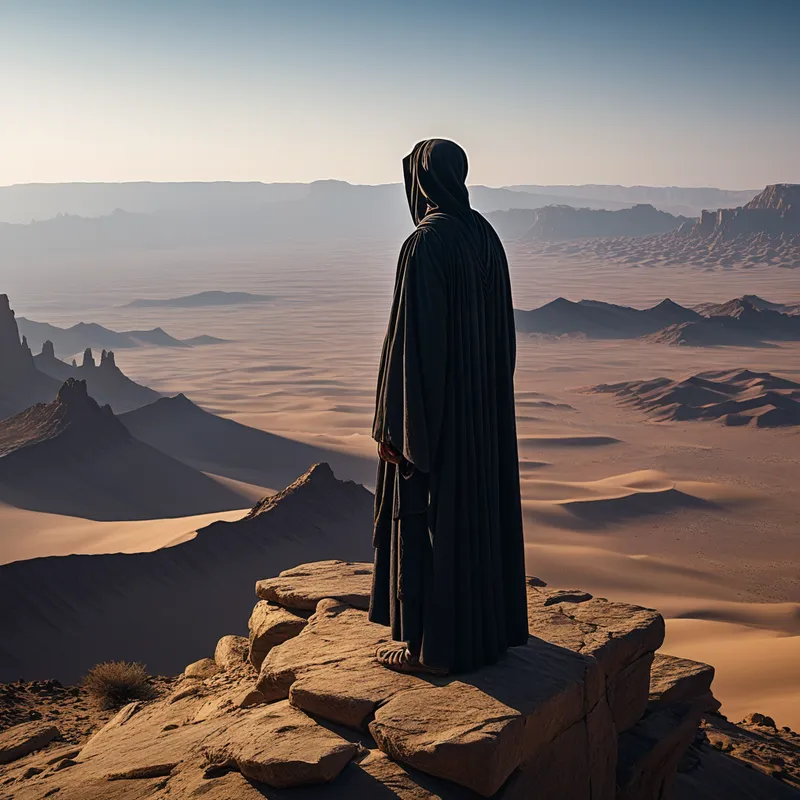
The wind was a sculptor here, and its only medium was dust and despair. It had carved the wilderness into a monument of absence—a place where the sun was a hammer and the night a cloak of freezing stars. Into this crucible of desolation walked a man, driven not by men, but by a spirit that whispered of a necessary unraveling.
For forty days and forty nights, he was a creature of stone and thirst. He drank from the silence. He ate the thin sustenance of his own purpose, while the wild things watched with indifferent eyes. His name was Yeshua, and he was hollowing himself out, becoming a vessel for a confrontation he alone could endure.
When the hunger was a living beast in his bones and the solitude had pared his soul to its essence, the adversary appeared. Not with thunder, but with the intimate certainty of a thought becoming flesh. He was Ha-Satan, the accuser, the questioner, whose form was as shifting as the desert mirage, yet his eyes held the cold, ancient light of a fallen star.
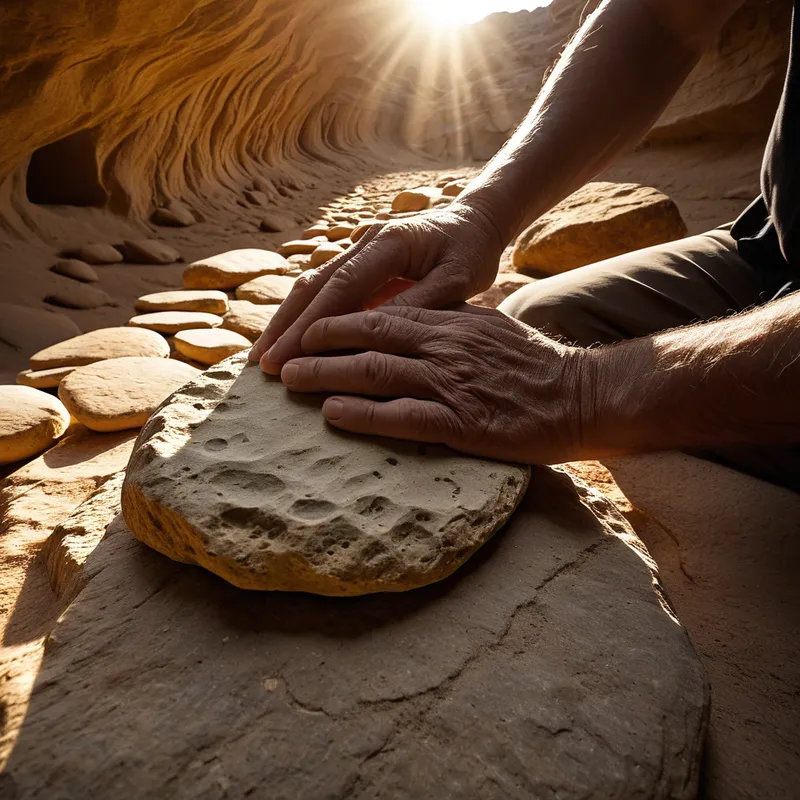
“If you are the son of the divine,” the voice was like dry parchment, logical and smooth, “command these stones to become bread.” The temptation was not in the hunger, but in the miracle—to use the sacred power to serve the fragile self, to bend the spirit’s purpose to the stomach’s need.
The man looked at the stones, then through them. “One does not live by bread alone,” he said, his voice rasping but firm, “but by every word that comes from the mouth of the divine.” He chose the hunger. He chose the dependency.
Undeterred, the tempter gathered him up, a whirlwind of will, and set him upon the highest pinnacle of the Temple in the holy city. Below, the courtyard was a mosaic of tiny, trusting lives. “If you are his son,” the adversary whispered, now wearing the guise of scriptural cunning, “throw yourself down. For it is written, ‘He will command his angels concerning you,’ and ‘On their hands they will bear you up, lest you strike your foot against a stone.’” This was the temptation of spectacle—to force the hand of the divine, to turn faith into a theatrical guarantee, to trade mystery for a crowd’s gasp.
The man did not look down at the safety net of promised angels. He looked at the tempter. “Again it is written,” he said, the wind whipping his robes, “‘Do not put the Lord your God to the test.’” He chose the uncertainty. He chose the unproven path.
For the final act, the adversary showed him all the kingdoms of the world and their glory, unfolding in a single, breathtaking moment of time—the march of empires, the glitter of crowns, the roar of adoring masses. “All these I will give you,” the voice was vast, the offer ultimate, “if you will fall down and worship me.” This was the temptation of the shortcut—to gain the whole world by a single, hidden act of allegiance, to achieve the end by betraying the means.
The man turned from the dazzling panorama. His eyes, now clear as the desert sky after a storm, held only a final, quiet authority. “Away with you, Satan! For it is written, ‘Worship the Lord your God, and serve only him.’” In that refusal, he claimed a kingdom no empire could touch. The tempter, his questions spent, departed. And only then did the angels come—not to catch a falling showman, but to minister to the one who had chosen to remain human, hungry, and free.
Cultural Origins & Context
This narrative is found in the Synoptic Gospels, primarily in the Gospels of Matthew and Luke. It serves as the foundational initiation story for the public ministry of Jesus, positioned immediately after his baptism by John the Baptist and before he begins teaching and healing.
The story functions as a theological and narrative cornerstone. For early Christian communities, it established Jesus as the new Abraham and the true Moses, who both endured their own trials. The forty days directly mirror Israel’s forty years of testing in the wilderness, framing Jesus as the one who succeeds where the collective nation had failed. It was a story told to define the nature of messiahship against contemporary expectations of a political or military liberator, asserting that true power is rooted in spiritual obedience and sacrifice, not in worldly dominion. It served as a paradigm for disciples facing their own trials, persecution, and temptations of compromise.
Symbolic Architecture
The wilderness is the primordial tabula rasa of the soul. It is not merely a place of hardship, but the necessary void where the chatter of the world falls away, and the foundational questions of identity and purpose rise, stark and unavoidable. The forty days signify a complete cycle of purification and incubation, a psychic gestation.
The three temptations are not random evils but a precise, escalating curriculum in the corruption of power.
The temptation of bread is the temptation to misuse one's gifts for personal comfort and security. It asks: Will you use your innate talents, your spiritual insight, or your deep resources merely to alleviate your own anxiety and need? Will you commodify your soul’s purpose for base sustenance?
The temptation of the pinnacle is the temptation to demand divine proof and manipulate spiritual reality for validation. It is the ego’s desire for specialness, for a faith that removes all risk, for a relationship with the transcendent that guarantees safety and spectacle. It is religion as ego-inflation.
The temptation of the kingdoms is the temptation to achieve a noble end through an ignoble means. It is the ultimate compromise: accepting a poisoned foundation to build a beautiful house. It is the soul’s seduction by the illusion of efficiency, trading integrity for influence.
Satan here is the archetypal shadow and the daimon of the wrong path. He is not a cartoon villain, but the voice of a compelling, alternative logic—the logic of the world. His defeat is not through battle, but through unwavering recognition and invocation of a deeper, more authentic law.

The Dreamer's Resonance
When this myth stirs in the modern dreamscape, the dreamer is in a state of profound existential trial or life transition. The “wilderness” may manifest as a dream of being lost in a vast, empty office building, an endless grey highway, or a featureless landscape. It is the somatic feeling of being in between—between jobs, relationships, identities, or stages of life.
The tempter rarely appears as a horned demon. More likely, it is a supremely confident, well-dressed stranger offering a perfect contract; a trusted mentor suggesting a clever but unethical shortcut; or even the dreamer’s own face in the mirror, whispering rationalizations. The “bread” might be a dream of refusing a job that pays well but feels soul-crushing. The “pinnacle” could be a dream of standing before a crowd, about to claim credit for something you didn’t do, feeling the dizzying pull of false acclaim. The “kingdoms” often appear as a dream of being offered total control, success, or admiration in exchange for a silent, secret betrayal of a core value.
The psychological process is one of discernment. The ego is being pressured to define its boundaries. What will you not do, even for a good reason? The anxiety in the dream is the friction of the nascent self rubbing against the seductive, ready-made identities offered by the world.

Alchemical Translation
The alchemy of this myth is the transmutation of latent potential (prima materia) into individuated character (lapis philosophorum). It models the heroic journey of the psyche not outward, but inward, to the citadel of the Self.
The first refusal—"not by bread alone"—is the Nigredo. It is the conscious acceptance of hunger, limitation, and need. The ego must surrender its claim to absolute self-sufficiency and acknowledge its dependence on something beyond its own cunning. This blackening is not failure, but the fertile decay of the old, self-serving identity.
The second refusal—"do not put God to the test"—is the Albedo. Having endured the Nigredo, the psyche begins to purify. It washes away the need for external validation and theatrical proofs. Faith becomes a quiet, inner knowing, not a bargaining chip with the universe. This is the emergence of a will aligned with essence, not ego.
The final, definitive refusal—"worship the Lord only"—is the Rubedo, the culmination. Here, the greatest shadow is faced and rejected: the temptation of the corrupted foundation. The individual consciously chooses the slow, difficult, authentic path of becoming over the glittering, ready-made identity of worldly success. This is the birth of true sovereignty. The “angels” that minister at the end are not saviors, but the integrated psychic forces—peace, clarity, strength—that naturally attend the one who has passed through the fire of choice and remained intact.
For the modern individual, the wilderness is any threshold where who you are confronts what you could have. The myth does not promise the temptations cease, but that having faced the fundamental three—comfort, certainty, and power—the soul’s compass is set. The journey thereafter is not about avoiding the desert, but knowing that within its silence, the true self is both tested, and found.
Associated Symbols
Explore related symbols from the CaleaDream lexicon: