The Tale of Panji Myth Meaning & Symbolism
A Javanese prince, disguised as a commoner, embarks on a profound quest to reunite with his lost beloved, navigating trials of identity, duty, and destiny.
The Tale of The Tale of Panji
Listen, and let the gamelan of memory sound. In the golden age of the Javanese kingdoms, when the air was thick with the scent of melati and destiny, there lived a prince whose name was a sigh upon the wind: Raden Panji Inu Kertapati of the kingdom of Kuripan. His soul was not his own, for it was twinned, perfectly and eternally, with that of his beloved, the princess Dewi Sekartaji of Daha. Their union was written in the stars, a promise made before time.
But fate is a weaver of cruel patterns. On the cusp of their wedding, a cataclysm of misunderstanding, political machination, or perhaps a test from the gods themselves, tore them asunder. Sekartaji vanished—lost, hidden, or fleeing into the wild unknown. The prince’s world, once ordered and radiant, shattered into a thousand aching fragments. His royal robes felt like chains; the palace, a gilded cage echoing with her absence.
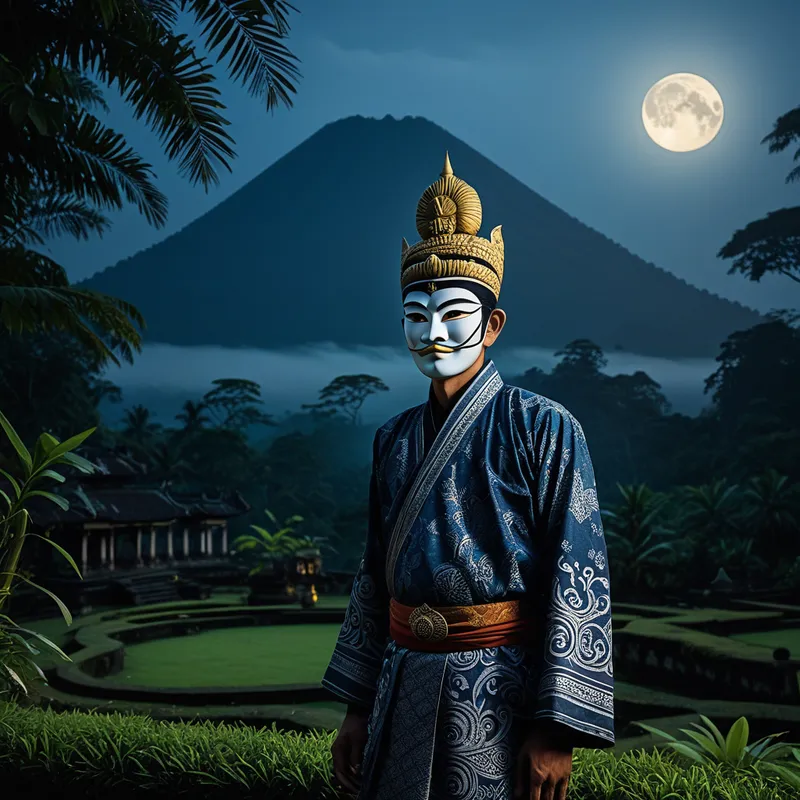
And so, Panji made the choice that defines all heroes of the heart: he stepped out of his name. He shed the makuta, disguised himself as a commoner, and took on a new identity—sometimes a wandering warrior, sometimes a humble farmer. He became Kuda Wanengpati, or Wirun, or Ande-Ande Lumut. His quest was not for gold or land, but for a face, a spirit, a missing half of his own soul. He wandered through dense teak forests, crossed treacherous rivers, and entered rival courts, serving kings and battling foes, all the while his eyes searching every face for a glimpse of her.
His journey was a tapestry of trials. He proved his valor not as a prince by birth, but as a man by deed. He solved riddles, pacified conflicts, and displayed unparalleled skill in art and war. In every court, his true nobility shone through his humble guise, attracting admiration and often the affection of other princesses—yet his heart remained a sealed vessel, waiting only for its one true key. Through years of longing, the final reunion is not a simple recognition. It is a moment of profound revelation, often occurring in a garden or during a ritual performance, where tokens are exchanged, old songs are sung, and the layers of disguise fall away not as masks, but as seasons of a soul’s growth. When Panji and Sekartaji finally behold each other, it is the reunion of two who have been utterly transformed by the search itself. The kingdoms are united, order is restored, but it is a new order, forged in the fires of longing and proven in the wilderness of the self.
Cultural Origins & Context
The Panji cycles are not a single, frozen myth but a living, breathing narrative ecosystem that flourished from circa the 14th century in East Java, later spreading across the Malay Archipelago to Bali, Thailand, Cambodia, and beyond. These stories form the core of a “secular” mythology, distinct from the Itihasa imported earlier. They are deeply rooted in the historical interplay between the Javanese kingdoms of Kuripan and Daha.
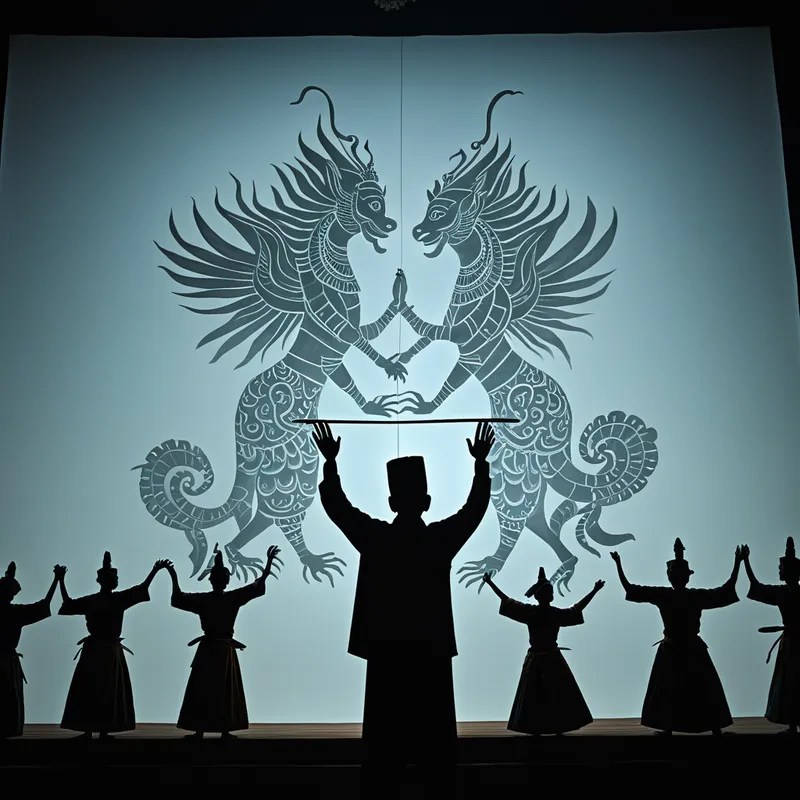
The primary vessel for this myth was, and remains, the wayang. The dalang was the myth-keeper, performing all-night wayang gedog or wayang gambuh performances. The tales were also immortalized in kakawin and kidung, and depicted in temple reliefs. Their societal function was multifaceted: they provided a model of idealised love and loyalty, explored tensions between personal desire and state duty (dharma), and served as a cultural template for the integration of diverse identities—royal and common, Javanese and wider island—into a cohesive whole.
Symbolic Architecture
At its [heart](/symbols/heart “Symbol: The heart symbolizes love, emotion, and the core of one’s existence, representing deep connections with others and self.”/), the Tale of Panji is a profound map of the psyche’s [journey](/symbols/journey “Symbol: A journey in dreams typically signifies adventure, growth, or a significant life transition.”/) toward wholeness. Panji and Sekartaji are not merely lovers; they represent the syzygy, the separated halves of a complete [soul](/symbols/soul “Symbol: The soul represents the essence of a person, encompassing their spirit, identity, and connection to the universe.”/). Their physical [separation](/symbols/separation “Symbol: A spiritual or mythic division between realms, states of being, or consciousness, often marking a transition or loss of connection.”/) initiates the central, necessary [drama](/symbols/drama “Symbol: Drama signifies narratives, emotional expression, and the exploration of human experiences.”/) of the psyche: the [quest](/symbols/quest “Symbol: A quest symbolizes a journey or search for purpose, fulfillment, or knowledge, often representing life’s challenges and adventures.”/).
The donning of a disguise is not a lie, but the shedding of a limiting truth. To find what is most essential, one must first become unknown, even to oneself.
Panji’s voluntary descent from [prince](/symbols/prince “Symbol: A prince symbolizes nobility, leadership, and aspiration, often representing potential or personal authority.”/) to commoner symbolizes the ego’s necessary humiliation, the relinquishing of a rigid, socially-constructed [identity](/symbols/identity “Symbol: Identity represents the sense of self, encompassing personal beliefs, cultural background, and social roles.”/) ([Persona](/symbols/persona “Symbol: The social mask or outward identity one presents to the world, often concealing the true self.”/)) to encounter the raw, unadorned self. The [forest](/symbols/forest “Symbol: The forest symbolizes a complex domain of the unconscious mind, representing both mystery and potential for personal growth.”/) he traverses is the unconscious, populated by projections, challenges, and [shadow](/symbols/shadow “Symbol: The ‘shadow’ embodies the unconscious, repressed aspects of the self and often represents fears or hidden emotions.”/) aspects. His many aliases are the provisional selves we try on during [life](/symbols/life “Symbol: The symbol of ‘Life’ represents a journey of growth, interconnectedness, and existential meaning, encompassing both the joys and challenges that define human experience.”/)’s transitions. The repeated near-misses and delayed reunions speak to the soul’s painful, iterative process of preparation. One is not ready for the divine [reunion](/symbols/reunion “Symbol: A reunion symbolizes reconnection, healing, and the revival of past relationships and experiences.”/) until one has been fully cooked in the fire of experience.
The Dreamer’s Resonance
When this myth stirs in the modern dream, it often manifests as a profound sense of searching. You may dream of a beloved face you cannot quite see, of wandering through endless, familiar-yet-alien cityscapes or landscapes, or of possessing an important object (a key, a letter, a jewel) whose purpose you have forgotten.
Somatically, this can feel like a hollow ache in the chest, a restless energy in the limbs—the body sensing a missing completion. Psychologically, you are navigating a journey of identity. The dream-ego is in a state of flux, having outgrown an old role (the “prince” or “princess” of your own life story) but not yet having integrated the new, more authentic self forged in the trials of change. The dream is the unconscious affirming the process: the longing itself is the path. The grief for what is lost is the proof of its reality.
Alchemical Translation
The alchemy of the Panji myth is the transmutation of a fragmented, persona-bound consciousness into an individuated self. The initial state is a kind of psychic hieros gamos (sacred marriage) that exists in potential but not in lived reality. The conflict—the separation—is the nigredo, the blackening, the necessary descent into darkness, doubt, and longing.
The soul’s reunion is not a return to a forgotten past, but a creation of a future that could only be born from the crucible of separation.
Panji’s wanderings are the albedo, the whitening, the purification through action and the assuming of multiple, fluid identities. He learns to carry his intrinsic nobility (gold) within, regardless of his outer form (silver). Each trial strips away another layer of egoistic expectation. The final recognition scene is the rubedo, the reddening, the glorious culmination. It represents the moment when the conscious ego (Panji) finally recognizes and integrates the lost, guiding essence of the unconscious (Sekartaji). The united kingdoms symbolize the psyche now ruled by this central, reconciling principle—a self that knows both palace and forest, duty and desire, name and namelessness. The myth models the ultimate triumph: not of finding another, but of becoming whole enough to truly meet them.
Associated Symbols
Explore related symbols from the CaleaDream lexicon:
- Mask — The many disguises of Panji represent the provisional identities the ego must wear and shed on the path to discovering the authentic self beneath the social persona.
- Journey — The core narrative structure of the myth is an epic quest, symbolizing the lifelong psychic process of seeking, experiencing trials, and moving toward wholeness.
- Forest — Represents the unknown, the unconscious realm where the hero is tested, loses his way, and ultimately finds his true strength and direction.
- Key — Often appears as a token of recognition or a solution to a riddle, symbolizing the revelation or insight that unlocks the next stage of the quest or the final reunion.
- Love — The driving force of the narrative, representing not merely romantic affection but the soul’s deep, archetypal yearning for its missing counterpart and ultimate unity.
- Dance — Evokes the intricate, performative nature of the tale in wayang and court culture, symbolizing the ritualized, patterned steps one must learn in life’s journey.
- Mirror — Represents self-reflection, recognition, and the moment of truth when the disguised self is seen for who it truly is, both by oneself and the beloved.
- Temple — Symbolizes the sacred inner space where the final reunion or recognition occurs, representing the psyche as a holy site of integration.
- Gold — The innate, unchanging nobility and value of Panji’s true self, which persists and shines through all his humble disguises and trials.
- Shadow — The unknown aspects of the self encountered in the forest of the unconscious, as well as the literal shadow puppets that bring the myth to life in wayang.