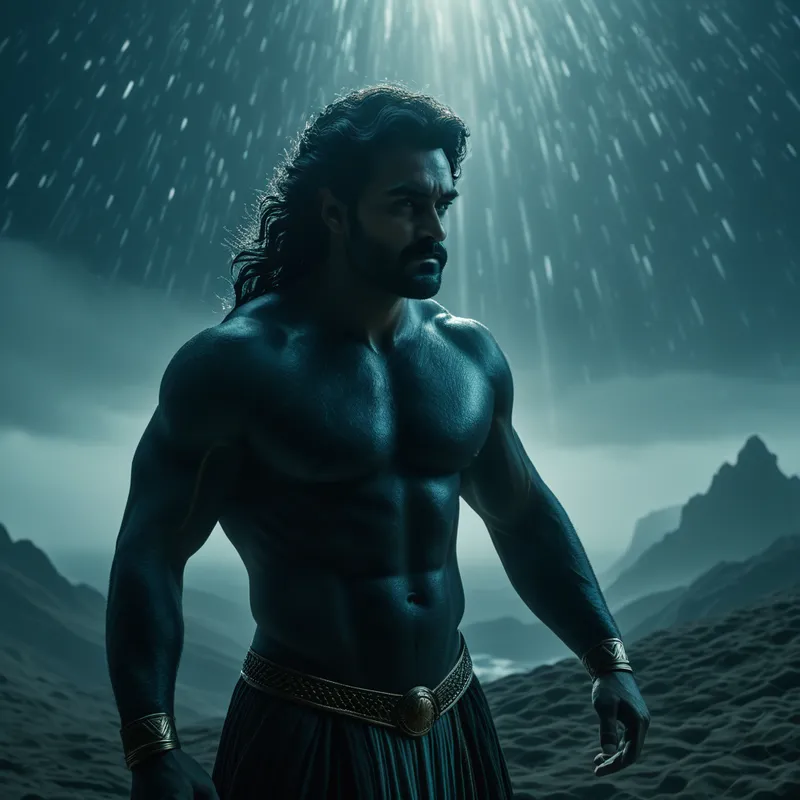
The Storytelling Griot
West African griots were master storytellers who preserved history, shaped cultural identity, and wielded influence through their oral traditions across generations.
The Tale of The Storytelling Griot
In the time when [the world](/myths/the-world “Myth from Tarot culture.”/) was woven from sound, before the written word cast its silent shadow, there lived a man named Kéléfa. He was not a king, nor a warrior, nor a farmer of the red earth. He was a jali, a griot, born into the lineage of [the word](/myths/the-word “Myth from Biblical culture.”/). His instrument was not the sword but the kora, its [calabash](/myths/calabash “Myth from African Diaspora culture.”/) body a womb of history, its twenty-one strings the sinews of forgotten kings.
Kéléfa’s village sat at [the crossroads](/myths/the-crossroads “Myth from Celtic culture.”/) of empires. One season, a great Mansa, a king of gold and ambition, arrived with his entourage, his silence a wall of pride. He sought to build a new monument, to etch his name upon [the wind](/myths/the-wind “Myth from Various culture.”/). He summoned Kéléfa. “Sing of my conquests,” the Mansa commanded. “Make my name thunder in the mouths of men yet unborn.”
Kéléfa bowed, not in submission, but in tuning. That night, under the cloak of stars that were the eyes of ancestors, he did not sing of battles won. He plucked the strings and his voice, low as a river’s deep current, began with the Mansa’s grandfather—a man of clever compromise, not war. He sang of a fragile alliance sealed with a daughter’s hand, of a drought survived through shared grain, not seized hoards. He sang the king’s own father’s hidden doubt on the eve of a famous victory. The court held its breath. The Mansa’s face was stone.
Yet, as the story unfolded, the Mansa saw not an insult, but a reflection. He saw the unbroken thread of his own power, not as a solitary spear, but as a weave of debt, loyalty, and legacy. The griot’s tale was the true monument, one that would not crumble. He had not been flattered; he had been remembered into existence. From that night, the Mansa’s decisions changed, tempered by the weight of the lineage now living in his ears. Kéléfa, the keeper of the invisible crown, had shaped a king by refusing to tell the simple story. He had told the true one, and in doing so, he forged a new memory into the living flesh of the present.
Cultural Origins & Context
The griot, known as jali in Mandinka or jeli among the Mande peoples, is not a mere entertainer but a living institution. This role is hereditary, a sacred trust passed through bloodlines within specific clans, such as the Kouyaté, Diabaté, or Sissoko. They are the archivists of a civilization that chose breath and vibration over ink and parchment. In societies like the Mali Empire, the Songhai, and the Wolof kingdoms, the griot served as counselor, historian, diplomat, and social mediator.
Their power was dual-edged. They were attached to royal courts, preserving the lineage, laws, and epic exploits of the nobility—the Sundiata, an epic of the founder of the Mali Empire, survives through them. Yet, this intimacy granted them the unique privilege of critique. A griot could speak painful truths to power, camouflaged in proverbs or ancestral precedent, where others would lose their heads. Their words could anoint a ruler with legitimacy or subtly question his worth by omitting a glorious deed of a forefather. They were the ultimate [axis mundi](/myths/axis-mundi “Myth from Various culture.”/), connecting the living community to the ancestral world and the yet-unborn through the umbilical cord of narrative.
Symbolic Architecture
The griot represents the [human](/symbols/human “Symbol: The symbol of a human represents individuality, complexity of emotions, and social relationships.”/) [psyche](/myths/psyche “Myth from Greek culture.”/)’s faculty of [memory](/symbols/memory “Symbol: Memory symbolizes the past, lessons learned, and the narratives we construct about our identities.”/) made active. He is not a passive repository but a dynamic, shaping force. The [stories](/symbols/stories “Symbol: Stories symbolize the narratives of our lives, reflecting personal experiences and collective culture.”/) are not dead artifacts but living entities that require regular invocation to sustain the world’s order. To forget a [lineage](/symbols/lineage “Symbol: Represents ancestral heritage, family connections, and the transmission of traits, values, and responsibilities across generations.”/) is to unravel a people; to misremember a treaty is to invite [chaos](/symbols/chaos “Symbol: In Arts & Music, chaos represents raw creative potential, uncontrolled expression, and the breakdown of order to forge new artistic forms.”/). The griot is the [guardian](/symbols/guardian “Symbol: A protector figure representing safety, authority, and guidance, often embodying parental, societal, or spiritual oversight.”/) of the cultural individuation process, holding [the mirror](/myths/the-mirror “Myth from Various culture.”/) of collective [identity](/symbols/identity “Symbol: Identity represents the sense of self, encompassing personal beliefs, cultural background, and social roles.”/) up to society.
The griot’s voice is the loom on which the scattered threads of event, character, and consequence are woven into the coherent fabric of meaning. Without this weave, experience remains a chaotic pile of yarn—felt but incomprehensible.
His [instrument](/symbols/instrument “Symbol: An instrument symbolizes creativity, communication, and the means by which one expresses oneself or influences the world.”/), often the kora or the balafon, is key. Its [music](/symbols/music “Symbol: Music in dreams often symbolizes the harmony between the conscious and unconscious mind, illustrating emotional expression and communication.”/) is not accompaniment but the very [soil](/symbols/soil “Symbol: Soil symbolizes fertility, nourishment, and the foundation of life, serving as a metaphor for growth and stability.”/) from which the [story](/symbols/story “Symbol: The symbol of ‘Story’ represents the narrative woven through our lives, embodying experiences, lessons, and emotions that shape our identities.”/) grows. The melodies are mnemonic maps, emotional gateways that bypass the rational mind to plant memory directly in the [heart](/symbols/heart “Symbol: The heart symbolizes love, emotion, and the core of one’s existence, representing deep connections with others and self.”/) and the bones. The griot thus symbolizes the [integration](/symbols/integration “Symbol: The process of unifying disparate parts of the self or experience into a cohesive whole, often representing psychological wholeness or resolution of internal conflict.”/) of intellect and [emotion](/symbols/emotion “Symbol: Emotion symbolizes our inner feelings and responses to experiences, often guiding our actions and choices.”/), fact and feeling, into a holistic [truth](/symbols/truth “Symbol: Truth represents authenticity, honesty, and the quest for knowledge beyond mere appearances.”/). He is the embodied [synchronicity](/symbols/synchronicity “Symbol: Meaningful coincidences that suggest an underlying connection between events, often interpreted as guidance or confirmation from the universe.”/), where a plucked string resonates with a fateful [decision](/symbols/decision “Symbol: A decision in a dream reflects the choices one faces in waking life and can symbolize the pursuit of clarity and resolution.”/) made centuries past.
The Dreamer’s Resonance
To encounter the griot in a dream, or to feel his resonance in the soul, is to confront one’s own relationship with personal history and voice. He appears when we are at risk of becoming a people without a past, a self without a coherent narrative. The inner griot calls us to gather the fragments of our experience—the shames, the triumphs, the quiet betrayals, the unspoken loves—and sing them into a story that grants them meaning and place.
This is not an act of vanity or fabrication, but of profound psychological necessity. It is the work of assembling the Self from the shards of the [persona](/myths/persona “Myth from Greek culture.”/) and the whispers of the shadow. The griot within does not flatter; he remembers everything. To ignore him is to be condemned to repeat the unintegrated trauma, to act out the forgotten family script. To listen is to gain agency over one’s own destiny, to become the author-hero of one’s life, fully conscious of its ancestral verses and its potential new rhymes.

Alchemical Translation
The griot’s art is a spiritual alchemy. He performs the opus of tradition, transforming the base metal of raw, chronological events into the gold of timeless wisdom. His stage is the [temenos](/myths/temenos “Myth from Greek culture.”/), the sacred space created by the listening circle, where linear time collapses. In that space, a battle fought five hundred years ago is as immediate as yesterday’s argument, because its psychological truth is identical.
The griot does not report history; he re-members it. He literally puts the members—the dismembered parts of the past—back together into a living, breathing body of meaning that the community can inhabit.
This is the translation of fact into truth, of data into destiny. In a modern context, gripped by digital amnesia and fragmented narratives, the griot archetype challenges us to become custodians of depth. It asks: What stories are we repeating mindlessly? What essential memories have we allowed to be silenced? To engage with this archetype is to begin the labor of conscious storytelling—of our families, our communities, our own souls—understanding that whoever controls the narrative controls the reality. The griot’s final secret is that storytelling is not about the past; it is the primary technology for shaping the future.
Associated Symbols
Explore related symbols from the CaleaDream lexicon:
- Memory — The living tapestry of the past, actively woven and rewoven in the present, constituting the very ground of identity and consciousness.
- Story — The fundamental vessel of meaning, the patterned breath that transforms chaotic experience into navigable destiny.
- Voice — The embodied instrument of power and preservation, carrying the vibration of ancestral truth into the realm of the living.
- Ancestor — The timeless presence in the blood and memory, whose unfinished stories continue to shape the choices of the present.
- Circle — The sacred space of the storytelling event, where community is forged, time is suspended, and listeners become participants in the myth.
- Mirror — The griot’s function as a reflector of collective identity, showing a people not what they wish to see, but who they truly are in the light of their history.
- River — The continuous, flowing nature of oral tradition, forever moving, adapting, and carrying the silt of generations yet never being the same [water](/myths/water “Myth from Chinese culture.”/) twice.
- Seed — The story as a living unit of cultural DNA, planted in the fertile soil of a listener’s mind to germinate across generations.
- Mask — The persona of the performer, which allows both the griot and the audience to safely encounter profound and sometimes dangerous truths.
- Root — The deep, hereditary connection to the past that provides nourishment and stability, allowing the tree of culture to grow and reach for [the sky](/myths/the-sky “Myth from Persian culture.”/).