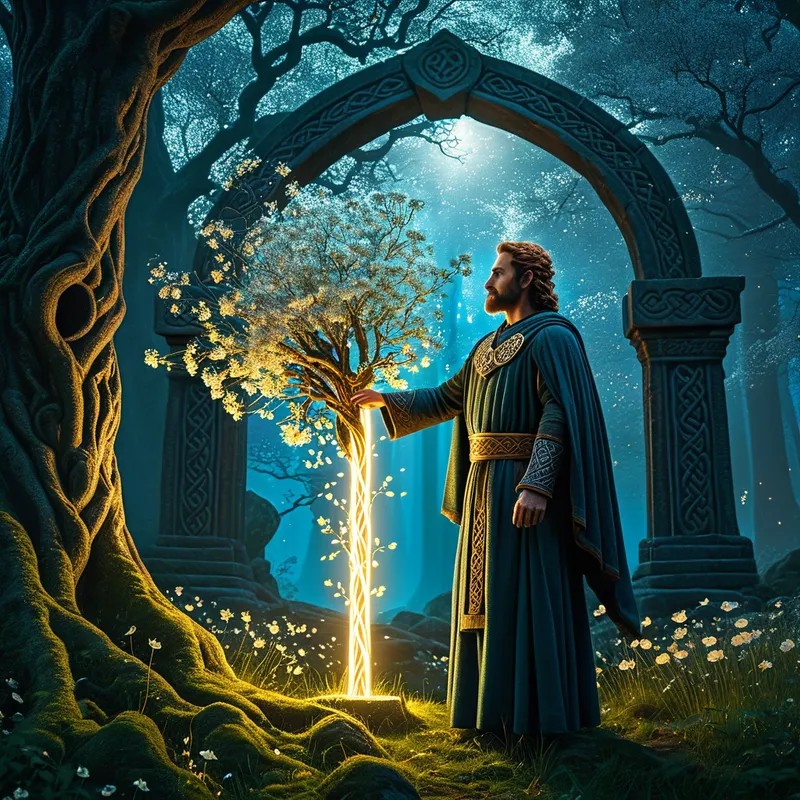
The Silver Bough Myth Meaning & Symbolism
A sacred branch of silver apple blossom granting passage to the Otherworld, symbolizing the soul's perilous journey between realities.
The Tale of The Silver Bough
Listen, and let the fire’s crackle become the rustle of leaves in a forest older than memory. In a time when the veil between the worlds was thin as morning mist, there lived a mortal, a seeker of truth or a bearer of a heavy heart. Perhaps they were a poet, whose soul ached for a beauty this world could not hold. Perhaps they were a warrior, weary of blood, seeking a peace unknown to the living. Their name is lost, for this is every soul’s story.
Their journey began not with a map, but with a longing—a pull towards the west, where the sun drowns in the sea. Through forests where the trees whispered secrets in a forgotten tongue, over hills that rolled like the backs of sleeping giants, they walked. The air grew still, charged with a silence that hummed. The light took on a golden, honeyed quality, though no sun could be seen. This was the borderland, the sídhe.
There, beneath the boughs of an ancient apple tree that bore blossoms and fruit simultaneously, they found their guide. Not a person, but a presence—a being of the Aos Sí, a guardian of thresholds. The being spoke not with words, but with a gesture towards the tree. From its sacred wood, a branch was to be cut, but only with pure intent and a heart free of deceit. The seeker, their purpose clear as a mountain spring, performed the rite. As the blade touched the wood, it did not sever; it transformed. The branch fell into their hand not as dead timber, but as living silver, adorned with nine perfect blossoms that chimed like distant bells.
This was the Silver Bough, the key and the passport.
Holding it aloft, the world shimmered. A door appeared in the hillside, or perhaps the very air parted. Music spilled forth—a melody that made the heart both ache and soar. The seeker crossed over. The Otherworld was a realm of impossible harmony. Rivers flowed with light, trees sang, and time folded in upon itself. Joy was palpable, a scent on the air. Yet, this was not a land for the uninvited. The Silver Bough was their protection and their purpose. It gained them audience with the king or queen of that realm, a sovereign of terrible beauty seated on a throne of intertwined roots and precious stones.
The sovereign’s eyes held the depth of centuries. “You have come bearing the branch,” the ruler’s voice was like wind through stones. “Speak your need.” The seeker would present their plea—for a lost love, for wisdom, for healing, for a song to save their people. The answer was never simple. A task might be set, a riddle given, a warning issued: to eat the food of that land was to risk binding oneself to it forever.
After what felt like both a moment and a lifetime, the seeker would return. The Silver Bough, its blossoms perhaps now one fewer, was their safe passage back. They emerged from the mound or the forest edge, the weight of the mortal world settling upon them once more. But they were changed. In their eyes flickered the remembered light of that other place, and in their soul, they carried either a blessing or a sorrow so profound it would shape the destiny of generations. The bough itself? It was often left at the threshold, or it vanished, its purpose fulfilled, waiting in the sacred tree for the next pure heart that dared to seek.
Cultural Origins & Context
The motif of the Silver Bough, most famously recounted in the medieval Irish tale The Voyage of Bran and echoed in later Scottish and Welsh lore, is not a single, fixed story but a deep-seated archetypal pattern within the Celtic worldview. It was the province of the fili, the poet-seers who preserved history, law, and myth in intricate verse. For them, this was not mere entertainment; it was a map of the soul's potential geography.
The myth functioned on multiple societal levels. It explained the palpable, numinous presence of the landscape—certain mounds, lakes, and islands were seen as literal doorways. It provided a narrative framework for the liminal states of life: vision quests, poetic inspiration (seen as a form of divine madness or imbas), and the journey of the soul after death. The Silver Bough ritualized the act of crossing. It affirmed that passage to the Tír na nÓg was possible, but only under strict, sacred conditions. It taught that communion with the divine required proper mediation (the bough), purity of intent, and the courage to face the awe and terror of the ultimate Other.
Symbolic Architecture
At its core, the Silver Bough is the ultimate symbol of the permitted threshold. It is not a weapon to force entry, but a sacred implement that aligns the bearer with the laws of the unseen world.
The Silver Bough is the soul’s credentials, proof that one’s longing has been heard and sanctioned by a reality greater than the ego.
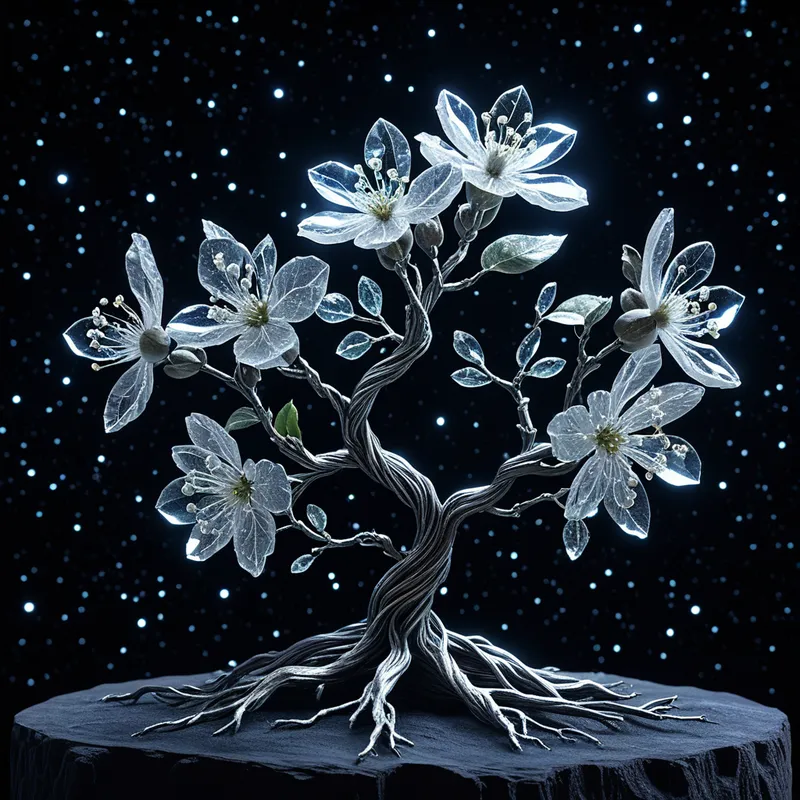
The apple tree from which it comes is the World Tree, the axis of all realities. The silver represents the moon—reflective, intuitive, belonging to the night and the subconscious. The nine blossoms often signify completion, the sacred number in Celtic tradition, pointing to the full cycle of preparation needed for such a journey.
Psychologically, the hero represents the conscious ego, venturing into the vast, autonomous realm of the collective unconscious. The Otherworld sovereign is the archetype of the Self, the central organizing principle of the psyche that holds both immense wisdom and terrifying power. The entire journey models a necessary dialogue between the small, personal self and the vast, transpersonal Self. The warning against the food is a warning against inflation—of becoming identified with the numinous experience and losing one’s grounding in mortal life.
The Dreamer's Resonance
When this myth stirs in modern dreams, it signals a profound interior transition. To dream of seeking or finding a silver branch indicates the psyche is preparing to cross a major inner threshold. This is not about everyday decisions, but about core identity shifts: a calling to a new vocation, the integration of a major trauma, or the confrontation with a deep, spiritual emptiness.
Somatically, this process may feel like a pulling sensation in the chest (the “longing”), coupled with anxiety or insomnia—the soul’s restlessness as it approaches the border. The dream bough may be incomplete, tarnished, or difficult to hold, reflecting the dreamer’s doubts about their readiness or worthiness for the transformation ahead. Dreaming of the Otherworld sovereign often manifests as an encounter with a majestic, intimidating, or profoundly calm figure who offers a cryptic gift or a silent judgment. This is the Self confronting the ego with the consequences of its journey. The return journey in a dream, often abrupt or confusing, mirrors the difficult task of bringing a transcendent insight back into the limitations of daily life.
Alchemical Translation
The myth of the Silver Bough is a perfect allegory for the Jungian process of individuation. The initial longing is the first stirring of the Self, calling the ego away from its comfortable, known world (the nigredo, or blackening, a state of confusion and yearning). The cutting of the bough is the act of conscious decision—the separatio—where one deliberately isolates a piece of one’s innate potential (the sacred tree of the psyche) to serve as a tool for the journey.
Individuation requires a passport issued by the very depths one seeks to enter; the quest must be authentic, or the gates remain shut.
The journey itself is the confrontation with the contents of the unconscious (the albedo, or whitening, an illuminating but often disorienting stage). Meeting the sovereign is the crucial moment of coniunctio—the conjunction of the ego with the Self. The plea presented is the ego’s limited desire; the sovereign’s response is the Self’s boundless, often paradoxical, perspective. The instruction or task given is the new psychic directive that will re-order the dreamer’s life.
The return is the most critical, and most neglected, phase: the rubedo, or reddening. It is the embodiment of the gold gained in the Otherworld into the lead of earthly existence. The changed seeker must now live the insight. The Silver Bough may be left behind, but its imprint—the memory of that wholeness—becomes the inner compass. For the modern individual, this translates to the hard, daily work of living one’s truth after a moment of enlightenment, of allowing a visionary experience to slowly, patiently, reshape one’s relationships, work, and very being. The myth assures us that such a round-trip is possible, that the soul can touch eternity and return, not to escape life, but to live it with a depth once only whispered of in ancient tales by the fire.
Associated Symbols
Explore related symbols from the CaleaDream lexicon: