The SidheMounds Myth Meaning & Symbolism
A mortal king enters the timeless SidheMounds, wins a goddess's love, and returns to a world that has forgotten him, forever caught between two realms.
The Tale of The SidheMounds
Listen now, and let the fire’s crackle fade. Let the wind outside become the sigh of the land itself. I will tell you of a time when the hills were not just earth and stone, but the very skin of the world, stretched taut over the beating heart of the Síd.
It was in the days of the High King Cormac mac Airt, when the borders between our world and the next were thin as morning mist. A young king, Eochaid, ruled in Ériu. He was a man of the sun, of clear judgments and firm spear-shafts. Yet, a restlessness was upon him, a hollow in his chest no victory feast could fill.
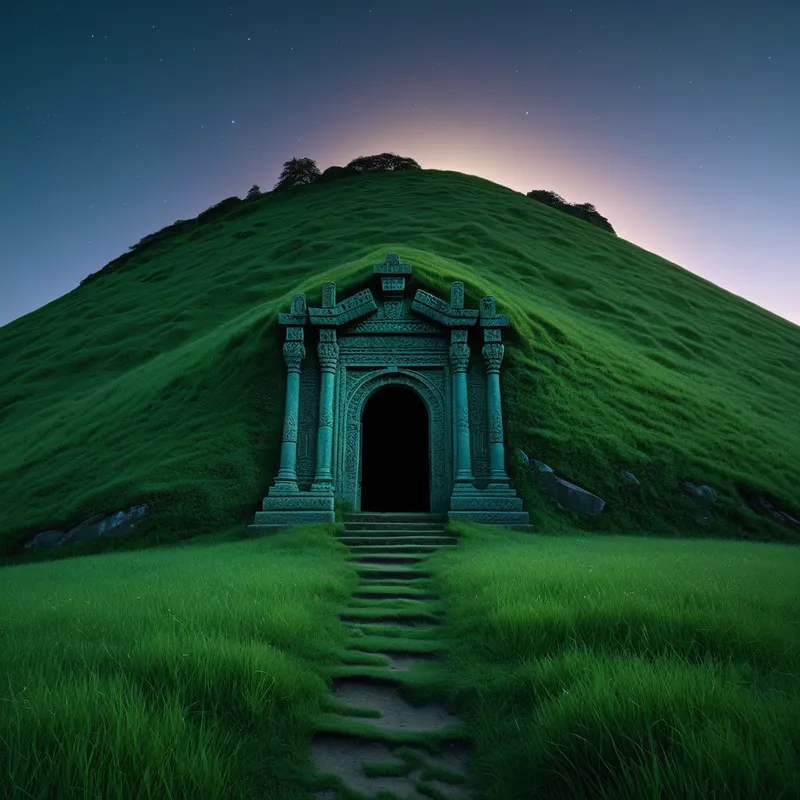
One day, hunting near the royal Hill of Tara, a mist descended—not a common fog, but a silver veil that drank the sound of the world. When it parted, the landscape was changed. Before him rose a hill he had never seen, greener than emerald, crowned with a light that was neither sun nor moon. From within the hill came music, a melody that plucked at the very threads of his soul. Drawn as if by a cord around his heart, Eochaid approached. The grassy side of the mound shimmered, and a doorway appeared, framed by ancient, carved stones humming with power.
He crossed the threshold. Inside was not darkness, but an endless, golden twilight. The air was sweet with the scent of everlasting apple blossoms. Here was the Tír na nÓg, the Land of Youth. And there, upon a throne of living crystal, sat a woman. She was Étaín, or one like her—her beauty was not of face alone, but of presence, as if the sovereignty of the land itself had taken human form. Her eyes held the patience of centuries.
“You have crossed the feadh,” she said, her voice the sound of a deep spring. “The price of entry is memory. The price of staying is your name.”
Eochaid, ensnared, remained. Time in the SidheMound flowed like honey, slow and golden. He learned the dances that shape the seasons, the songs that hold the stars in place. He loved the goddess-queen, and for a while, the hollow in him was filled with the light of the Otherworld. But the mortal core of him, the part woven from sunlight and decay, began to ache. He remembered the rough feel of his cloak, the taste of salt air, the faces of his companions—memories that grew faint and ghostly in that timeless place.
He begged to return, just for a day, to see his kingdom. The queen’s eyes filled with a sorrow as deep as the earth. “The world you knew moves to a faster drum,” she warned. “A day in the mound is a lifetime in the sun.”
He insisted. Stepping back through the glowing door, he found the world utterly changed. Tara was a ruin, overgrown. The people spoke a tongue he barely recognized. No one knew King Eochaid. A hundred years had passed. He was a ghost in his own land, a man out of time. He turned, desperate, back to the mound—but the hill was just a hill, silent and solid. The doorway was sealed. The music was gone. He stood forever in the between-place, belonging neither to the timeless Síd nor to the mortal world that had forgotten him, a king of two realms and none.

Cultural Origins & Context
This tale, in its many variations, is a cornerstone of the Insular Celtic mythological cycle. It was not written but spoken, carried by the fili and bards for centuries before being recorded by medieval Christian monks. These scribes often framed the stories as histories of a pre-Christian, heroic past, yet the pagan bones of the narrative shine through.
The societal function was multifaceted. On one level, it explained the ancient, pre-Celtic burial mounds (sí or sidhe mounds) that dotted the landscape, attributing them to the Túatha Dé Danann after their defeat. It reinforced the sacredness of the land itself, with kingship (fírinne flatha) being a marriage to the land’s spirit, often represented by a goddess from the mounds. Most profoundly, it served as a cultural meditation on fate, memory, and the human condition—caught between the longing for eternal beauty and the irrevocable pull of mortal time and duty.
Symbolic Architecture
The SidheMound is the ultimate [symbol](/symbols/symbol “Symbol: A symbol can represent an idea, concept, or belief, serving as a powerful tool for communication and understanding.”/) of the unconscious itself—a verdant, inviting [hill](/symbols/hill “Symbol: A hill represents challenges, progress, or obstacles in life’s journey, often symbolizing effort and perspective.”/) that contains a vast, autonomous, and numinous [interior](/symbols/interior “Symbol: The interior symbolizes one’s inner self, thoughts, and emotions, often reflecting personal growth, vulnerabilities, and secrets.”/) world. It represents the psychic territory we both yearn for and fear to enter fully.
To enter the mound is to willingly step into the depths of one’s own soul, where the rules of the conscious ego—time, logic, personal identity—hold no sway.
Eochaid is the ego-[consciousness](/symbols/consciousness “Symbol: Consciousness represents the state of awareness and perception, encompassing thoughts, feelings, and experiences.”/), the ruling principle of the daylight world. His restlessness is the psyche’s call toward greater wholeness, a summons from the Self. The [goddess](/symbols/goddess “Symbol: The goddess symbolizes feminine power, divinity, and the nurturing aspects of life, embodying creation and wisdom.”/) within is the [anima](/symbols/anima “Symbol: The feminine archetype within the male unconscious, representing soul, creativity, and connection to the inner world.”/), the [soul](/symbols/soul “Symbol: The soul represents the essence of a person, encompassing their spirit, identity, and connection to the universe.”/)-[image](/symbols/image “Symbol: An image represents perception, memories, and the visual narratives we create in our minds.”/), and also the Self in its transformative, sovereign [aspect](/symbols/aspect “Symbol: A distinct feature, quality, or perspective of something, often representing a partial view of a larger whole.”/). Their union is the symbolic [marriage](/symbols/marriage “Symbol: Marriage symbolizes commitment, partnership, and the merging of two identities, often reflecting one’s feelings about relationships and social obligations.”/) necessary for psychological [depth](/symbols/depth “Symbol: Represents profound layers of consciousness, hidden truths, or the unknown aspects of existence, often symbolizing introspection and existential exploration.”/). The tragic return represents the near-impossible [task](/symbols/task “Symbol: A task represents responsibilities, duties, or challenges one faces.”/) of integrating a profound unconscious experience back into a conscious [life](/symbols/life “Symbol: The symbol of ‘Life’ represents a journey of growth, interconnectedness, and existential meaning, encompassing both the joys and challenges that define human experience.”/) that is not structured to contain it. The forgotten [king](/symbols/king “Symbol: A symbol of ultimate authority, leadership, and societal order, often representing the dreamer’s inner power or external control figures.”/) is the ego that has been fundamentally altered by the unconscious but cannot find a home in its old world.
The Dreamer’s Resonance
When this myth pattern stirs in modern dreams, it often manifests as dreams of discovering hidden rooms in one’s house, finding ancient tunnels under familiar streets, or encountering a mesmerizing, otherworldly lover who promises fulfillment but at a mysterious cost. The somatic experience is one of simultaneous awe and dread, a thrilling expansion followed by a chilling disorientation.
Psychologically, this dream signals a powerful activation of the deep unconscious. The dreamer is at a threshold. The “mound” has opened because the psyche is ready for—or demanding—a confrontation with contents that have been buried (repressed ancestral patterns, innate potentials, core wounds). The conflict is between the allure of that inner richness and the terror of losing one’s constructed identity (“your name”). To dream of being trapped between the mound and the changed world is to experience the painful, liminal state of a transformation that is underway but not yet complete, where one feels alienated from both one’s old life and the new one not yet born.

Alchemical Translation
The myth models the perilous, essential process of individuation. The journey into the mound is the nigredo—the descent into the prima materia of the soul, a confrontation with shadow and archetype. The union with the goddess is the albedo and coniunctio, the sacred marriage that promises wholeness.
The tragedy is not the descent, but the failed return. The alchemical work is not complete until the lapis philosophorum, the transformed consciousness, is brought back and applied to the world.
For the modern individual, the “return” is the stage of integration. It is the often-messy, disorienting work of translating numinous insight into daily life, relationship, and vocation. The world will seem to have forgotten you, because you have changed and it has not. The alchemical challenge is to build a new “kingdom”—a conscious personality strong and flexible enough to house both the mortal and the divine, to honor the memory of the mound while standing firm in the sunlight. One must become the bridge itself, holding the tension of the threshold, allowing the music of the Síd to inform one’s actions in the world of time, without being swallowed by either realm.
Associated Symbols
Explore related symbols from the CaleaDream lexicon:
- Door — The shimmering entrance to the SidheMound represents the liminal threshold between consciousness and the unconscious, the point of no return on the journey of transformation.
- Earth — The mound itself is the body of the world, symbolizing the grounded, physical realm that contains and conceals the numinous, psychic depths within.
- Time — The differential flow of time between the mound and the mortal world signifies the atemporal nature of the unconscious versus the linear progression of ego-consciousness.
- Memory — The “price” of entry and the cause of Eochaid’s exile; represents the ego’s narrative identity, which must be surrendered to the unconscious and is tragically lost upon return.
- King — Eochaid as the archetypal ruler of the conscious psyche, whose legitimacy and wholeness depend on a sacred marriage with the deep, feminine sovereignty of the land/Self.
- Goddess — The sovereign queen within the mound embodies the anima and the Self, the transformative, eternal feminine principle that confers meaning and depth.
- Hill — The visible, tangible aspect of the SidheMound, representing an accessible yet mysterious point of entry into the vertical dimension of the psyche, rising from the mundane landscape.
- Mist — The silver veil that heralds the opening of the Otherworld, symbolizing the dissolution of ordinary perception and the beginning of a numinous, dreamlike state.
- Music — The irresistible melody from within the mound is the call of the Self, the archetypal pattern or harmony of the soul that draws the ego toward its destiny.
- Crown — Eochaid’s lost kingship represents the integrated, sovereign Self, a state of psychological wholeness he glimpses in the mound but cannot maintain in the divided world.
- Journey — The entire narrative arc is the quintessential journey from the known to the unknown and back again, mapping the path of individuation.
- Threshold — The constant, painful space Eochaid inhabits at the end; the permanent state of the individuating psyche, which must learn to dwell at the border of two worlds.
- Fencing Off