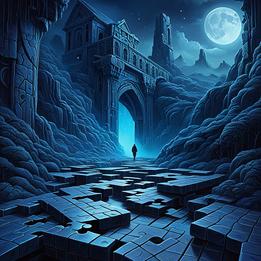
Riddle
A puzzle or enigmatic statement requiring cleverness to solve, symbolizing hidden truths, intellectual challenge, and the search for meaning.
Riddle Dream Meaning
A puzzle or enigmatic statement requiring cleverness to solve, symbolizing hidden truths, intellectual challenge, and the search for meaning.
Interpretive Themes
Hidden Knowledge
highSymbolizes the quest for wisdom.
Intellectual Challenge
highRepresents cognitive effort and growth.
Adaptability
mediumReflects on life's unanswered questions.
Self-Discovery
mediumThe riddle as a mirror to self.
Communication Barrier
lowMay indicate miscommunication or secrecy.
Mythological Resonance
The Sphinx
GreekPosed the riddle 'What walks on four legs in the morning, two at noon, and three in the evening?' to travelers, with Oedipus solving it to reveal the answer: Man.
Odin
NorseSacrificed an eye at Mímir's Well to gain wisdom, engaging in riddles with giants and gods to uncover cosmic secrets.
Cultural Lenses
Jungian Perspective
View Context →Represents the archetype of the trickster or sage, symbolizing the unconscious mind's attempt to communicate hidden truths through symbolic language, urging integration of shadow aspects.
Freudian Perspective
View Context →May symbolize repressed desires or childhood conflicts encoded in language, with the solution representing wish fulfillment or resolution of unconscious tensions.
Gestalt Perspective
View Context →The riddle is a projection of the dreamer's unfinished business or polarities; solving it involves integrating conflicting parts of the self to achieve wholeness.
Cognitive Perspective
View Context →Reflects the brain's problem-solving processes during sleep, possibly consolidating memories or practicing mental flexibility, with the riddle representing real-life cognitive challenges.
Evolutionary Perspective
View Context →Rooted in adaptive problem-solving and social bonding, riddles in dreams may simulate threat assessment or cooperative puzzle-solving crucial for survival in ancestral environments.
Global/Universal Perspective
View Context →A cross-cultural symbol of wisdom tests, appearing in myths and folklore worldwide (e.g., Sphinx's riddle), representing life's fundamental mysteries and human ingenuity.
East Asian Perspective
View Context →In traditions like Zen koans, riddles are spiritual tools to transcend logical thinking, pointing to enlightenment; historically used in imperial examinations to test wisdom.
South Asian Perspective
View Context →Linked to Vedic puzzles and philosophical dialogues in texts like the Upanishads, symbolizing the search for Brahman (ultimate reality) through intellectual and spiritual inquiry.
Middle Eastern Perspective
View Context →Featured in Arabic and Persian literature (e.g., One Thousand and One Nights), riddles often carry moral lessons, testing cleverness and virtue in courts and storytelling traditions.
European Perspective
View Context →From Greek mythology to medieval Arthurian legends, riddles test heroes' wit and destiny; in modern times, associated with literary puzzles and cryptographic challenges.
African Perspective
View Context →In oral traditions, riddles (like Akan 'mmotoho') teach critical thinking and cultural values, often used in initiation rites to symbolize the transition to adulthood and wisdom.
North American Perspective
View Context →In Indigenous cultures, riddles appear in teaching stories; in modern context, associated with escape rooms and puzzle games reflecting a culture of innovation and problem-solving.
Historical Authorities
Want a deeper analysis?
Get a personalized interpretation of your entire dream including this symbol.
Interpret My DreamThe Oracle's Prediction
Combine multiple symbolsA profound insight will come through unexpected conversation or reading.
Timeframe
Immediate (Next 48h)
Intensity
Deep
You will be presented with a challenging opportunity that requires creative thinking.
Timeframe
Lunation (~29 Days)
Intensity
Deep
Common Appearances & Contexts
| Context | Emotion | Interpretation |
|---|---|---|
| Context Solving a riddle | Emotion triumph | Interpretation Overcoming a personal challenge. |
| Context Failing to solve | Emotion anxiety | Interpretation Fear of inadequacy or failure. |
| Context Hearing a riddle | Emotion curiosity | Interpretation Openness to new insights. |
| Context Creating a riddle | Emotion pride | Interpretation Desire to be understood. |
| Context Riddle in darkness | Emotion fear | Interpretation Uncertainty about the future. |
| Context Riddle from authority | Emotion pressure | Interpretation Feeling tested or judged. |
| Context Riddle with friends | Emotion joy | Interpretation Collaborative problem-solving. |
| Context Ancient riddle | Emotion awe | Interpretation Connection to timeless wisdom. |
| Context Riddle in nature | Emotion wonder | Interpretation Seeking patterns in life. |
| Context Riddle as a gift | Emotion gratitude | Interpretation Receiving a meaningful challenge. |
| Context Riddle in a maze | Emotion confusion | Interpretation Feeling lost or trapped. |
| Context Riddle from a child | Emotion amusement | Interpretation Rediscovering simple truths. |
Interpret Your Full Dream
Beyond this symbol, every dream carries a unique story. Share your dream for a personalized AI-powered interpretation.