The Republic Myth Meaning & Symbolism
A philosopher's journey into the cave of collective illusion, returning with a vision of the soul's perfect city, a luminous ideal cast upon the wall of reality.
The Tale of The Republic
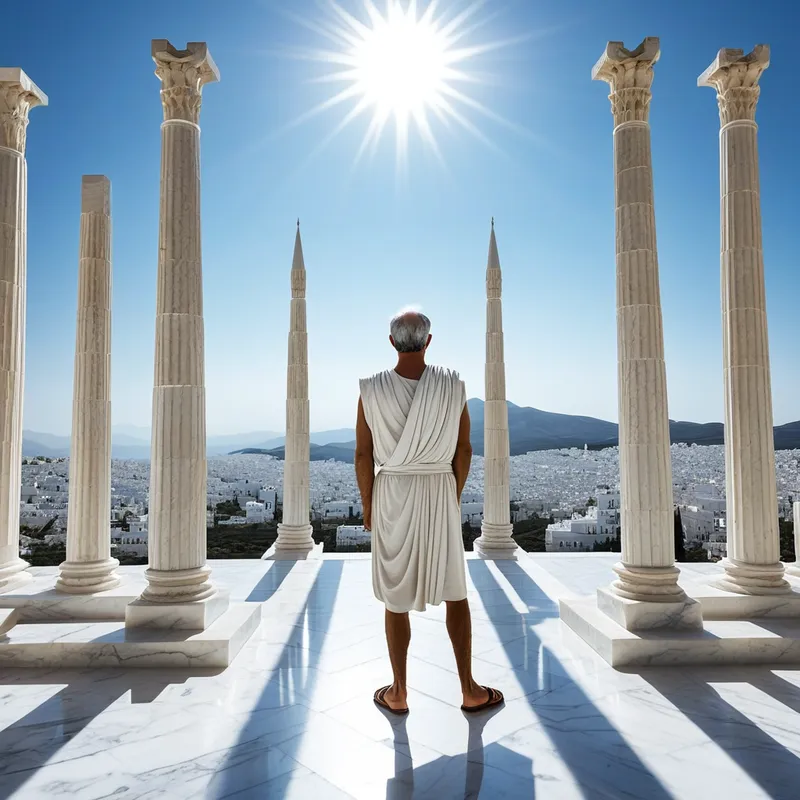
Listen, and I will tell you of a journey not across seas of salt, but across seas of shadow and light. It begins not in a palace of kings, but in a harbor, in the house of an old man named Cephalus. The air is thick with the scent of incense and aged wine, and the shadows from the oil lamps dance upon the walls like restless spirits.
Here, the seeker Socrates gathers with companions—the fiery Glaucon and the steady Adeimantus. They speak of age, of justice, of the debts men owe to gods and to one another. But the conversation, like a ship caught in a sudden storm, is blown into deeper waters. What is justice itself? Not the semblance seen in the courts of men, but the pure form, the perfect pattern that would make a soul—or a city—truly whole.
And so, they begin to build a city in speech. Not with stone and mortar, but with logos, with reason. They conjure from the earth a simple city of need, where each person fulfills their nature. But the companions are not satisfied; they demand to see a city "in fever," a luxurious city swollen with desire. From this fever, they birth the guardians—warriors whose souls must be forged of a rare metal, blending the fierceness of a noble hound with the gentleness of a philosopher. Their education is a sacred rite: music to harmonize the spirit, gymnastics to temper the body, all to make them perfect defenders of the order they cannot yet fully see.
Then, the vision ascends. Socrates speaks of a greater mystery: the Philosopher-Kings. These are souls who have turned their gaze from the shifting shadows of common opinion to the unchanging realities—the Forms. They have beheld the sun of the Good, the source of all truth and being. Reluctant, they must be compelled to return to the cave of public life, to govern not for power, but from duty, ordering the city according to the celestial pattern they alone have witnessed.
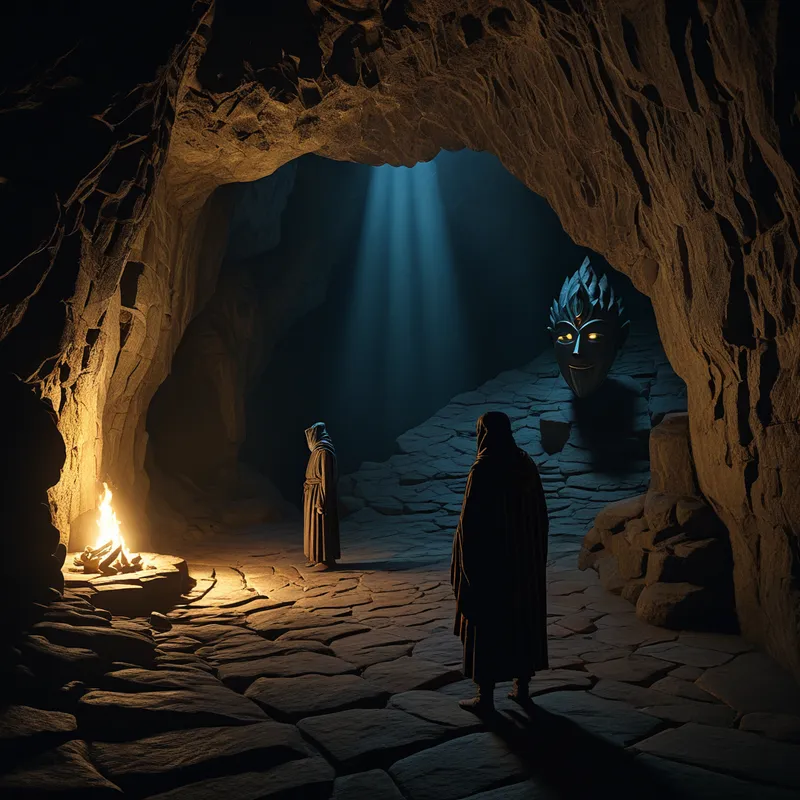
The tale culminates in a haunting parable. Imagine, Socrates says, a deep underground cave. Men are chained there from childhood, facing a blank wall. Behind them, a fire burns, and between the fire and the prisoners, puppeteers carry objects, casting flickering shadows on the wall. This is the only reality the prisoners know. If one were freed, turned around, and dragged up the steep, painful ascent to the world above, the true light of the sun would blind him. He would at first rage, longing for the familiar shadows. But gradually, his eyes would adjust. He would see the true forms of things, the stars, and finally the sun itself—the cause of all. His duty, his painful blessing, would be to descend back into the darkness, to tell the truth of the light to those who know only shadows, who would likely kill him for disturbing their world.
The story ends not with a conquest, but with a quiet revelation. The just city, he admits, may never exist on earth. But it exists as a pattern in heaven, a model for the one who wishes to found the city within his own soul.
Cultural Origins & Context
This myth was born in the mind of Plato, in the 4th century BCE, in the wake of Athenian trauma. It is not a folk tale passed down by bards, but a consciously crafted philosophical drama, a "likely story" designed to heal a cultural psyche. Athens had lost the Peloponnesian War, executed Plato’s mentor Socrates, and seen its democracy descend into factionalism and tyranny. The Republic was Plato’s profound response: a diagnosis of the sick soul of the polis and a prescription for its cure.
It was passed down not around campfires, but in the Academy, through dialectical conversation and written scrolls. Its societal function was radical: to re-found society not on tradition or power, but on knowledge of eternal truth. It served as a foundational text for an intellectual elite, a blueprint for education, and a devastating critique of the superficiality of political life. It asked the ultimate question: is it better to seem just, or to be just, even if you suffer for it?
Symbolic Architecture
The myth’s power lies in its layered symbolism, a perfect architecture of the psyche.
The Cave represents the phenomenal world of sensory experience and unexamined opinion—the collective unconscious of a society, or the personal psyche trapped in identification with its own projections. The Shadows are the illusions we take for reality: social norms, inherited beliefs, and the distorted images of our own desires.
The journey from the cave is not a flight from the world, but a descent into the source of the world's meaning.
The painful Ascent symbolizes the arduous path of education (paideia) and philosophical awakening. It is the disorientation of the ego when confronted with the greater reality of the Self. The Sun, the Form of the Good, represents the ultimate archetype of wholeness, the central organizing principle of the psyche (the Self in Jungian terms) that gives light, life, and intelligibility to all other contents.
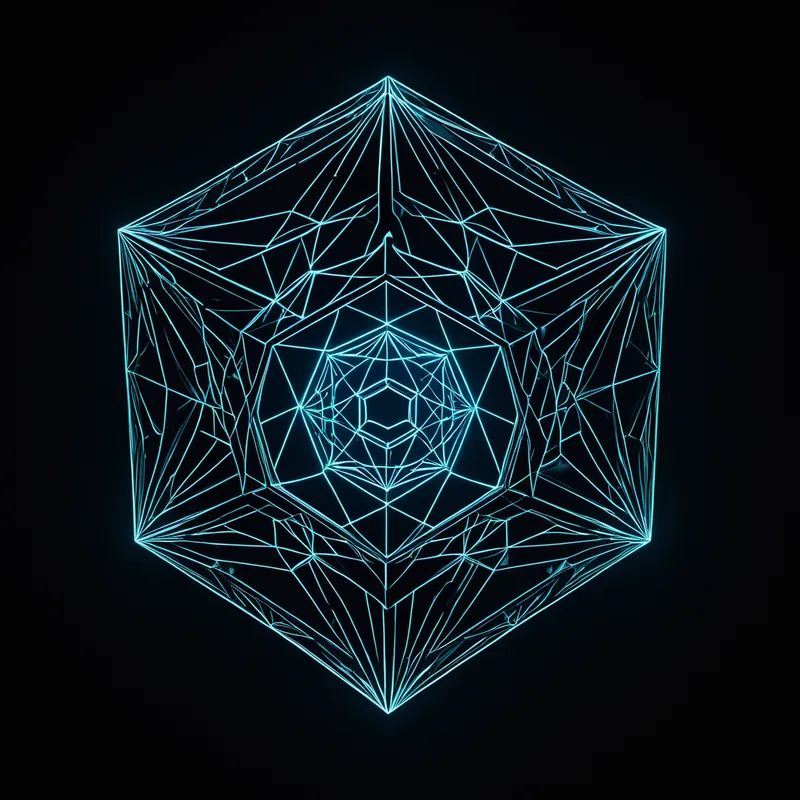
The Philosopher-King is the archetype of the integrated individual, where consciousness (the philosopher) successfully governs the inner kingdom of instincts, passions, and complexes (the citizens and guardians). The tripartite City-Soul—Rulers/Reason, Guardians/Spirit, Producers/Appetite—is a direct map of the human psyche, where justice is the harmonious state of each part performing its proper function under the guidance of wisdom.
The Dreamer's Resonance
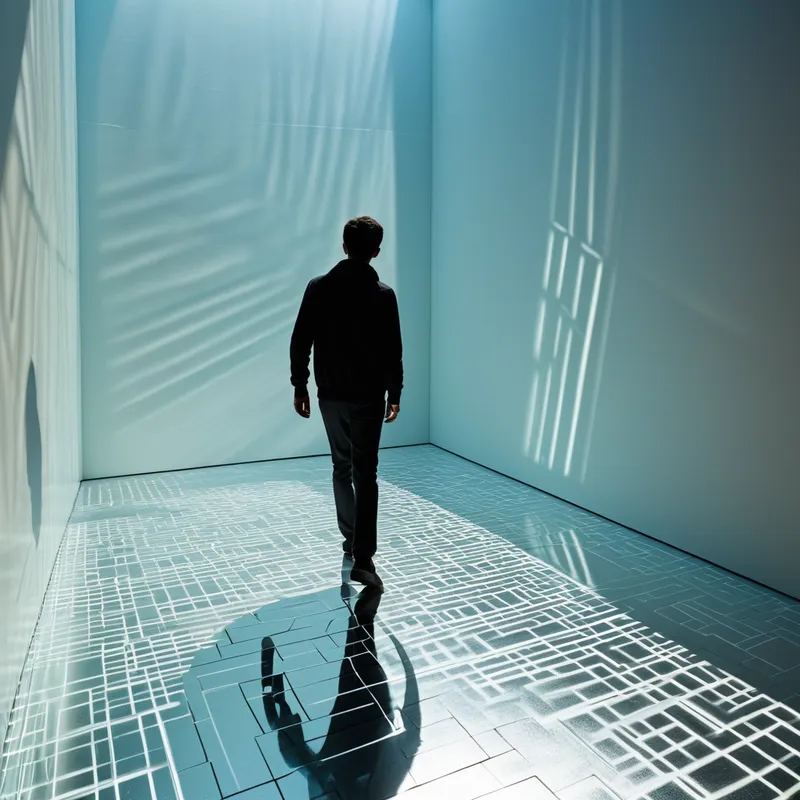
When this myth stirs in the modern dreamer, it often manifests as dreams of imprisonment or constraint in familiar, yet false, environments. One might dream of being in a basement, a movie theater, or an office, watching a screen where the action is compelling but meaningless. The somatic feeling is one of restless agitation, a sense that "this is not all there is," coupled with a fear of breaking the unspoken rules of the space.
The turning point in such a dream—the moment of being forced to turn away from the screen or wall—can be terrifying, often accompanied by vertigo or nausea. This is the psyche’s rebellion against the dominant conscious attitude, initiating a process of dis-identification. To dream of the blinding light is to confront a truth so potent it feels annihilating to the old ego-structure. The dreamer undergoing this process is at the threshold between a life lived by default and one lived by design, grappling with the terrifying responsibility of their own awakening.
Alchemical Translation
The alchemical work modeled here is the opus contra naturam—the work against one’s own unconscious nature. The prima materia is the leaden, chained soul in the cave of personal and collective complexes. The process begins with solutio (dissolution), as the comforting certainties of the shadow-world are dissolved by a gnawing doubt or a crisis.
The ascent is the separatio and sublimatio, the painful separating of consciousness from its entangled projections and its elevation to a higher, broader perspective. Confronting the Sun is the coniunctio, the sacred marriage where the individual mind apprehends the transpersonal pattern of the Self.
The true philosopher-king is not born in a palace, but forged in the return journey, in the willingness to bear the light back into the darkness of one's own and others' ignorance.
The final, most critical stage is the Return. This is the coagulatio—the embodiment, the making solid. It is not enough to have the vision; the alchemist must bring the gold back down and manifest it in life. For the modern individual, this is Individuation in action: integrating the insights from the Self into daily life, ordering one’s personal "republic" (relationships, work, creativity) according to the inner pattern of truth one has glimpsed. The triumph is not escape, but grounded governance—a soul in which reason, spirit, and appetite are in just harmony, a living city of the psyche founded on the rock of self-knowledge.
Associated Symbols
Explore related symbols from the CaleaDream lexicon: