
The Potter Myth Meaning & Symbolism
A divine potter shapes humanity from clay, shatters flawed vessels, and re-forms them, symbolizing the soul's painful, necessary journey toward wholeness.
The Tale of The Potter
In the beginning, before time was counted, there was the Potter. He did not dwell in a palace of gold, but in a workshop at the edge of eternity, where the air smelled of damp earth and the silence was filled with the hum of potential. His tools were simple: a wheel spun by the breath of the world, a basin of water from the deep springs of Tehom, and his own two hands, which knew the memory of every shape that ever was or could be.
He gathered the clay, not from any ordinary riverbank, but from the primal dust where spirit and matter were one. He kneaded it, feeling for the hidden spark within the cold, dark earth. Then, with a touch that was both infinitely powerful and tender as a mother’s, he set the wheel to spinning. The universe held its breath. Upon that turning disk, forms emerged: vessels of every conceivable shape—some broad and sturdy to hold abundance, others slender and delicate for the finest oils of joy.
He shaped humanity. With a sculptor’s focus, he formed the hollow of a belly, the curve of a shoulder, the intricate chamber of a skull meant to hold the wine of consciousness. He breathed into the clay’s opening, and the vessel lived. It held the Ruach, glowing from within like a lamp.
But the Potter’s work was not done with the first firing. Some vessels, upon the wheel, developed a hidden flaw—a stubborn air pocket of pride, a weak spot of fear in the wall. The Potter’s eye, which sees the inside as clearly as the outside, would pause. His face, often serene, would cloud with the sorrow of a creator who loves his creation too much to let it be less than it was meant to be.
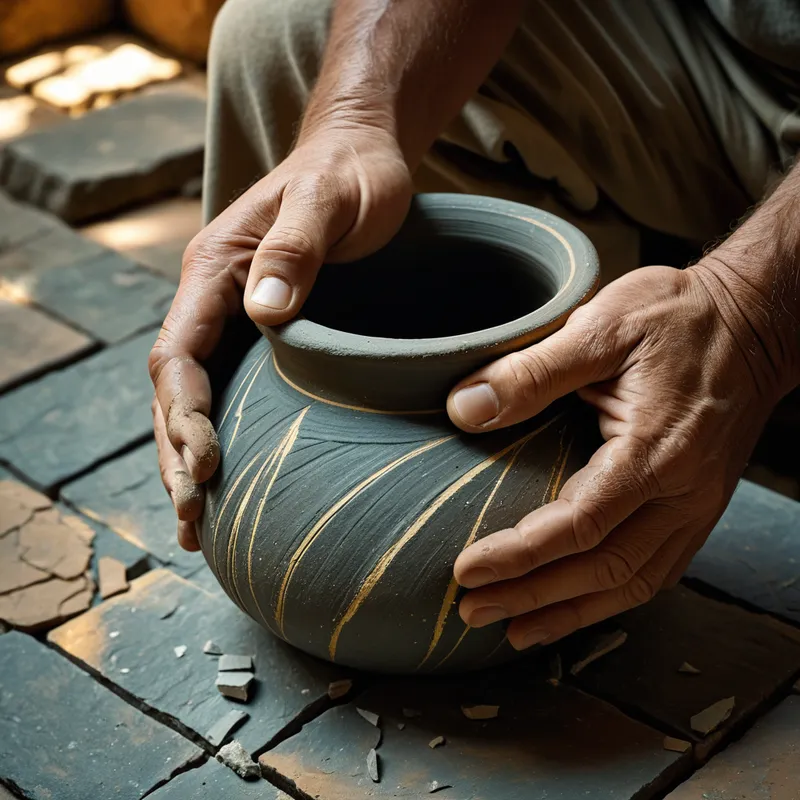
And then, with a resolve that shook the foundations of the workshop, he would close his hands around the flawed vessel. There was no anger in the act, only a terrible, necessary grace. The clay form—so carefully shaped, so loved—would collapse. It shattered not into dust, but back into a weeping mound of raw material on the wheel. The sound was not of breaking, but of returning.
The wheel never stopped spinning. From the very same clay, now wiser for its forming and its breaking, the Potter would begin again. The second vessel, born from the memory of the first, was always stronger, its walls more even, its capacity to hold the sacred breath ever greater. It was the same, yet utterly new—a testament that the master’s design is not thwarted by the breaking, but fulfilled through it.
Cultural Origins & Context
This powerful metaphor is not a single, isolated myth, but a recurring prophetic image woven through the Tanakh. It finds its most explicit expression in the books of Jeremiah (chapter 18) and Isaiah (chapter 64, verse 8), and is echoed in the wisdom literature. It was not a story told to children at bedtime, but a stark, visceral parable delivered by prophets to a nation in crisis—during the siege of Jerusalem and the trauma of the Babylonian Exile.
The prophet, as the mouthpiece of the divine, would visit a literal potter’s workshop, a common sight in ancient Judah, and transform this everyday craft into a cosmic drama. The societal function was one of radical recontextualization. To a people who saw themselves as a finished, permanent nation—now being “shattered” by invasion and exile—the myth re-framed their catastrophe. It was not meaningless destruction by a capricious god or a stronger army, but the purposeful, painful action of a sovereign creator who retains the right to re-form what he has made. It was a call to surrender and hope, demanding the humility to be clay in the hands of a will greater than one’s own.
Symbolic Architecture
At its core, the myth dismantles the illusion of the static self. We are not fired-and-finished porcelain figures on a shelf, but dynamic, malleable beings in perpetual process upon the wheel of experience.
The most profound creation often requires a prior, sacred destruction.
The Potter represents the archetypal Self, the organizing, purposeful center of the psyche that drives toward individuation. His workshop is the liminal space where destiny is shaped, the meeting point of divine intention and earthly material. The clay is the raw substance of our being—our instincts, our history, our inherited patterns, and our potential. It is neutral, containing both flaw and promise.
The flaw (the hidden air pocket, the weak spot) is not “sin” in a simplistic moral sense, but a structural psychic fault—a complex, a neurosis, an inflated identity, or a foundational wound that prevents the vessel from holding the full pressure of life and spirit. The breaking is the inevitable crisis: the depression, the failed relationship, the loss, the identity-shattering event that reduces us to our essential matter. It is the ego’s experience of annihilation.
The re-forming is the critical alchemy. The myth insists the clay is not discarded. The essence is preserved. The new vessel, made from the old, symbolizes the integrated personality—the one that has consciously incorporated the experience of its own breaking. It is more resilient, more compassionate, and has a greater capacity to contain the transcendent.

The Dreamer's Resonance
When this myth stirs in the modern unconscious, it often surfaces in dreams of profound transformation tinged with anxiety. One might dream of being in a vast, quiet workshop where giant, loving hands reshape their body from earth. They may dream of their own home—a symbol of the psyche—cracking apart, only to reveal its walls are made of clay being smoothed by an invisible presence. Dreams of shattered pottery that magically reassembles itself, or of being kneaded like dough, are direct manifestations.
Somatically, this process can feel like a deep, structural crumbling—a fatigue that is more than tiredness, a sense of being “undone.” Psychologically, it is the process of deintegration, a necessary dissolution of outgrown ego structures before reintegration can occur. The dreamer is not being punished; they are, however painfully, being returned to the wheel. The emotional tone in the dream is key: is the breaking violent and terrifying, or is there a strange, solemn peace in the dismantling? The latter suggests a nascent trust in the process, a somatic surrender to the Self.

Alchemical Translation
The alchemical journey—nigredo (blackening), albedo (whitening), rubedo (reddening)—finds a perfect parallel in the Potter’s workshop. The nigredo is the primal, dark clay and the shadow of the flaw within it. The crushing of the vessel is the supreme blackening, the moment of despair and derelictio. The wheel’s constant spin is the albedo, the purifying wash of insight and reflection that follows the crisis. The re-forming and final firing is the rubedo, the achievement of the “philosopher’s stone”—which, in psychological terms, is the durable, radiant vessel of the individuated personality.
Individuation is not about building a perfect statue, but about consenting, again and again, to be clay.
For the modern individual, the myth models the necessity of creative destruction. We must learn to distinguish the Potter’s hand from mere misfortune. This is the move from victimhood to participation. The struggle is to stop clinging to the familiar, cracked form of who we were—our outdated career identity, our defensive behaviors, our cherished self-narratives—and to surrender to the breaking. The triumph is not in avoiding the wheel, but in discovering, through the ordeal, that our core substance is indestructible and ever-fit for new creation. We are not the temporary vessel; we are the eternal clay, forever capable of being shaped into a vessel that can hold more light.
Associated Symbols
Explore related symbols from the CaleaDream lexicon: