Ruach Myth Meaning & Symbolism
The story of the divine breath that animates the void, weaving order from chaos and consciousness from clay, a foundational myth of spirit and matter.
The Tale of Ruach
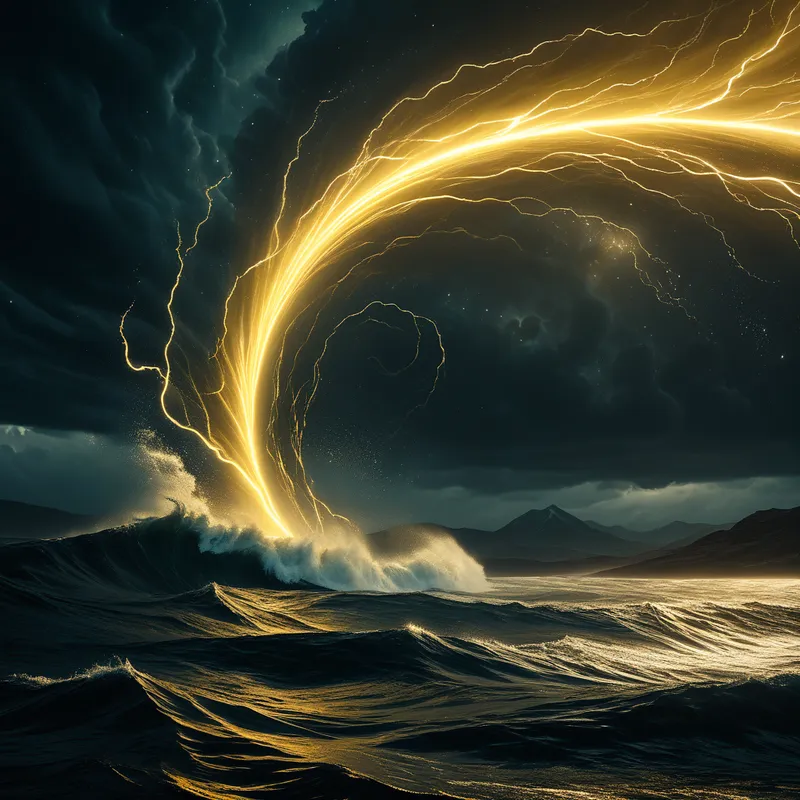
In the beginning, there was no beginning. There was only the <abbr title="The formless void, the primordial deep, the state before creation">Tohu va-Bohu</abbr>, a seething, silent, and sightless deep. A <abbr title="The abyss, the primordial waters of chaos">Tehom</abbr> of unformed potential, dark and fathomless, where light was not yet a concept, and sound was not yet a vibration. It was the womb of all and the tomb of nothing, a profound and pregnant emptiness.
And over the face of these waters, there brooded a presence. Not a form, but a focus. Not a voice, but a vibration at the edge of silence. It was the <abbr title="The spirit, wind, or breath of God">[Ruach Elohim](/myths/ruach-elohim "Myth from Abrahamic culture.")</abbr>. It was not a gust that blows from here to there, but the very principle of movement, the first inclination toward something-other-than-this. It was the breath that precedes the word, the thought that precedes the act.
Then, from the heart of that brooding presence, a sound emerged. Not a sound to be heard by ears, for there were none, but a fundamental command that was its own execution: "Yehi Or." Let there be light. And the <abbr title="The spirit, wind, or breath of God">Ruach Elohim</abbr>, which had been hovering, now became the instrument. It was the exhale that carried the command into the fabric of the <abbr title="The abyss, the primordial waters of chaos">Tehom</abbr>. It was the wind that parted the darkness, not by pushing it aside, but by informing it, by translating the divine imperative into a reality of radiance. Light was not made from nothing; it was summoned from the deep by the breath of intent.
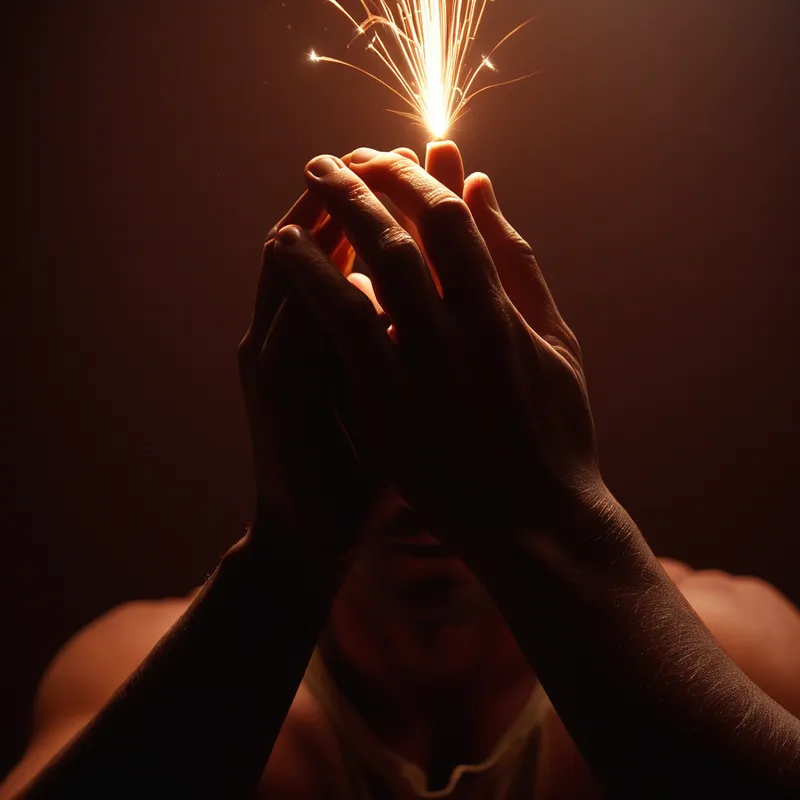
The story unfolds—the vault of the sky is breathed into being, separating the waters above from the waters below. Land is drawn forth from the sea by a divine inhalation. But the culmination, the most intimate act, comes from the dust of the earth. From the <abbr title="The red clay, the earth, from which humanity is formed">Adamah</abbr>, a form is shaped. It is perfect in contour, yet utterly inert. A sculpture of potential. Then, the <abbr title="The living, animating breath that gives life">Neshamah</abbr>, the living breath, is breathed. The <abbr title="The spirit, wind, or breath of God">Ruach Elohim</abim> does not blow upon it from afar. The Creator brings its mouth to the mouth of the clay, and breathes directly into its nostrils. It is not an act of magic, but of the most profound intimacy—a kiss of life. The clay chest rises. The eyes open, not just to see, but to perceive. The <abbr title="The red clay, the earth, from which humanity is formed">Adamah</abbr> becomes <abbr title="Humanity, humankind, derived from the earth">Adam</abbr>, a living being. The breath becomes his own, the sacred wind now circulating within a vessel of earth, forever binding spirit to dust.
Cultural Origins & Context
This is not a myth from the periphery of Hebrew culture; it is its foundational cosmology, enshrined in the opening verses of <abbr title="The first book of the Hebrew Bible, Genesis">Bereshit</abbr> (Genesis). It was preserved and transmitted not by bards around a fire, but by priests, scribes, and scholars within a tradition that placed supreme value on the spoken and written word. The context is one of exile and identity formation. As the Hebrew people sought to understand their place in a world of older, polytheistic empires with dramatic creation battles (like the Babylonian Enuma Elish), this narrative presented a radically different theology.
Here, creation is not born from violent conflict between gods, but from the sovereign, orderly command of a single, formless God, enacted through His <abbr title="The spirit, wind, or breath of God">Ruach</abbr>. The societal function was paramount: it established a worldview of a purposeful, intelligible universe brought into being by wisdom (Chokhmah) and breath (Ruach). It positioned humanity not as an afterthought, but as the apex of creation, uniquely infused with the divine breath, charged with stewardship and endowed with moral consciousness. This imbued daily life, law, and ethics with a sense of sacred responsibility rooted in that first, animating gift.
Symbolic Architecture
The myth of <abbr title="The spirit, wind, or breath of God">Ruach</abbr> is a symbolic blueprint for the emergence of consciousness itself. It maps the journey from undifferentiated potential to articulated, ensouled existence.
The void is not empty; it is full of unmanifested possibility. The breath is the first act of discrimination, the primal movement that begins the separation of light from dark, self from other.
The <abbr title="The formless void, the primordial deep, the state before creation">Tohu va-Bohu</abbr> represents the unconscious in its raw, chaotic state—the swirling mass of instincts, potentials, and unprocessed psychic material. The <abbr title="The spirit, wind, or breath of God">Ruach Elohim</abbr> hovering over it symbolizes the emergent ego, the first point of awareness that begins to observe and organize the chaos. The spoken Word ("Yehi Or") is the act of naming, of bringing a concept from the formless deep of the psyche into the light of conscious understanding.
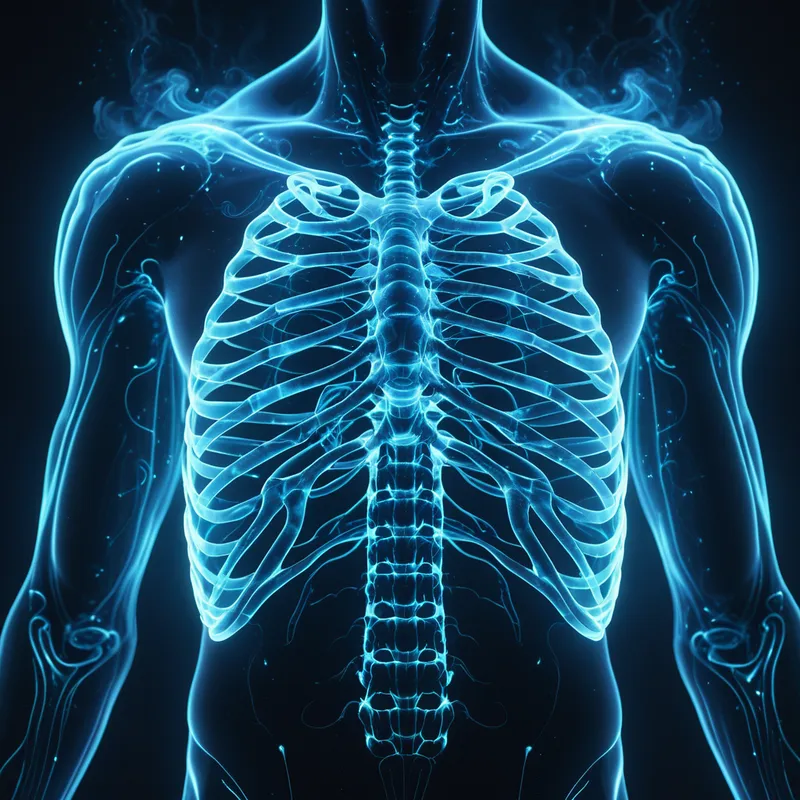
Most crucially, the breathing of life into <abbr title="Humanity, humankind, derived from the earth">Adam</abbr> encapsulates the central mystery of human existence: we are hybrids. We are <abbr title="The red clay, the earth, from which humanity is formed">Adamah</abbr>—earthly, mortal, subject to cycles of growth and decay. And we are <abbr title="The living, animating breath that gives life">Neshamah</abbr>—spiritual, animated by a spark of the divine, capable of transcendence, creativity, and moral choice. The myth asserts that true life, true humanity, exists precisely at this intersection. The breath is not the soul as a separate entity; it is the animation of the material, the spirit made operative in the world.
The Dreamer's Resonance
When this myth stirs in the modern unconscious, it often manifests in dreams of profound transition between states of being. One may dream of standing on a shore, watching a vast, dark ocean (Tehom), feeling a wind (Ruach) begin to stir that both terrifies and exhilarates. This somatic experience points to the onset of a psychic reorganization, the feeling that the old, formless way of being is about to be structured anew.
Dreams of suffocation, or conversely, of taking a first, shocking breath of incredibly pure air, speak directly to the <abbr title="The living, animating breath that gives life">Neshamah</abbr> archetype. They indicate a crisis or a gift related to one's vital energy, inspiration, or "spirit." A dream of molding clay that will not come to life reflects a creative endeavor or a sense of self that feels inert, waiting for the necessary spark of animating passion or purpose. The psychological process is one of inspiration in its literal sense—the drawing in of spirit. The dreamer is navigating the space between a lifeless pattern (a job, a relationship, an old identity) and the infusion of new meaning that will make it feel truly alive again.
Alchemical Translation
The alchemical process mirrored in this myth is the solve et coagula—dissolve and coagulate—applied to the psyche. The <abbr title="The formless void, the primordial deep, the state before creation">Tohu va-Bohu</abbr> is the nigredo, the blackening, the initial chaotic state of the unexamined life or the dark night of the soul. The work of individuation begins with the brooding <abbr title="The spirit, wind, or breath of God">Ruach</abbr>, which is the ego's turning of attention inward, the first conscious engagement with the inner chaos.
Individuation is not about becoming pure spirit, but about becoming a conscious vessel where spirit and matter, divine breath and earthly clay, consciously cooperate.
The spoken Words of creation are the insights, the "aha" moments, that bring light and order (albedo, the whitening). They separate psychic contents: this is a projection, this is a complex, this is a true talent. Finally, the breathing into clay is the rubedo, the reddening, the ultimate integration. It is the moment when the insights of analysis are fully embodied. The transformed individual does not float above their human condition; they live it more fully, their mortal life now infused with and directed by a hard-won sense of meaning and purpose—the divine breath made personal. The struggle is to hold the tension of the hybrid identity, to honor both the limitations of the clay and the boundless potential of the breath, forging a self that is uniquely, authentically, and vibrantly alive.
Associated Symbols
Explore related symbols from the CaleaDream lexicon: