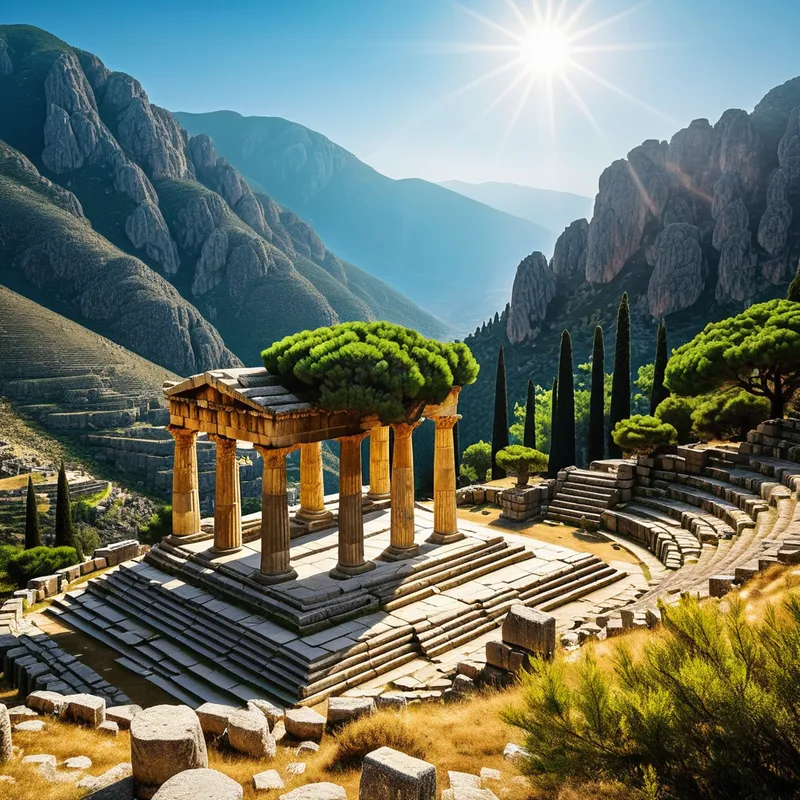
The Oracle's Seat at Delphi Myth Meaning & Symbolism
The myth of the priestess Pythia, who channeled Apollo's prophecies from a chasm at Delphi, revealing divine will at the world's sacred center.
The Tale of The Oracle's Seat at Delphi
Before kings built empires and heroes sought their names, the earth itself dreamed. In a place where two great eagles, released by Zeus from opposite ends of the world, met in their flight, the navel of the world was found. It was a savage, holy place. A deep chasm split the rock of Mount Parnassus, and from it breathed a strange, sweet-smelling vapor, the pneuma, the breath of the goddess Gaia herself. Here, the great serpent Python coiled, its scales glinting like dark water, its hiss the only voice that answered the wind.
Then came the god of light, the far-shooter, Apollo. He descended like a shaft of piercing sunlight. With his silver bow, he slew Python, letting its dark blood soak into the sacred ground. But this was no mere conquest. It was a terrible marriage. Apollo did not destroy the chasm’s power; he harnessed it, consecrating the site as his own. The wild, chthonic breath of the Earth Mother was now wed to the lucid, celestial will of the Sun God.
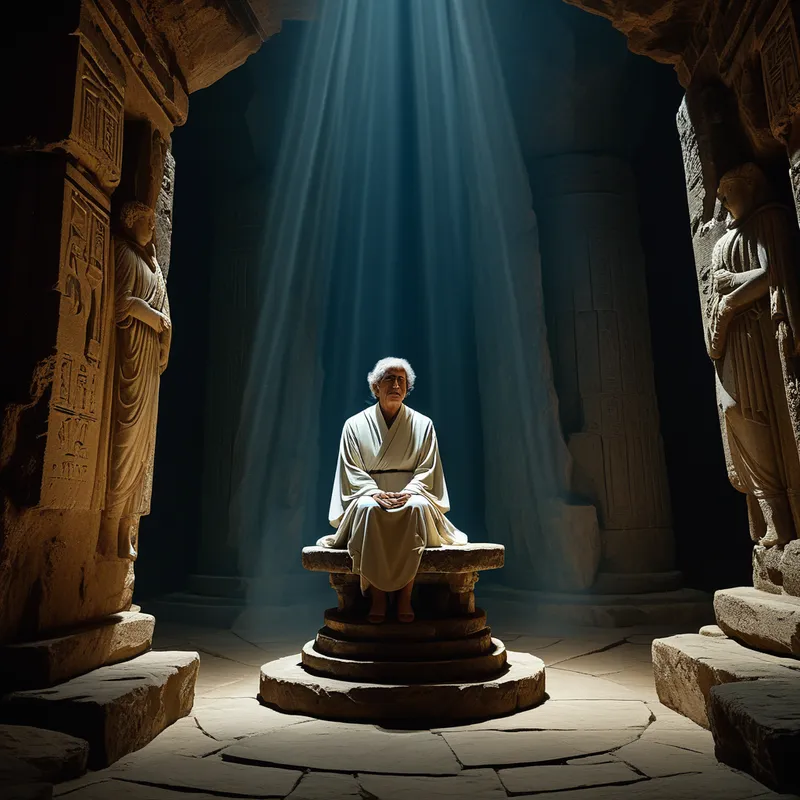
To serve this new, paradoxical power, a vessel was needed. Not a priest, but a priestess. A woman of Delphi, chosen from among the locals, often of humble birth. She would be named the Pythia. Before her sacred duty, she would bathe in the Castalian Spring, its waters washing away the mundane. She would chew leaves from the sacred laurel tree, Apollo’s own plant, and drink from a sacred spring. Then, on the seventh day of each month—a day sacred to Apollo—she would descend into the temple’s innermost chamber, the adyton.
The air there was thick, heavy with the smell of burning barley meal and laurel leaves. In the center, over the very cleft where Python once lay, stood a tall, three-legged stool, the tripod. The Pythia would seat herself upon it. As the vapors from the chasm rose, they enveloped her. Her body would grow rigid, her eyes would lose focus, seeing not the dark room but the woven threads of fate. Her head would loll, her limbs twitch. From her lips, freed from her own mind, would come sounds—groans, cries, fragmented words. These were the god’s utterances.
Beside her, a hooded priest, the prophetes, would listen intently. His task was to translate her ecstatic ravings into the cryptic, often ambiguous hexameter verses that would be delivered to the supplicant waiting outside. A king might ask about war, a merchant about a voyage, a city about a plague. The answer would come, never a simple yes or no, but a riddle that placed the burden of destiny back upon the questioner’s own wisdom. The seat was the threshold; the woman was the medium; the words were a collaboration between the divine, the earthly, and the human interpreter. For centuries, the fate of nations trembled before the whisper from the tripod.
Cultural Origins & Context
The Oracle at Delphi was not merely a story; it was a historical institution of immense political and religious power for over a millennium, from the 8th century BCE until its decline under Christian Roman emperors. Its mythic origins, as described, served to explain and sanctify its unparalleled authority. The site was considered the literal omphalos, or navel, of the world—the center point from which all distances were measured.
The myth was passed down through a combination of sacred hymns, like the Homeric Hymn to Apollo, the works of historians like Herodotus and Plutarch (who himself served as a priest at Delphi), and the countless personal accounts of those who consulted it. Its societal function was multifaceted. For individuals, it was a source of personal guidance. For city-states, it was a crucial political tool; founding new colonies, enacting laws, or waging war were rarely undertaken without Delphic approval. The Oracle’s ambiguity was its genius—it rarely gave direct commands, instead offering symbolic guidance that required interpretation, thus ensuring its pronouncements could rarely be proven definitively wrong and that responsibility ultimately lay with the humans who acted.
Symbolic Architecture
At its core, the myth of the Oracle’s Seat is a profound map of consciousness. The site itself symbolizes the human psyche in its totality: the chthonic chasm represents the deep, instinctual, and often chaotic unconscious (Gaia). The luminous, structuring power of Apollo represents the conscious mind and the drive for clarity and meaning. The Oracle is not the destruction of one by the other, but their necessary and volatile integration.
The tripod is the stabilized ego, the necessary structure that allows the self to sit above the abyss without falling in. It is the firm ground of identity from which one can safely engage the unknown.
The Pythia is the archetypal mediator, the transcendent function in human form. Her transformation—from an ordinary woman to a divine mouthpiece—symbolizes the temporary dissolution of the personal ego required to access transpersonal knowledge. The vapors are the rising contents of the unconscious, the intoxicating, often frightening, raw data of the psyche. Her fragmented speech is the raw, unedited language of the unconscious, which is inherently non-linear and symbolic.
The priest who interprets her words represents the necessary return to consciousness. Raw revelation is useless, even dangerous, without interpretation and integration into the context of lived reality. The famous Delphic maxims, "Know thyself" and "Nothing in excess," carved at the temple entrance, frame the entire process: this divine encounter is ultimately in service of human self-awareness and moderation.

The Dreamer's Resonance
When this mythic pattern stirs in the modern dreamer, it often signals a critical moment of inner consultation. Dreaming of sitting in a special chair in a strange, underground place, or of hearing a distorted, authoritative voice from an unseen source, can point to the psyche’s attempt to access deeper wisdom.
Somatically, this might be preceded by a period of anxiety, confusion, or a feeling of being at a crossroads—the "supplicant’s" state. The dream itself may carry a sense of awe, dread, or disorientation, mirroring the Pythia’s altered state. The dreamer is not necessarily the Pythia; they may be the questioner awaiting an answer, or even the priest trying to interpret confusing symbols. This dream pattern suggests the unconscious is offering a pronouncement, but it is veiled. The psychological process is one of confronting the shadowy, ambiguous contents of one’s own inner "chasm"—repressed truths, unacknowledged potentials, or fateful choices—and seeking a higher perspective to make sense of them. The frustration of receiving a riddle instead of an answer is the work; the psyche demands active engagement, not passive receipt of orders.

Alchemical Translation
The journey to the Oracle’s Seat models the alchemical process of individuation—the forging of a coherent Self from the disparate elements of the psyche. The initial state is one of inner conflict: the conscious mind (Apollo) is at odds with the primal, serpentine energies of the unconscious (Python/ Gaia). The "slaying" of the Python is not annihilation, but the necessary act of the conscious ego confronting and differentiating itself from the undifferentiated, overwhelming power of the unconscious.
The sacred marriage of Apollo and the site is the coniunctio oppositorum, the alchemical marriage of opposites. Light and dark, order and chaos, conscious and unconscious, must unite to produce the gold of true insight.
The Pythia’s ritual—the bathing, fasting, and ingestion of laurel—represents the nigredo, a purgation and dissolution of the ordinary personality. Sitting on the tripod over the vapors is the albedo, the whitening, where the ego becomes a vessel for a whiter, purer, but still incomprehensible truth (the fragmented speech). The priest’s interpretation is the rubedo, the reddening, where this raw material is brought into the fiery light of conscious understanding and given practical, communicable form.
For the modern individual, this myth instructs that wisdom is not found in pure, sunlit rationality alone, nor in surrendering to chaotic instinct. It is found in the terrifying, sacred space between, where the structured self dares to listen to the cryptic whispers from below. Our "oracular seat" is any disciplined practice—therapy, meditation, art, deep reflection—that allows us to safely lower a vessel into our own inner chasm, draw up its strange waters, and have the courage to interpret what we find. The ultimate prophecy, as the temple foretold, is always a deeper knowledge of the self.
Associated Symbols
Explore related symbols from the CaleaDream lexicon: