The One Ring Myth Meaning & Symbolism
A tale of a perfect artifact of power, its corrupting influence on all beings, and the impossible quest to destroy it, requiring ultimate sacrifice.
The Tale of The One Ring
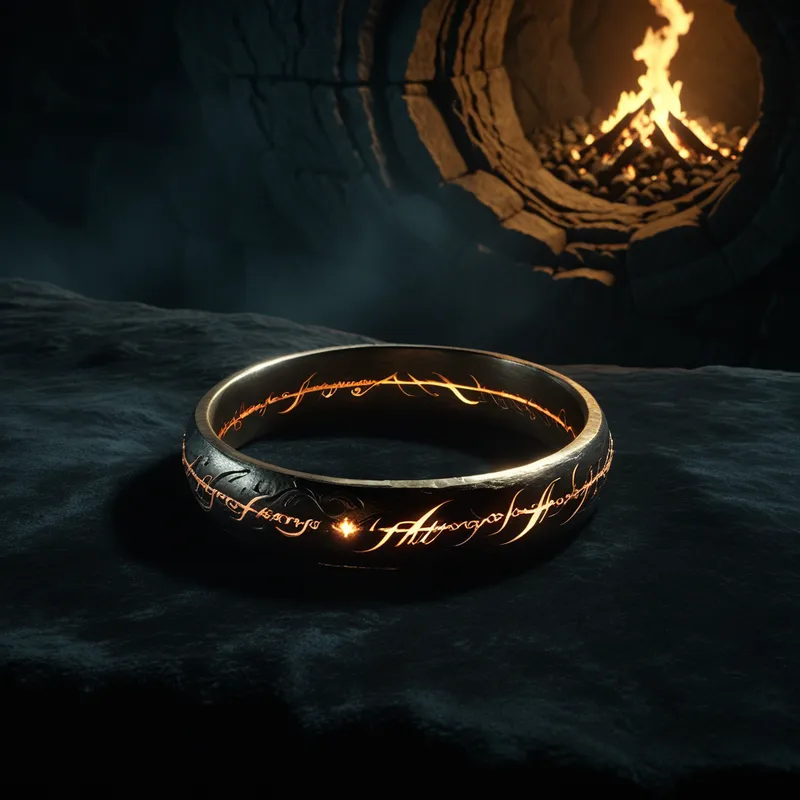
Listen now, and hear the tale of the Great Ring, the Ruling Ring, the burden of all the world. It began not with a hero, but with a shadow. In the deeps of time, in the land of Mordor, the Dark Lord Sauron, in his cunning and his pride, forged a master ring. Into this circle of gold he poured his cruelty, his will to dominate, and a great part of his own spirit. And while this Ring endured, so too would he. It was the One Ring to rule them all, and its secret fire and hidden script bound the wills of all who wore the lesser rings of power.
For an age, it was lost, cut from his hand in a great battle, and the world breathed easier, though the shadow never fully lifted. It fell into the hands of a simple creature, Sméagol, who coveted its beauty and was twisted by its whisper. He became Gollum, a thing of slime and stone, nursing his "precious" in the mountain's roots for centuries uncounted. The Ring desired to be found, and so it was, by another of the simple folk, the Hobbit Frodo Baggins.
And so the burden passed. A council of the wise—Elves, Men, a Dwarf, and a Wizard—saw the doom that approached. The Ring could not be used, only destroyed, and that meant a journey into the very heart of the Shadow, to the fire-mountain Orodruin, where it was made. A Fellowship was formed, a fragile company of nine, to bear the Ring-bearer on his hopeless quest.
Feel the weight of it. The air grows thin in the high passes of Caradhras. The silence of the Mines of Moria is a physical pressure, broken only by the drip of water and the distant drum-beat of doom. Witness the fall of the Wizard Gandalf into shadow, a sacrifice to hold back the terror. The Fellowship shattered by betrayal and loss, until only the Ring-bearer and his most loyal friend, Samwise Gamgee, trudged on, guided and hunted by the wretched Gollum.
The land itself became a enemy—the dead marshes with their corpse-candles, the bleak plains of Gorgoroth under an ash-choked sky. The Ring grew heavier with every step, not in the hand, but in the soul. It whispered promises of strength, of a kingdom where Frodo would be a just and powerful king. It showed him visions of a world remade under his order. It fed on his fear and his hunger, until the very mission to destroy it became a torment, a war within his own heart.
At the last, upon the narrow ledge overlooking the Crack of Doom, the final battle was not with armies or monsters, but with the self. The Ring claimed its bearer utterly. "I have come," Frodo said, his voice not his own. "But I do not choose now to do what I came to do. The Ring is mine!" And in that moment of ultimate failure, of possession, the quest was completed by the very corruption that had dogged their steps—Gollum's desperate, final lunge to reclaim his treasure. With a shriek, both Ring and creature fell into the consuming fire. A great tremor shook the world, a wave of silence, then a roar as the tower of the Dark Lord crumbled into dust. The shadow passed. The burden was lifted. But the bearer was forever marked, wounded not by blade, but by the slow poison of absolute power.
Cultural Origins & Context
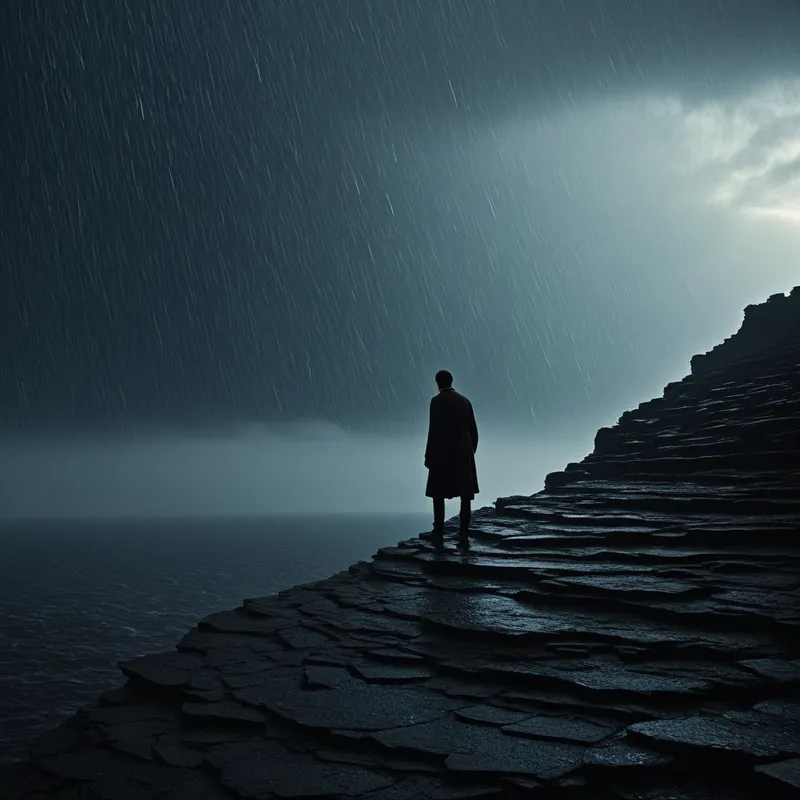
This is not a myth from the forgotten past of our primary world, but a foundational myth from the intricate, secondary world of Middle-earth, meticulously authored by J.R.R. Tolkien. He crafted it not as a mere novel, but as an elaborate pseudo-history, a "legendarium" for England. The tale of the Ring is the culminating narrative of his Silmarillion and The Lord of the Rings, presented as a redaction of the "Red Book of Westmarch," a Hobbit-written chronicle.
Its societal function within the fiction is that of a foundational trauma and triumph, the defining event of the Third Age. For the cultures of Middle-earth—the fading Elves, the resurgent Kingdom of Men, the secluded Hobbits—it is a story of a collective near-extinction and a hard-won renewal. It is a warning passed down: that power, even sought for good, carries a deadly flaw. It is told in halls, by firesides, and in songs, serving as a cultural anchor for humility and vigilance. In our world, it functions similarly, having escaped its textual bounds to become a modern global myth, a shared story that provides a framework for understanding the perennial temptations of power, corruption, and the nature of evil.
Symbolic Architecture
At its core, the Ring is the perfect symbol of instrumental power—power as a means to an end, divorced from ethics. It is the ultimate Shadow object, reflecting and amplifying the latent darkness in every heart that beholds it.
The Ring does not create evil; it unveils it. It is a mirror held up to the soul, showing not your face, but the face of what you could become with the means to impose your will upon the world.
The Fellowship represents the totality of the psyche embarking on a perilous process. Gandalf is the Senex, the guiding spirit. Aragorn is the latent King, the integrated Self in potential. Boromir is the ego tempted by the shadow, believing it can wield power for the good of the tribe. Frodo is the suffering consciousness, the ego chosen to bear the unbearable weight of the psyche's own destructive potential. Sam is the embodied, loyal Anima in its positive form, the connection to the simple, good earth that ultimately sustains life. Gollum is the fully realized shadow, the ego utterly consumed and deformed by its obsession, a necessary and tragic part of the whole.
The journey to Mordor is the journey into the underworld of the self, a necessary Nekyia. The goal is not to wield the power (the Ring), but to relinquish it—a psychological act of unparalleled difficulty, representing the renunciation of the ego's inflation and its desire for total control.
The Dreamer's Resonance
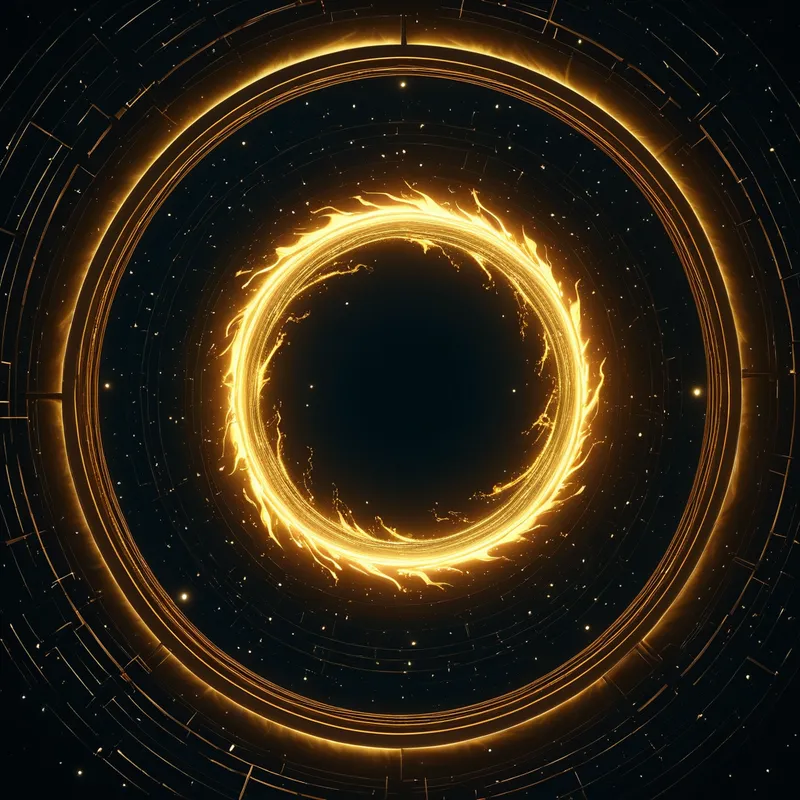
When this myth stirs in the modern dreamer, it often manifests not as literal rings or Hobbits, but as a somatic and emotional pattern. The dreamer may find themselves carrying a secret object of immense, troubling value. They may be on a forced journey to a dreaded destination, accompanied by a small, loyal companion (the Sam-function) or haunted by a wretched, whispering presence (the Gollum/shadow).
The somatic experience is key: a profound, increasing weight. The dream-body feels heavy, sluggish, burdened. This is the psyche signaling an unbearable moral or emotional load—a responsibility, a guilt, a hidden ambition, or a toxic identification with a role or goal that is consuming the authentic self. The whispering promises in the dream are the seductive logic of the ego-shadow alliance: "Take this power. Use it to fix your life, to control your world, to finally be safe and significant." The dream is a stage for the central conflict: the conscious self's mission (to be free, to be whole) versus the shadow's claim ("It is mine!").
Alchemical Translation
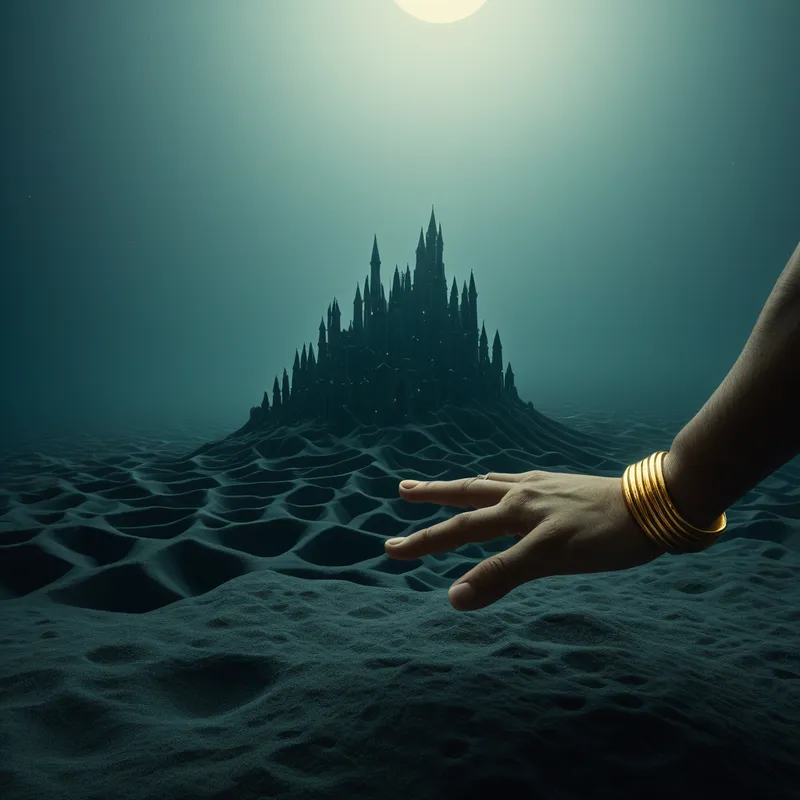
The myth of the Ring is a grand allegory for the alchemical process of Individuation, specifically its most harrowing stage: the confrontation with and integration of the shadow. The forging of the Ring is the primal act of Separatio, where a part of the spirit (Sauron's) is concretized into a fixed, dominant form—the inflated ego-complex.
The quest is the long Calcinatio and Solutio. The ego (Frodo) must voluntarily carry this toxic, inflated complex (the Ring) into the deepest core of its own psychic reality (Mordor, the personal unconscious), suffering its corrosive influence without fully identifying with it. This is the "narrow path" where one must hold the tension of opposites: the desire for power and the need for renunciation.
The triumph is not in the ego's strength, but in its failure. The final act of destruction is achieved not by willpower, but by the intervention of the completely assimilated, tragic shadow (Gollum). This signifies that the integrated psyche does not "defeat" its dark side; it incorporates it, and in doing so, the destructive complex loses its autonomous, compulsive power and is rendered back to its elemental state.
The Scouring of the Shire, the final chapter, is the Rubedo—the application of the transformed self to the mundane world. The hero returns, but cannot stay, for the wound of transformation is too deep. He must pass over the sea, to the West, symbolizing the final integration of the conscious personality with the transpersonal, timeless layers of the Self. The Ring is destroyed, the tyranny of the absolute power complex is broken, and the psyche is freed—not for bliss, but for a quieter, more authentic, and deeply scarred wholeness.
Associated Symbols
Explore related symbols from the CaleaDream lexicon: