
The Mountain Hnitbjorg Myth Meaning & Symbolism
The god Odin embarks on a perilous, shapeshifting quest to steal the mead of poetry from the mountain fortress of the giant Suttungr.
The Tale of The Mountain Hnitbjorg
Listen, and hear of the mountain that was a vault, and the god who became a thief for the sake of a song. The air was cold, the kind that bites to the bone, in the land of the giants, the Jotnar. There stood Hnitbjorg, not a peak to be climbed, but a prison to be breached. Its walls were not of stone, but of a promise broken and a treasure hoarded.
Within its unyielding heart, in a chamber carved by greed, the giant Suttungr guarded his prize: Kvasir's Mead. This was no ordinary drink. It was the distilled blood of a being born from the spit of gods, fermented with honey, the very essence of all poetry and profound speech. Whoever drank it would become a skald or a scholar. Suttungr, in his might, cared not for verse, only for possession. He set his daughter, Gunnlod, as the living lock upon the door, a sentinel in the silent dark.
But a whisper can find a crack where a shout cannot. The whisperer was Odin, the Hanged God, who had already traded an eye for a drink from Mimir's Well. His hunger for wisdom was a ravening thing. He came not with thunder, but with cunning. In the guise of a weary traveler named Bolverkr, he tricked Suttungr's brother, inciting a feud that ended with Odin promising to retrieve the mead as a peace-offering.
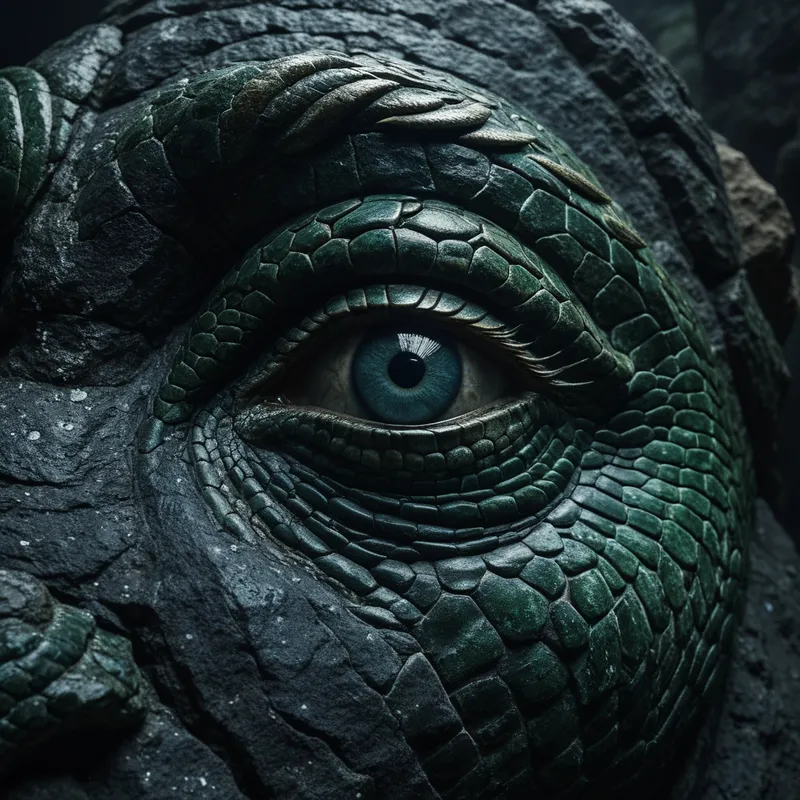
Thus he stood before the mountain, its sheer face offering no handhold. But Odin’s magic was the magic of becoming. From his belt, he took the Gungnir, not to strike, but to guide. He pressed his form against the cold stone, and his bones softened, his skin grew cool and scaled. He became a serpent, a slick, silent thread of life, and found the one fissure in all of Hnitbjorg, a vein of emptiness in the solid rock. For three nights he crawled through that stone intestine, the weight of the world above him, until he emerged, a man once more, in the chamber where Gunnlod kept her lonely vigil.
He did not fight her. He wooed her. For three more nights, he spoke with the voice of all the worlds he had seen, weaving a loneliness so profound that her guard became a gateway. He promised her his heart, and in the dim light, she believed him. For one night of love, for two, for three, she let him drink from the three great vessels—Odrerir, Bodn, and Son—draining each to the dregs. The mead, the stolen song, flooded into him.
Then, the transformation again. Not into a serpent, but into an eagle, a great, beating storm of feathers and purpose. He burst from the mountain’s throat, the mead within him a searing light. Behind him came Suttungr, also in eagle-form, a tempest of rage. The chase tore the sky. As Odin neared the walls of Asgard, he vomited the mead into waiting vessels. But in his desperate speed, a few drops fell backwards, spattering into the mortal world below. This, the poets say, is the source of bad poetry—the spillage of the gods. The rest was saved, secured in the divine realm, won not by strength, but by a terrible, shapeshifting sacrifice.
Cultural Origins & Context
This myth is preserved primarily in the Prose Edda of Snorri Sturluson, a scholar writing in Christianized Iceland but drawing from older skaldic traditions. Its function was twofold. For the skalds (poets), it was an etiological myth, a sacred explanation for the origin of their craft and its divine, intoxicating power. To invoke poetry was to channel a substance stolen from the giants by the Allfather himself, legitimizing the poet's role as a vessel of dangerous, hard-won wisdom.
On a societal level, the tale reflects core Norse values in a complex way. It celebrates cunning (seidr) and pragmatic sacrifice over brute force. Odin’s actions are morally ambiguous—he lies, betrays, and seduces—yet he does so for a prize that benefits gods and, indirectly, humanity. This mirrors the harsh pragmatism of the Viking Age, where survival and advantage often required fluid morality. The myth was told not as a simple parable of good versus evil, but as a testament to the price and power of numinous knowledge, and the lengths to which one must go to obtain it.
Symbolic Architecture
Hnitbjorg is not merely a mountain; it is the psychical structure of the defended complex. It represents any rigid, imprisoning system—be it a dogma, a trauma, a giant-sized ego, or a cultural inhibition—that holds a precious, life-giving resource captive. The mead is the intoxicating fluid of inspiration, the unintegrated creative potential or profound insight locked away in the unconscious, guarded by the shadow (Suttungr) and its often-lonely sentinel (Gunnlod), which can be a neglected aspect of the psyche yearning for connection.
The quest for wisdom is not an ascent, but an infiltration. It requires becoming small, flexible, and willing to traverse the dark, narrow passage of the unknown self.
Odin’s transformations are the key. To approach the fortress, he becomes the serpent, an ancient symbol of wisdom, healing, and the chthonic underworld of instinct. To win the guard, he becomes the lover, engaging the anima (the feminine inner figure) not with force but with relatedness. To escape with the prize, he becomes the eagle, the sovereign bird of spiritual height and perspective. The myth maps a complete psychic operation: descent, engagement, and triumphant integration.

The Dreamer's Resonance
When Hnitbjorg appears in a modern dream, it may manifest as an immense, unscalable cliff face, a sealed vault in a corporate building, or an impossibly complex lock on a door behind which a brilliant light shines. The dreamer often feels a potent mixture of longing and frustration. Somatic sensations might include constriction in the chest (the feeling of being walled in) or a dry throat (the thirst for the mead).
Psychologically, this dream signals a confrontation with a "walled-off" potential. The dreamer is facing a part of their own nature or a talent that has been rendered inaccessible, perhaps by past injury, societal conditioning, or self-imposed limitation. The giant guarding it is often a personification of a stubborn defense mechanism or an internalized critical voice. The dream is an invitation from the unconscious to stop trying to storm the walls directly, and to consider the Odinic path: cunning, adaptability, and a willingness to relate to the guardian, not just defeat it.

Alchemical Translation
The myth of Hnitbjorg is a perfect allegory for the alchemical process of individuation, the Jungian journey toward psychic wholeness. The prima materia—the raw, unconscious content—is the mead, the chaotic potential of the Self. The giant’s hoarding represents the nigredo, the blackening, where this potential is trapped in shadow and leads to a stagnant, fortified state of being.
Odin’s journey is the arduous work of the albedo and citrinitas, the whitening and yellowing. The serpentine descent into the mountain is a nekyia, a deliberate journey into the underworld of the psyche. The seduction of Gunnlod is the coniunctio, the sacred marriage with the anima, which makes the guarded treasure accessible. This engagement is crucial; one cannot simply steal from the unconscious, one must relate to it.
The final eagle transformation and escape is the rubedo, the reddening. The integrated wisdom, now consciously held, allows for a transcendent perspective and the ability to bring the treasure back to the "community" of the conscious mind.
The spilled drops acknowledge that not all of this process is neat or perfect. Some raw material remains unintegrated, becoming the "bad poetry" of our lives—the neuroses, slips, and creative failures. But the core achievement stands. For the modern individual, the myth teaches that accessing our deepest inspiration or wisdom requires us to be shape-shifters: to humble ourselves, to engage our inner world with cunning and compassion, and to finally take flight with a hard-won prize that transforms not just us, but the world we bring it into.
Associated Symbols
Explore related symbols from the CaleaDream lexicon: