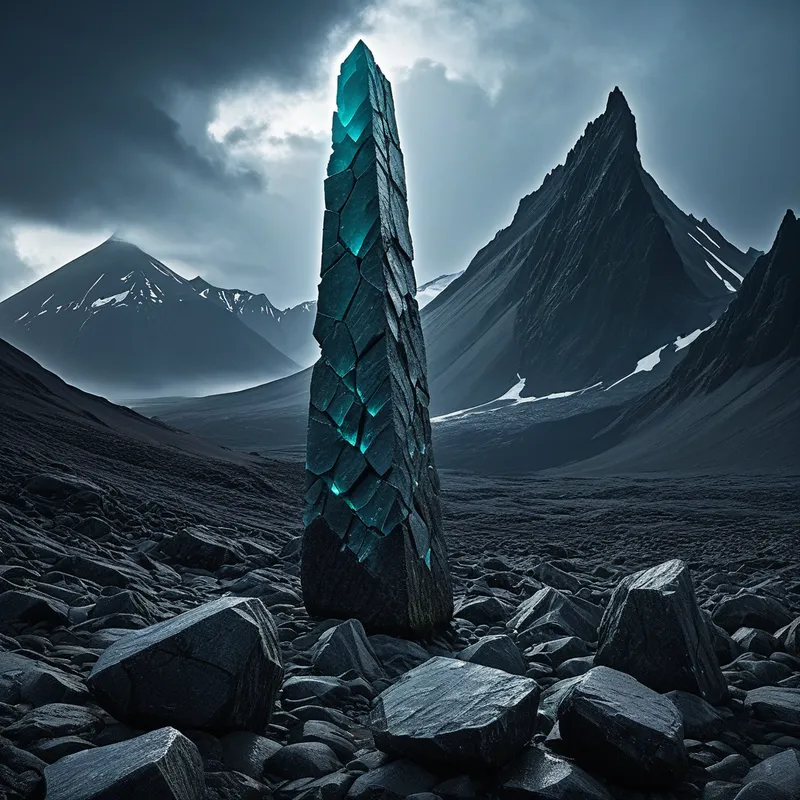
Jotnar Myth Meaning & Symbolism
The Jotnar are the primal giants of Norse myth, representing the chaotic, untamed forces of nature and the unconscious that the gods must engage to shape the world.
The Tale of Jotnar
Listen. Before the sun knew its path and the moon its hiding place, there was the Ginnungagap, the yawning void. And from the meeting of elemental fires and elemental ice in that abyss, the first life stirred. Not the sleek gods of later tales, but the Jotnar. Ymir was their forefather, a being of rime and rage, and from his sleeping body the world itself was carved.
Their breath was the wind that scours stone. Their blood became the salt sea. Their bones became the mountains, and their scattered thoughts the clouds that race across the sky. They were the landscape given hunger and intent. When the first gods, Odin and his kin, slew Ymir to fashion the world from his corpse, they did not end the Jotnar. They merely made them neighbors, pushed them to the edges of the ordered realms—to Jotunheim, a place of crushing glaciers, deep forests where no paths hold, and mountains that grind against the sky.
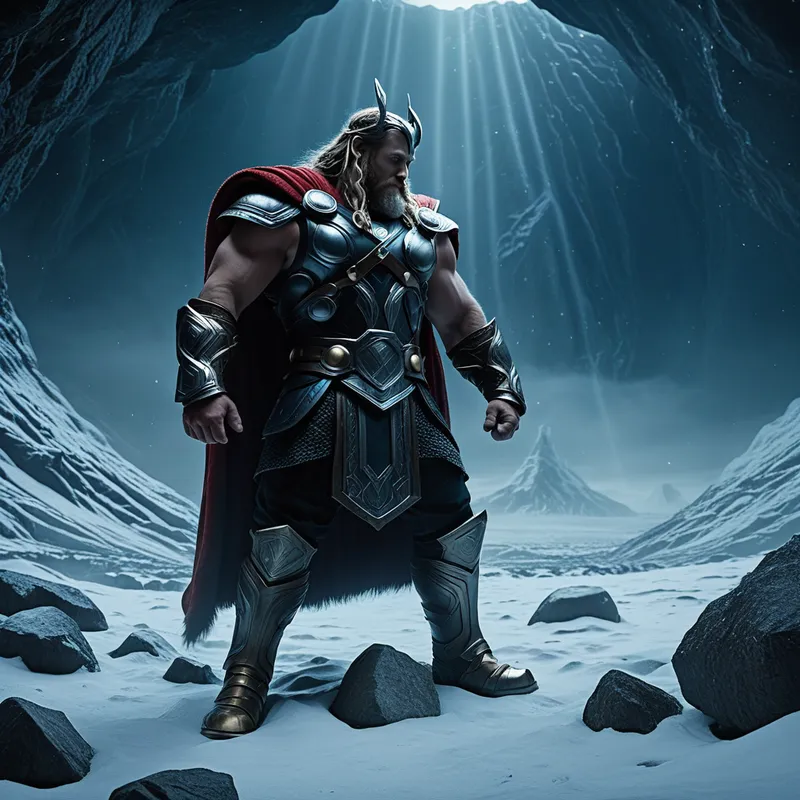
The gods built their walls around Asgard, but the Jotnar are the walls. They are the frost that tests the hearth, the landslide that swallows the road, the wave that drowns the shore. They are not mere enemies; they are the other half of a necessary conversation. Thor rides out in his chariot, the lightning his hammer's herald, not to exterminate them, but to wrestle with the world's own wildness. He tests his strength against the mountain that walks, Hrungnir, and in the shattering of that stone giant, the very earth trembles.
And the gods seek them out, too. For wisdom lies in the deep places. Odin, the All-Father, journeys to the well at the roots of the Yggdrasil, guarded by the head of the wisest of giants, Mimir, to drink from waters of memory and fate. The great trickster Loki is himself born of Jotun blood, a chaos that lives within the gods' own halls. He brings them both terrible grief and indispensable cunning, for the line between destruction and invention is drawn by a Jotun's hand.
The final conflict, Ragnarok, is not a war of good against evil. It is the world's fever breaking. The great wolf Fenrir, the world-serpent Jormungandr—these are Jotun-spawn, children of chaos, who rise from their bonds. They meet the gods on the final plain, and in that cataclysm, fire and ice, order and chaos, god and giant, all consume each other. From that ash, the sagas whisper, a new and green world will emerge, born from the same hidden seed.
Cultural Origins & Context
These stories were not scripture, but living breath in the longhouses of the Viking Age. They were the province of skalds—poet-historians who wielded complex meters like weapons—and of everyday folk explaining why the winter was so cruel or why the earth shook. The myths were recorded later, primarily in 13th-century Iceland, in texts like the Poetic Edda and the Prose Edda by Snorri Sturluson.
Their function was multifaceted. On one hand, they modeled a worldview for a people living at the mercy of a magnificent and brutal environment. The Jotnar personified the very real, existential threats of famine, storm, and isolation. On the other, they provided a cosmological map. The world was not a safe garden but a middle realm, Midgard, carved from a giant and perpetually bordered by the forces that formed it. The myths taught engagement, not naive optimism. Survival and prosperity required the strength of Thor, the cunning of Loki, and the wisdom of Odin—all qualities honed against and sometimes learned from the Jotnar.
Symbolic Architecture
The Jotnar are the ultimate symbol of the untamed, unconscious foundation of reality. They are not "evil" in a moral sense, but they are antithetical to order, structure, and conscious identity. They represent the raw, undifferentiated potential from which the ego (the gods) must differentiate itself to exist.
The giant is the psychic bedrock, the unprocessed mass of instinct, trauma, and creative potential that precedes and underlies the conscious personality.
In psychological terms, they are the contents of the collective unconscious—the archaic, autonomous psychic forces that surge up unbidden. Thor's endless battles are the ego's necessary, exhausting work of confronting these forces, of trying to impose conscious will on the unconscious tumult. Loki represents the dangerous truth that these chaotic forces are not always external; they are an intrinsic part of the psyche, a necessary shadow that provides fluidity and innovation, but at the risk of total dissolution.
The Jotnar also symbolize the irreducible "Other." They are the wilderness that will not be farmed, the emotion that will not be rationalized, the creative idea that shatters convention. The gods' frequent intermarriage and dealings with them show that consciousness cannot exist in a pure state; it must negotiate, trade, and even integrate with this otherness to be whole.
The Dreamer's Resonance
When the pattern of the Jotnar stirs in modern dreams, it manifests as an encounter with overwhelming, impersonal force. This is not a dream of a personal enemy, but of a tidal wave, an avalanche, a vast shadow that blots out the sky, or a figure of immense, geological scale. The somatic experience is one of profound awe, dread, and a feeling of insignificance.
Psychologically, the dreamer is facing an upwelling from the deepest strata of the psyche. It could be a long-repressed emotional complex (a "giant" of rage or grief), a tidal shift in life direction that feels destructive to the old self, or the raw, frightening potential of a new creative or spiritual beginning that demands the death of current structures. The dream is an announcement: a force has been activated that your conscious identity cannot manage with its usual tools. The ego is being confronted with its own smallness in the face of the psyche's totality.
Alchemical Translation
The alchemical work modeled by the Jotnar myth is the nigredo—the blackening, the confrontation with the primal matter, the massa confusa. Individuation does not begin with light, but with an honest acknowledgment of this inner chaos and darkness. The giant is the unrefined ore of the Self.
The triumph is not in slaying the giant, but in enduring its gaze and learning its language. The goal is not victory, but a transformed relationship.
Thor's approach—direct confrontation—is a necessary first stage. The ego must develop strength and boundaries. But Odin's path is the next: seeking out the severed head of Mimir, he sacrifices his eye (a one-sided, solar consciousness) for a drink from the well of the giant (the waters of the unconscious). This is the act of trading certainty for depth, of allowing the chaotic, "giant" part of the psyche to become an oracle.
For the modern individual, this translates to the difficult work of shadow integration. It means stopping the project of trying to "kill" one's chaotic emotions, irrational fears, or wild creativity. Instead, it involves journeying to the edges of one's ordered self (Midgard), facing these Jotnar-aspects, and asking, as Odin did, what wisdom they guard. The creative outburst, the midlife crisis, the depressive collapse—each can be a Jotunn appearing at the wall. The psychic transmutation occurs when we cease seeing it purely as an enemy to be defeated and begin to recognize it as the raw material of the world-to-come, the necessary chaos from which a more authentic, resilient, and complete self can be slowly, painfully, and magnificently reborn.
Associated Symbols
Explore related symbols from the CaleaDream lexicon: