The Mo'o Water Dragons
Shape-shifting water dragons in Hawaiian mythology who guard freshwater sources, appearing as both beautiful women and terrifying reptiles.
The Tale of The Mo’o Water Dragons
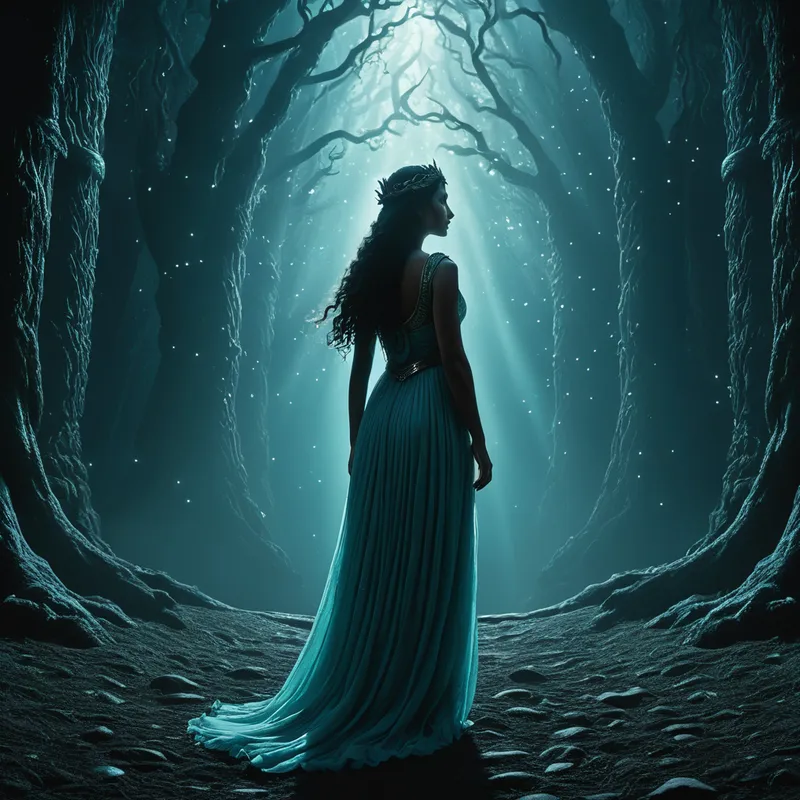
In the deep, shadowed pools of the island’s heart, where the ‘auwai ([water](/myths/water “Myth from Chinese culture.”/) channels) whisper secrets to the stone, the Mo’o dwell. They are not mere monsters of lore but ancient, sentient currents given form, the living memory of the water itself. One such tale speaks of a Mo’o named Kihawahine, who made her home in the pond of Moku‘ula on Maui. To the people, she was a fearsome guardian, a massive reptilian [dragon](/myths/dragon “Myth from Chinese culture.”/) whose scales shimmered like wet obsidian in the sun. Yet she possessed a profound duality. She could shed her formidable skin and walk among humans as a woman of breathtaking beauty, her hair the color of deep [water](/myths/water “Myth from Chinese culture.”/), her eyes holding the stillness of a mountain pool.
Her story is woven with the fate of the chiefs. It is said she became a revered ‘aumakua, a familial guardian spirit, for the royal line of Maui. In her human form, she offered counsel and warnings, her presence a blessing upon the land so long as she was respected. But the Mo’o’s nature is tied intrinsically to their domain—the freshwater springs, the fishponds, the hidden caves where water gathers. A Mo’o’s power and very being are the water; to pollute it, to divert it selfishly, or to show disrespect at its source is to invite a terrifying transformation. The beautiful woman’s skin would ripple and darken, her form elongating into the powerful, coiling body of [the dragon](/myths/the-dragon “Myth from Chinese culture.”/). In this state, she was a force of primal retribution, capable of causing droughts or devastating floods, a reminder that the water of life could also become the water of [death](/myths/death “Myth from Tarot culture.”/).
Other Mo’o, like the one said to reside in the waterfall at Waimea on O’ahu, were known to test travelers. Appearing as a distressed maiden by the pool, she would ask for help or for food. To share one’s fish or poi with humility was to pass a test of the heart, often rewarded with safe passage or a hidden blessing. To refuse with arrogance was to see the maiden vanish, replaced by a churning in the pool and the emergence of a vast, hungry jaw. The Mo’o did not merely guard water as a resource; they guarded the sacred [covenant](/myths/covenant “Myth from Christian culture.”/) between the people and the land, the reciprocal flow of respect and sustenance.
Cultural Origins & Context
The Mo’o are not imported legends but autochthonous beings, born from the Hawaiian landscape and its understanding of life. In the Hawaiian worldview, all natural phenomena and familial lineages are connected through mana. Fresh water, the most precious and life-giving resource on the islands, possesses immense mana. The Mo’o are the personification of that mana—the conscious, watchful spirit of the springs and streams.
They occupy a unique space in the spirit hierarchy. They are often classified as kupua: extraordinary beings with shape-shifting abilities and dual natures, neither wholly god (akua) nor human, but something powerfully in-between. As ‘aumakua, specific Mo’o could be called upon for protection and guidance, linking them directly to the genealogical and spiritual identity of a family. This relationship was deeply practical and sacred; caring for the Mo’o’s water source was an act of filial piety, ensuring the family’s health and the land’s fertility.
Archaeologically, their presence is etched into the landscape. Sacred stones near springs, often called pōhaku o Kāne (stones of Kāne, god of life and fresh water), were sometimes seen as their resting places or manifestations. The tales served as ecological and social law, using the awe of the Mo’o to protect vulnerable watersheds from overuse and to codify the understanding that survival depended on a humble, reciprocal relationship with nature’s most vital elements.
Symbolic Architecture
The Mo’o is a master [symbol](/symbols/symbol “Symbol: A symbol can represent an idea, concept, or belief, serving as a powerful tool for communication and understanding.”/) of liminality—[the threshold](/myths/the-threshold “Myth from Folklore culture.”/) state where opposites meet and are held in [tension](/symbols/tension “Symbol: A state of mental or emotional strain, often manifesting physically as tightness, pressure, or unease, signaling unresolved conflict or anticipation.”/). It embodies the seamless flow between [human](/symbols/human “Symbol: The symbol of a human represents individuality, complexity of emotions, and social relationships.”/) and reptile, [beauty](/symbols/beauty “Symbol: This symbol embodies aesthetics, harmony, and the appreciation of life’s finer qualities.”/) and [terror](/symbols/terror “Symbol: An overwhelming, primal fear that paralyzes and signals extreme threat, often linked to survival instincts or deep psychological trauma.”/), nurturance and destruction, [life](/symbols/life “Symbol: The symbol of ‘Life’ represents a journey of growth, interconnectedness, and existential meaning, encompassing both the joys and challenges that define human experience.”/)-giving [water](/symbols/water “Symbol: Water symbolizes the subconscious mind, emotions, and the flow of life, representing both cleansing and creation.”/) and drowning flood. This is not a contradiction but a complete [picture](/symbols/picture “Symbol: A picture in a dream often symbolizes one’s perceptions, memories, or the desire to capture and preserve moments in time.”/) of a profound natural force.
The Mo’o teaches that the guardian and the threat are one entity; the power that sustains you is the same power that can consume you, depending entirely on the quality of your relationship to it.
Psychologically, the Mo’o represents the autonomous, instinctual [psyche](/myths/psyche “Myth from Greek culture.”/)—the deep, often reptilian layers of the unconscious that hold vital life [energy](/symbols/energy “Symbol: Energy symbolizes vitality, motivation, and the drive that fuels actions and ambitions.”/) (libido, creativity, spiritual power). In its beautiful maiden form, this energy is integrated, approachable, and offers wisdom. When ignored, polluted, or disrespected, this same energy rises in its raw, untamed, and terrifying draconic form, demanding acknowledgment. The shape-shifting is a [metaphor](/symbols/metaphor “Symbol: A figure of speech where one thing represents another, often revealing hidden connections and deeper truths through symbolic comparison.”/) for how the unconscious contents present themselves to the conscious mind: either as relatable, symbolic figures or as overwhelming, monstrous compulsions.
Furthermore, the Mo’o’s intimate bond with its specific pool or spring symbolizes the rootedness of psychic energy. Our deepest instincts and creative powers are not abstract; they are tied to specific places within us—memories, wounds, talents—and must be honored in their particularity. To neglect your “spring” is to risk the [dragon](/symbols/dragon “Symbol: Dragons are potent symbols of power, wisdom, and transformation, often embodying the duality of creation and destruction.”/)’s [wrath](/symbols/wrath “Symbol: Intense, often destructive anger representing repressed emotions, moral outrage, or survival instincts.”/).
The Dreamer’s Resonance
To encounter a Mo’o in the dreamscape is to stand at the brink of one’s own inner wellspring. Dreaming of the beautiful woman by the water may signal an invitation from the deeper self—an intuitive insight, a creative possibility, or a call to attend to one’s emotional and spiritual nourishment. She is the aspect of the unconscious that is willing to communicate, to form a relationship.
Dreaming of the dragon form, especially if it emerges from a once-calm pool, is a potent alarm from the psyche. It suggests that a vital source of life energy within the dreamer is being threatened, corrupted, or chronically ignored. This could manifest as a building rage, a deepening depression, or a somatic illness—the “dragon” rising to make its presence undeniably felt. The terror is not meant to destroy the dreamer but to force a confrontation with what has been neglected.
The act of the Mo’o testing the traveler is a classic dream motif of the psyche evaluating [the ego](/myths/the-ego “Myth from Jungian culture.”/)’s attitude. Are you approaching your own depths with humility and a willingness to share your resources (time, attention, respect), or with arrogance and a hoarding spirit? The dream’s outcome hinges on this inner posture. The Mo’o dream is ultimately about establishing right relationship with the powerful, ancient, and sometimes frightening sources of life within us.
Alchemical Translation
The alchemical process mirrored in the Mo’o myth is the [solve et coagula](/myths/solve-et-coagula “Myth from Alchemical culture.”/)—dissolve and coagulate. The Mo’o itself is the [prima materia](/myths/prima-materia “Myth from Alchemical culture.”/), the primal substance that holds all potential. Its constant shape-shifting between liquid (water guardian) and solid (dragon, woman, stone) embodies the alchemical fluidity necessary for transformation.
The dragon guarding the treasure at the spring is not merely an obstacle; it is the treasure in its unrefined, volatile state. The work is not to slay it, but to learn its language, to honor its home, and thereby to transmute its raw power into the elixir of consciousness.
The maiden form represents the [albedo](/myths/albedo “Myth from Alchemical culture.”/), the whitening—a state of clarity, reflection, and spiritualized understanding. The terrifying dragon is the [nigredo](/myths/nigredo “Myth from Alchemical culture.”/), the blackening—the necessary descent into the chaotic, dark, and putrefying aspects of [the self](/myths/the-self “Myth from Jungian culture.”/) to release the trapped spirit. The sacred spring is the vas, [the vessel](/myths/the-vessel “Myth from Alchemical culture.”/) where this inner work occurs. The goal is not to eliminate one state for the other, but to achieve the conjunctio oppositorum—[the sacred marriage](/myths/the-sacred-marriage “Myth from Various culture.”/) where the beautiful and the terrible, the human and the reptilian, are recognized as inseparable facets of a whole, regenerating self. To achieve this is to gain the protection and wisdom of the Mo’o as an ‘aumakua, an integrated guardian of one’s own soul.
Associated Symbols
Explore related symbols from the CaleaDream lexicon:
- Water — The primal element of life, emotion, and the unconscious, representing the fluid medium of the psyche where transformation occurs.
- Dragon — A powerful, ancient guardian of treasure or sacred knowledge, often representing the untamed, instinctual forces of nature and the self.
- Serpent — A symbol of cyclical time, healing, transformation, and the primal energy that moves through [the earth](/myths/the-earth “Myth from Hindu culture.”/) and the body.
- Transformation — The fundamental process of changing from one state of being to another, essential for growth, initiation, and alchemical renewal.
- Guardian — A protective entity or principle that defends a threshold, treasure, or sacred space, testing the worthiness of those who approach.
- Mirror — A surface for reflection and revelation, showing not only the outer appearance but also the hidden, often truer, aspects of the self or reality.
- Spring — A natural source of fresh water emerging from the earth, symbolizing the origin of life, renewal, and the spontaneous upwelling of spiritual or creative energy.
- Cave — A deep, enclosed space within the earth, representing [the womb](/myths/the-womb “Myth from Various culture.”/) of the unconscious, a place of introspection, initiation, and encounter with primal truths.
- Bridge — A structure connecting two separate realms, symbolizing transition, the link between consciousness and the unconscious, or the path of integration.
- Ritual — A prescribed set of symbolic actions performed to honor, invoke, or commune with deeper forces, establishing sacred order and relationship.
- Goddess — The divine feminine principle, embodying creativity, nature, sovereignty, and the cyclical powers of birth, death, and regeneration.
- Cascading Waterfall — Water in a state of powerful, continuous descent and flow, representing the release of emotion, spiritual cleansing, and the dynamic, unstoppable force of life.