The Me Divine Laws Myth Meaning & Symbolism
The story of how the goddess Inanna, through cunning and courage, brought the foundational principles of civilization from the god of wisdom to her city.
The Tale of The Me Divine Laws
In the time before time was counted, when the world was raw clay waiting for the seal of order, there existed the Me. They were not objects, but the very essences—the blueprints of kingship and the song of the lamentation priest, the craft of the scribe and the terror of the flood, the art of lovemaking and the dignity of the elder. All that makes a society more than a gathering of souls resided in these shimmering, intangible powers. They were held in the deep, in the Abzu, by Enki, the cunning lord of the sweet waters.
But in the great city of Uruk, a fire burned that was not content with what was given. Inanna, the Lady of Heaven, her heart a lion, her will a storm, looked upon her domain. She saw a city of potential, a people awaiting their destiny. To fulfill it, she needed the Me. She would not ask. She would take.
Dressed in her majesty, she journeyed to the Abzu, to the gleaming temple of Enki. The god of wisdom welcomed his daughter, his heart softened by her radiance. “Let us feast!” he proclaimed. In the glow of the feast, as the sweet beer flowed like the Tigris, Enki’s vigilance drowned in his own hospitality. Moved by her presence, he began to offer gifts. “In the name of my dignity, I give you the Me of the high priest!” he declared. “In the name of my power, I give you the Me of the hero!” One by one, in a drunken, generous stupor, he surrendered them: the Me of truth, of music, of carpentry, of the art of war. Over one hundred divine decrees passed from his lips to her being.
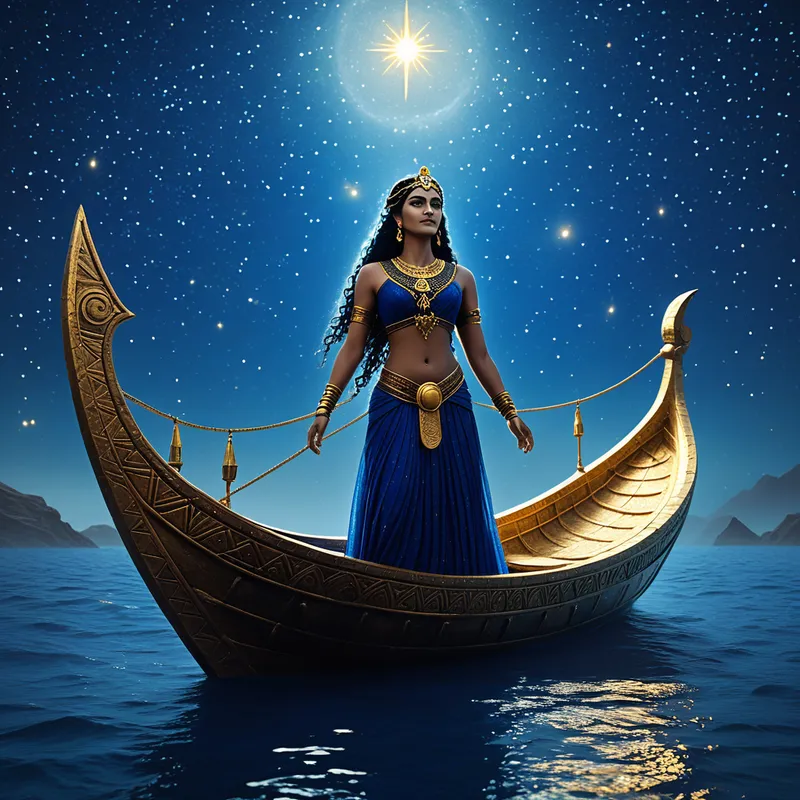
Inanna, sober and fierce, gathered each one. She did not tarry. She loaded them into her Boat of Heaven, and with her vizier Ninshubur, she set sail for Uruk. The waters of the Abzu churned in her wake.
When the dawn came and the fog of beer lifted from Enki’s mind, a cold clarity took its place. The Abzu felt empty. The Me were gone. A roar of betrayal shook the foundations. He summoned his minister, Isimud, and commanded pursuit. “Stop her! Bring back what is mine!” he thundered.
Thus began the great chase. From the depths of the Abzu to the canals of Sumer, Enki sent monstrous creations—the lahama of the deep, the galaturra of the reeds—to seize the Boat of Heaven. At each attack, Ninshubur stood firm, and Inanna commanded her boatman to press on, her cargo of destiny too precious to lose. The final monster, the mighty Ushumgalanna, rose from the Euphrates, its maw wide enough to swallow the sun. But Inanna, now transformed from guest to sovereign, faced it with the very power of the Me she carried. She was no longer just a goddess of desire; she was the embodiment of civilization’s might. The creature fell back.
She arrived at the quay of Uruk, and the people, sensing the shift in the world’s order, gathered. As she disembarked, she opened the containers. She did not hoard the Me in a temple vault. She poured them out into the heart of the city, into the streets and the homes, into the workshops and the palaces. The Me of music filled the air with the lyre’s song. The Me of justice settled upon the elders. The Me of rejoicing sparked festival in the square. Uruk was no longer just a city; it was now a living, breathing manifestation of cosmic order, won not by decree from above, but by daring from below.
Cultural Origins & Context
This myth, central to the identity of Uruk, comes to us from cuneiform tablets, most notably in the composition “Inanna and Enki.” It was not mere entertainment. It was a foundational charter, a divine explanation for why Uruk possessed the supreme attributes of civilization. In a culture where every aspect of life was seen as governed by divine principles, the story explained the transfer of cultural hegemony from Eridu (Enki’s cult center) to Uruk. It was likely recited during festivals, reinforcing civic pride and the legitimacy of the priesthood and monarchy who served as stewards of these Me. The tale validated Inanna’s often tumultuous, aggressive nature as essential to progress, framing rebellion not as chaos, but as the necessary catalyst for a new and higher order.
Symbolic Architecture
The Me represent the fundamental archetypal patterns that [structure](/symbols/structure “Symbol: Structure in dreams often symbolizes stability, organization, and the framework of one’s life, reflecting how one perceives their environment and personal life.”/) [reality](/symbols/reality “Symbol: Reality signifies the state of existence and perception, often reflecting one’s understanding of truth and life experiences.”/), both outer and inner. They are the psychic DNA of culture and [consciousness](/symbols/consciousness “Symbol: Consciousness represents the state of awareness and perception, encompassing thoughts, feelings, and experiences.”/).
To possess the Me is to move from potential to actuality, from chaos to cosmos. They are the invisible templates that make raw experience into meaningful life.
Inanna is the archetypal force of conscious will and desire for enlargement. She represents the part of the psyche that feels incomplete and strives for a more complex, empowered state of being. Her [journey](/symbols/journey “Symbol: A journey in dreams typically signifies adventure, growth, or a significant life transition.”/) is not one of physical combat, but of cunning and audacity—a psychological heist from the [depths](/symbols/depths “Symbol: Represents the subconscious, hidden emotions, or foundational aspects of the self, often linked to primal fears or profound truths.”/) of the unconscious.
Enki symbolizes the deep, unstructured wisdom of the unconscious. He holds all potential (the Me) but in a state of latent, undifferentiated soup. He is content with containment. His drunkenness is not mere vice, but a [symbol](/symbols/symbol “Symbol: A symbol can represent an idea, concept, or belief, serving as a powerful tool for communication and understanding.”/) of the unconscious state—generous but unguarded, creative but not self-aware. The theft is, paradoxically, a necessary act of [differentiation](/symbols/differentiation “Symbol: The process of distinguishing or separating parts of the self, emotions, or identity from a whole, often marking a developmental or psychological milestone.”/). Wisdom must be “stolen” from its primal repository by the conscious ego (Inanna) to be made active and useful in the world.
The Boat of [Heaven](/symbols/heaven “Symbol: A symbolic journey toward ultimate fulfillment, spiritual transcendence, or connection with the divine, often representing life’s highest aspirations.”/) is the [vessel](/symbols/vessel “Symbol: A container or structure that holds, transports, or protects something essential, representing the self, emotions, or life journey.”/) of the conscious self, tasked with transporting this precious, volatile cargo from the deep unconscious (Abzu) to the [realm](/symbols/realm “Symbol: The symbol of ‘Realm’ often signifies the boundaries of one’s consciousness, experiences, or emotional states, suggesting aspects of reality that are either explored or ignored.”/) of daylight consciousness (Uruk). The pursuing monsters are the regressive pulls of the unconscious, the fear of change, and the ego’s [terror](/symbols/terror “Symbol: An overwhelming, primal fear that paralyzes and signals extreme threat, often linked to survival instincts or deep psychological trauma.”/) of being overwhelmed by the [magnitude](/symbols/magnitude “Symbol: A measure of scale, intensity, or importance, often reflecting one’s perception of significance, impact, or overwhelming force in life.”/) of what it has taken on.
The Dreamer’s Resonance
When this myth stirs in the modern dreamer, it often signals a profound phase of psychic integration. Dreaming of stealing a powerful, forbidden artifact from a deep, watery place or a wise but sleeping authority figure points to the ego’s attempt to claim its own inherent authority and complexity. The dreamer may be undergoing a life transition—a career shift, an artistic awakening, a reclaiming of personal power—that requires them to “take” qualities they feel are held by others or by their own dormant potential.
Somatic sensations might include a feeling of thrilling audacity mixed with dread, the weight of a new responsibility, or the exhilaration of a successful escape. The chase sequences mirror anxiety dreams, reflecting the psyche’s resistance to this radical act of self-definition. The final act of “unpacking” the treasure in a familiar place (one’s dream-house or hometown) symbolizes the need to ground these new potentials into daily life, to make the internal shift externally real.
Alchemical Translation
The myth of the Me is a perfect allegory for the Jungian process of individuation—the journey toward becoming a whole, self-realized individual. The starting point is a feeling of lack or constraint (Uruk without the Me). The conscious self (Inanna) must dare to descend into the unconscious (the Abzu) and engage with its ruling principle (Enki), not in battle, but in a dynamic, tricky exchange.
The “theft” is the alchemical separatio: the extraction of specific, valuable elements from the undifferentiated mass of the unconscious.
The ego cannot create these fundamental principles (the Me) from nothing; they are innate, but buried. It must claim them. This act feels like rebellion against inner and outer authorities (“This is not my place,” “Who am I to have this power?”). The subsequent pursuit is the nigredo, the dark night of the soul, where the ego is tested by doubt, fear, and the temptation to return to a simpler, less responsible state.
Successfully bringing the cargo home is the albedo, the whitening. The new principles are purified through the ordeal. Finally, distributing the Me throughout Uruk is the rubedo, the reddening. It is the conscious integration and application of these archetypal powers into every facet of one’s personality and life. The individual does not just possess wisdom; they become a vessel through which the foundational laws of their own soul govern their world, creating inner—and ultimately outer—civilization.
Associated Symbols
Explore related symbols from the CaleaDream lexicon:
- Journey — The perilous voyage from the deep unconscious (Abzu) to the conscious city (Uruk), representing the essential transit required for psychological transformation.
- Water — The primordial, chaotic medium of the Abzu, symbolizing the unconscious mind from which all structured forms (the Me) must emerge.
- God — Represents Enki, the holder of latent wisdom and potential, the archetypal father of knowledge who must be creatively engaged, not merely obeyed.
- Goddess — Represents Inanna, the active, desiring, and sovereign feminine principle that drives the quest for greater complexity and empowered being.
- Boat — The Boat of Heaven, symbolizing the conscious ego or the constructed self, the necessary vessel for navigating the unconscious and carrying precious cargo.
- Law — The essence of the Me themselves, the intrinsic principles and decrees that bring order from chaos, both in society and in the individual psyche.
- Order — The ultimate goal of the myth; the state of cosmic and civic harmony achieved not through passive reception, but through active, daring acquisition.
- Rebel — The core archetype of Inanna’s action, embodying the necessary defiance of existing structures to initiate a new and more complete order.
- Trickster — The aspect of Inanna’s cunning and Enki’s drunken carelessness, highlighting the non-heroic, clever, and unpredictable means by which profound change occurs.
- Temple — The destination and repository; Uruk becomes a living temple of the Me, just as the integrated psyche becomes a sacred vessel for realized potential.
- Divine — The inherent quality of the Me and the actors; this is a drama of sacred forces, framing psychological development as a mythic, transcendent process.