The Mayan Underworld Xibalba
A treacherous underworld realm ruled by trickster death gods, where heroes faced impossible trials and cosmic order was tested.
The Tale of The Mayan Underworld Xibalba
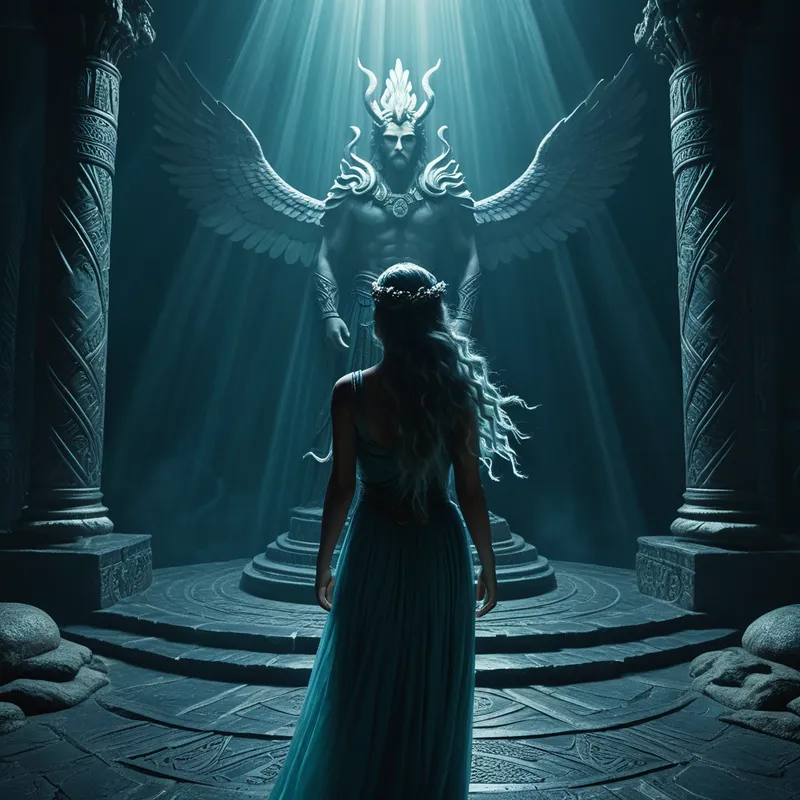
The descent does not begin in earth, but in a summons. The arrogant ballplayers, Hun [Hunahpu](/myths/hunahpu “Myth from Mayan culture.”/) and Vucub Hunahpu, lords of the surface world, heard the challenge echo from below. The lords of Xibalba invited them to a game. Drawn by pride, the brothers walked the steep, thorny road down into the gloom, crossing rivers of blood and pus, until they stood in the cold, damp halls of the [death](/myths/death “Myth from Tarot culture.”/) gods.
They were greeted not by monsters, but by polite deception. Wooden effigies sat upon the thrones. The brothers saluted these carvings, and the true lords, hidden in the shadows, erupted in cruel laughter. “You have been tricked!” they cackled. The first test was one of perception, and they had failed utterly. The lords offered them a bench to sit. It was a stone pitan, a heated cooking slab, and they burned themselves, squirming in agony to the delight of their hosts. Then came the cigars and torches, offered not for comfort but as impossible trials: “Keep these lit through the night, but do not consume them.” In the dark, the cigars and torches were secretly extinguished. At dawn, the lords declared them failures.
For their failure in the games of illusion, the brothers were sacrificed. Their bodies were buried in the [ballcourt](/myths/ballcourt “Myth from Mesoamerican culture.”/) of Xibalba, save for Hun Hunahpu’s head, which was placed in a barren [calabash](/myths/calabash “Myth from African Diaspora culture.”/) tree. From this decapitated head, the tree bore fruit. The head spat into the hand of a daughter of a Xibalban lord, Ixquic, and she conceived. Thus, the Hero Twins, [Hunahpu and Xbalanque](/myths/hunahpu-and-xbalanque “Myth from Mesoamerican culture.”/), were born from [the underworld](/myths/the-underworld “Myth from Greek culture.”/)’s own treachery, seeds of vengeance planted in its heart.
The Twins, aware of their heritage and destiny, grew to master the surface world’s arts. When the Xibalban lords, sensing a new threat, summoned them as they had their father, the Twins embarked not in arrogance, but in cunning preparation. They sent an insect ahead to map the palace, learning the names and natures of each lord: One Death and Seven Death, the rulers; Pus Master and Jaundice Master; Bone Scepter and Skull Scepter; and the demonic owls, Hun Came and Vucub Came.
Armed with this knowledge, they turned the tricks back upon the tricksters. They did not salute the mannequins, but called each hidden lord by his true name, stripping them of their power of anonymity. When offered the burning bench, they declined, saying “It is just a heated stone for cooking, is it not?” They accepted the cigars and torches, but replaced them with fireflies and the red feathers of the macaw, creating the illusion of flame while consuming nothing. They survived the House of Gloom, the House of Knives, the House of Cold, the House of Jaguars, and the House of Fire, not by brute force, but by cleverness and the aid of animal allies.
Their final victory was an act of transcendent trickery. Allowing themselves to be sacrificed in the ballcourt, their bones ground and cast into a river, they performed the ultimate resurrection, emerging first as catfish, then as ragged vagabonds. As performers, they danced for the lords, magically sacrificing and restoring each other. Entranced, One Death and Seven Death begged, “Do it to us!” The Twins obliged, but left [the lords of Xibalba](/myths/the-lords-of-xibalba “Myth from Mesoamerican culture.”/) dead, unmade by their own desire for the spectacle of their power. The Twins did not destroy Xibalba itself—that was impossible—but they broke its dominion, humbled its rulers, and ascended to become the sun and [the moon](/myths/the-moon “Myth from Tarot culture.”/), imposing a new, fragile order upon the cosmos from the very realm that sought to consume all order.
Cultural Origins & Context
Xibalba’s mythos is rooted in the deep, animistic worldview of the Maya, for whom the cosmos was a living, layered entity. The Popol Vuh, the K’iche’ Maya creation narrative compiled in the colonial period, provides the most complete account. This was not a story of mere entertainment, but a sacred charter explaining the nature of reality, death, and the precariousness of human existence.
The Maya lived in a world where the boundaries between realms were porous. Caves (ch’een) were literal portals to Xibalba, and the night sky was its inverted mirror. [The ballgame](/myths/the-ballgame “Myth from Mesoamerican culture.”/) (pitz) was not sport, but a ritual reenactment of this cosmic struggle, with the court representing the liminal space between worlds and the rubber ball the wandering sun, threatened with descent into the [underworld](/myths/underworld “Myth from Greek culture.”/). The fate of the arrogant father-gods and the [triumph](/myths/triumph “Myth from Roman culture.”/) of the clever Twins articulated a core cultural value: intelligence, humility, and ritual knowledge triumph over brute strength and hubris. Xibalba was the ever-present shadow to the agricultural cycle, the fear of famine and disease (embodied by the sickly lords like Pus Master), and the ultimate test for the soul after death. To navigate it required not purity, but wit.
Symbolic Architecture
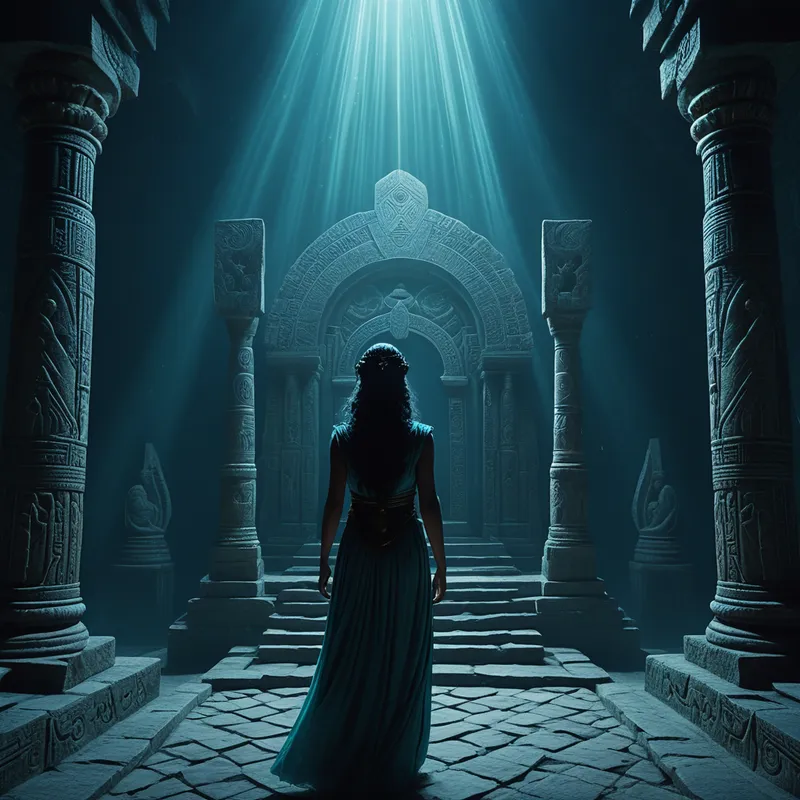
Xibalba is not a hell of [punishment](/symbols/punishment “Symbol: A dream symbol representing consequences for actions, often tied to guilt, societal rules, or internal moral conflicts.”/), but a [labyrinth](/symbols/labyrinth “Symbol: The labyrinth represents a complex journey, symbolizing the intricate path toward self-discovery and understanding one’s life’s direction.”/) of [consciousness](/symbols/consciousness “Symbol: Consciousness represents the state of awareness and perception, encompassing thoughts, feelings, and experiences.”/) designed to expose and exploit [the ego](/myths/the-ego “Myth from Jungian culture.”/)’s weaknesses. Its [architecture](/symbols/architecture “Symbol: Architecture in dreams often signifies structure, stability, and the framing of personal identity or life’s journey.”/) is psychological. The [path](/symbols/path “Symbol: The ‘path’ symbolizes a journey, choices, and the direction one’s life is taking, often representing individual growth and exploration.”/) down is one of increasing disorientation—the thorny road, the sensory assaults of the foul rivers. The [palace](/symbols/palace “Symbol: A palace symbolizes grandeur, authority, and the pursuit of one’s ambitions or dreams, often embodying a desire for stability and wealth.”/) itself is a [theater](/symbols/theater “Symbol: The theater represents the performance of life, creativity, and the exploration of one’s inner self through roles and narratives.”/) of [projection](/symbols/projection “Symbol: The unconscious act of attributing one’s own internal qualities, emotions, or shadow aspects onto external entities, people, or situations.”/), where what you see is never what is.
The wooden mannequins on the thrones are the ultimate trick: they represent the false self, the persona one presents to authority. To honor them is to be ensnared by one’s own projections and social facades. The true powers—the shadowy lords—remain unseen until one has the courage to name them directly.
The [series](/symbols/series “Symbol: A series in dreams can represent continuity, progression in life events, or the need for routine.”/) of houses—[Gloom](/symbols/gloom “Symbol: A pervasive emotional darkness or heaviness, often representing unresolved sadness, existential dread, or a subconscious processing of loss.”/), Knives, Cold, Jaguars, Fire—are not physical locations but states of being, chambers of existential [dread](/symbols/dread “Symbol: A profound, anticipatory fear of impending doom or catastrophe, often without a clear external threat. It manifests as a heavy, paralyzing emotional state.”/). To pass through the House of Cold is to endure the absolute [absence](/symbols/absence “Symbol: The state of something missing, void, or not present. Often signifies loss, potential, or existential questioning.”/) of [connection](/symbols/connection “Symbol: Connection symbolizes relationships, communication, and bonds among individuals.”/); to survive the House of Jaguars is to face untamed, predatory aspects of the [psyche](/myths/psyche “Myth from Greek culture.”/) without being devoured by them. The Twins succeed because they do not fight the houses on their own terms; they find the loophole in the [logic](/symbols/logic “Symbol: The principle of reasoning and rational thought, often representing order, structure, and intellectual clarity in dreams.”/) of each [nightmare](/symbols/nightmare “Symbol: Nightmares symbolize deep fears, unresolved anxiety, and emotional turmoil, often reflecting internal conflicts or stressors in waking life.”/), demonstrating that [the way](/myths/the-way “Myth from Taoist culture.”/) through a trap is to understand its [construction](/symbols/construction “Symbol: Construction symbolizes creation, building, and the process of change, often reflecting personal growth and the need to build a solid foundation.”/).
The Dreamer’s Resonance
To dream of Xibalba is to dream of the psyche’s own basement, where the unnamed lords of our personal underworld hold court. These are the aspects of self we have disowned: our hidden shames (Pus Master), our chronic irritations (Jaundice Master), our rigid judgments (Bone Scepter). The summons to descend often comes after a bout of hubris—a professional success, a moment of pride—that stirs [the shadow](/myths/the-shadow “Myth from Jungian culture.”/) into action.
The dream may present impossible tests: a car with no brakes, a speech for which you are unprepared, a labyrinthine bureaucracy. These are the modern Houses of Knives and Gloom. The Xibalban lesson for the dreamer is that the solution is never linear combat. It is the insect of subtle awareness that scouts ahead; it is the refusal to sit on the offered seat of heated opinion; it is the firefly of [inner light](/myths/inner-light “Myth from Buddhist culture.”/) that mimics compliance while preserving the core self. To overcome these dream trials is to integrate a piece of the shadow, not by defeating it in battle, but by outsmarting its rigid, repetitive logic.
Alchemical Translation
The alchemy of Xibalba is the [nigredo](/myths/nigredo “Myth from Alchemical culture.”/)—the blackening, the putrefaction—made sentient and cunning. It is the necessary dissolution of the naive ego (the father gods) so that a more conscious self (the Twins) can be born from its remains. The sacrifice in the ballcourt is not an end, but the grinding down of identity into its essential components, cast into [the river](/myths/the-river “Myth from Buddhist culture.”/) of the unconscious.
The Twins’ resurrection as catfish and vagabonds signifies the emergence of a new consciousness from the murky depths. This consciousness is fluid, adaptable, and humble in appearance. Its power lies in its ability to perform transformation as spectacle, to show death and rebirth as a dance, thereby enchanting and ultimately undoing the rigid, deathly authority that rules the underworld.
The final act, where the lords beg for their own destruction, is the ultimate alchemical revelation: the rulers of the shadow are addicted to their own patterns of control and spectacle. When one consciously enacts the transformative process for them, they are consumed by it, having no inner substance beyond their love of the trick. The liberated consciousness (the Twins) then ascends, carrying the integrated lessons of the underworld to illuminate the upper world.
Associated Symbols
Explore related symbols from the CaleaDream lexicon:
- Underworld — The realm of shadow, dissolution, and the unconscious, where the unintegrated aspects of [the self](/myths/the-self “Myth from Jungian culture.”/) hold court and demand recognition.
- Trickster — The archetypal force of disruption, cunning, and creative intelligence that subverts rigid order and exposes hidden truths through guile.
- Order — The imposed structure of reality, perpetually tested and renegotiated through its confrontation with [chaos](/myths/chaos “Myth from Greek culture.”/) and deception.
- Death — Not merely an end, but a transformative passage and a state of being ruled by lords who specialize in illusion and trial.
- [Labyrinth](/myths/labyrinth “Myth from Various culture.”/) — A complex, deceptive structure designed to disorient and test the seeker, mirroring the confusing halls and houses of Xibalba.
- Mirror — A surface of reflection and illusion, representing the deceptive nature of Xibalba’s reality and the need to see beyond false images.
- Sacrifice — The necessary surrender or dissolution of a former state, often through ritualized death, to enable transformation and rebirth.
- Rebirth — The emergence of a new, more conscious form from the ashes or bones of a sacrificed predecessor, as seen in the Hero Twins.
- Shadow — The hidden, disowned, or feared aspects of the self that reside in the personal underworld and manifest as antagonistic lords.
- Journey — The perilous descent and return, a fundamental ordeal that tests the traveler’s wit, resilience, and understanding.
- Mask — The false face or identity, like the wooden mannequins on the thrones, used to deceive and ensnare the unwary.
- Bone — The essential, enduring structure that remains after dissolution, capable of being ground down and reformed into new life.