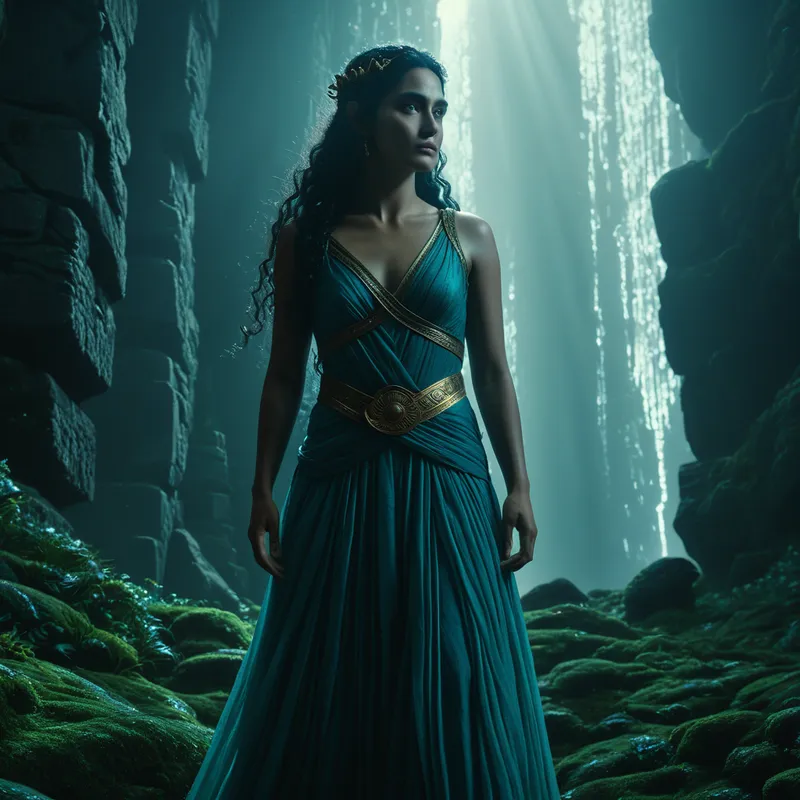
The Mammoth Underground God
A colossal deity of ice and earth worshipped in Siberian mythology, believed to dwell deep beneath the frozen tundra, embodying primal forces of nature.
The Tale of The Mammoth Underground God
In the time before time, when [the world](/myths/the-world “Myth from Tarot culture.”/) was a canvas of endless white and [the wind](/myths/the-wind “Myth from Various culture.”/) sang the only song, [the earth](/myths/the-earth “Myth from Hindu culture.”/) was not silent. Deep beneath the permafrost, in chambers of eternal ice and ancient stone, a presence stirred. It was not a presence of flesh, but of essence—a slow, tectonic dreaming. The people of the tundra, the Siberian tribes, knew this dreamer. They called it the Mammoth Underground God.
They said its body was the land itself: its great curved tusks were the stone ridges that broke the snow; its shaggy hide was the matted lichen and frozen peat; its breath was [the mist](/myths/the-mist “Myth from Celtic culture.”/) that rose from cracks in the ice on still mornings. It slept a sleep so deep that its dreams seeped upward, becoming the rivers that cut through the tundra and the strange, warm springs that bubbled in the dead of winter. In its slumber, it held the memory of a different world—a world of lush grasslands and temperate forests, a world it had shaped and then withdrawn from, carrying that green memory into the depths as the ice advanced.
The myth tells that the God did not die, but chose to descend. Seeing the great cold coming, a blanket to cover the earth, it gathered the seeds of life, the blueprints of beasts and plants, and withdrew into the sacred dark. There, it lay down, becoming both guardian and repository. Its immense form stabilized the world, its spine the central pillar upon which the tundra rested. To disturb its sleep was to risk the world’s balance; to honor it was to ensure the continuity of life.
Shamans, in their trance-states, would journey not to [the sky](/myths/the-sky “Myth from Persian culture.”/), but down, down through layers of frozen time. They spoke of encountering its vast, somnolent consciousness—a mind moving with the slowness of continents, thoughts as ponderous and grand as glacial advance. They learned that its heartbeat was the very pulse of the land, a low, infrasonic drum that the reindeer could feel through their hooves. The people did not build temples to this god; they recognized that the entire frozen expanse was its cathedral, and every step was upon its living form.
Cultural Origins & Context
The Mammoth Underground God is a profound synthesis of paleontological reality and spiritual insight, emerging from cultures for whom the mammoth was not an extinct curiosity but a tangible, almost contemporary presence. Across Siberia, from the Chukchi to the Yakut (Sakha), the frozen earth yielded mammoth tusks, teeth, and entire carcasses preserved in the permafrost. These were not mere bones; they were remains—physical proof of a colossal being that had simply gone into the earth.
This direct encounter with preserved giants fostered a mythology distinct from tales of purely fantastical beasts. The mammoth was understood as a creature of a previous world-order, a being so powerful it existed on the cusp of the natural and the divine. In the harsh, animistic world of Siberian shamanism, where every hill, river, and forest has a spirit, the largest and most ancient remains naturally suggested the greatest spirit. The permafrost was not a grave, but a layer between worlds; the mammoth was not dead, but dwelling.
The deity embodies the Cosmic Hunt in reverse—not a hunter in the sky, but the great prey that gave itself to the earth to sustain it. Rituals were often practical and reverent. The extraction of mammoth ivory, a vital resource, was preceded by offerings and apologies to the Underground God, acknowledging that one was taking a fragment of its body. It was a transaction with the divine, ensuring that the taking was balanced with respect, lest the God stir and cause the earth to tremble or the ice to crack unpredictably.
Symbolic Architecture
The myth constructs a powerful psychic [architecture](/symbols/architecture “Symbol: Architecture in dreams often signifies structure, stability, and the framing of personal identity or life’s journey.”/) where “below” is not a place of damnation, but of preservation, [memory](/symbols/memory “Symbol: Memory symbolizes the past, lessons learned, and the narratives we construct about our identities.”/), and latent potential. The God is a [paradox](/symbols/paradox “Symbol: A contradictory yet true concept that challenges logic and perception, often representing unresolved tensions or profound truths.”/): a [creator](/symbols/creator “Symbol: A figure representing ultimate origin, divine power, or profound authorship. Often embodies the source of existence, innovation, or personal destiny.”/) who has retreated into dormancy, holding the [blueprint](/symbols/blueprint “Symbol: A blueprint represents the foundational plan or design for something, often symbolizing potential, structure, and the mapping of one’s inner self or future.”/) for [life](/symbols/life “Symbol: The symbol of ‘Life’ represents a journey of growth, interconnectedness, and existential meaning, encompassing both the joys and challenges that define human experience.”/) within a [realm](/symbols/realm “Symbol: The symbol of ‘Realm’ often signifies the boundaries of one’s consciousness, experiences, or emotional states, suggesting aspects of reality that are either explored or ignored.”/) of apparent [death](/symbols/death “Symbol: Symbolizes transformation, endings, and new beginnings; often associated with fear of the unknown.”/) (ice and [stone](/symbols/stone “Symbol: In dreams, a stone often symbolizes strength, stability, and permanence, but it may also represent emotional burdens or obstacles that need to be acknowledged and processed.”/)). It represents the creative force in its potential state, the unmanifest held in perfect, frozen [stasis](/symbols/stasis “Symbol: A state of inactivity, equilibrium, or suspension where no change or progress occurs, often representing psychological or existential paralysis.”/).
This positions the Mammoth God as the ultimate vas bene clausum (well-sealed vessel) of alchemical tradition—the earth itself as the alchemical flask where the great work of preservation and transformation occurs beyond time.
Its [symbolism](/symbols/symbolism “Symbol: The use of symbols to represent ideas or qualities, often conveying deeper meanings beyond literal interpretation. In dreams, it’s the language of the unconscious.”/) directly challenges Western hierarchies of [spirit](/symbols/spirit “Symbol: Spirit symbolizes the essence of life, vitality, and the spiritual journey of the individual.”/). The supreme divine is not in a heavenly [zenith](/symbols/zenith “Symbol: The highest point in the sky or life’s peak moment, representing spiritual culmination, achievement, and divine connection.”/), but in a chthonic [nadir](/symbols/nadir “Symbol: The lowest point in the celestial sphere, representing profound spiritual descent, transformation, and the darkest moment before renewal.”/). The sacred is underfoot, in the dark and the cold, teaching that profound power and wisdom are often buried, awaiting [discovery](/symbols/discovery “Symbol: The act of finding something previously unknown, hidden, or lost, often representing personal growth, new opportunities, or hidden aspects of the self.”/), and that true [stability](/symbols/stability “Symbol: A state of firmness, balance, and resistance to change, often represented by solid objects, foundations, or steady tools.”/) comes from grounding, not ascending. The God’s sleep is not ignorance, but a profound, attentive rest—a [consciousness](/symbols/consciousness “Symbol: Consciousness represents the state of awareness and perception, encompassing thoughts, feelings, and experiences.”/) so expanded it encompasses geological time.
The Dreamer’s Resonance
Psychologically, the Mammoth Underground God is an archetypal image of the unconscious itself—vast, ancient, and structuring our world from beneath the surface of awareness. Its body is the somatic unconscious, the instinctual and ancestral memory stored in the very ground of our being. Its dreams, seeping upward as rivers and springs, are the intuitive insights, creative impulses, and archaic images that emerge into consciousness from the depths.
To encounter this God in a dream or vision is to confront the foundational layers of the [psyche](/myths/psyche “Myth from Greek culture.”/). It speaks to the parts of us that feel frozen in time, that carry the weight of ancestral legacy or personal history, and that hold immense potential in a state of dormancy. The myth suggests that psychological wholeness requires a respectful descent into this “frozen tundra” of [the self](/myths/the-self “Myth from Jungian culture.”/)—not to violently excavate, but to listen to the slow, tectonic movements of our deepest patterns and preserved traumas.
The God’s enduring sleep offers a model for relating to these depths. It is not a problem to be solved, but a presence to be acknowledged. Its stability allows for a life to be built above; [the ego](/myths/the-ego “Myth from Jungian culture.”/), like the people on the tundra, must learn to live in harmony with the sleeping giant below, recognizing that its stirrings (as anxiety, depression, or eruptive creativity) are natural movements of a larger psychic ecology.
Alchemical Translation
In the alchemical opus, the work begins with the [prima materia](/myths/prima-materia “Myth from Alchemical culture.”/)—the base, despised, and often hidden substance that contains the seed of the gold. The Mammoth Underground God is the perfect symbol for this initial stage. It is the massive, forgotten, “extinct” substance buried in the “earth” of the psyche. The alchemical process of [solutio](/myths/solutio “Myth from Alchemical culture.”/) (dissolution) is not represented by [water](/myths/water “Myth from Chinese culture.”/) here, but by a slow, psychic thaw—the gentle application of attention and warmth to these frozen depths to release the trapped energies and memories.
The goal is not to wake the God fully, which would be catastrophic (a psychic inflation or eruption), but to facilitate a gentle sublimation—allowing its “breath” (the warm springs of insight) to rise and nourish the conscious mind without disturbing the foundational stability.
The final stage, the [rubedo](/myths/rubedo “Myth from Alchemical culture.”/) or reddening, finds a unique expression here. It is not a flash of solar glory, but the slow, pervasive blush of life returning to the tundra—the hardy flowers that bloom in the brief summer. This is the gold: the integrated psyche where conscious life flourishes in full acknowledgment and harmony with the vast, sleeping, creative depth within. The gold is the enduring pattern of life itself, resurrected from the frozen archive.
Associated Symbols
Explore related symbols from the CaleaDream lexicon:
- Earth — The foundational substance and ultimate vessel; the body of the God and the medium that preserves and transforms all that is entrusted to it.
- Cave — The sacred interior, [the womb](/myths/the-womb “Myth from Various culture.”/) of the world where the divine sleeps; a place of initiation into the mysteries of the deep self.
- Dream — The active, generative state of the dormant deity; the medium through which latent forms and possibilities seep into the manifest world.
- Bone — The enduring structure, the fossilized memory; the literal and spiritual remains that testify to ancient life and provide framework for new growth.
- Underground — The realm of the potential, the repressed, and the foundational; the psychological and mythological basement where primal truths are stored.
- Seed — The encapsulated potential held in stasis within the frozen earth; the promise of future life preserved by the God’s vigil.
- Cyclic Nature — The understanding of creation, withdrawal, and eventual return; the God embodies the long cycle of geological and psychic eras.
- Mammoth Bone — A specific [talisman](/myths/talisman “Myth from Global culture.”/) of connection; a physical fragment of the divine body used to bridge the human world with the ancient, subterranean power.
- Stone — The most enduring aspect of the earth, representing permanence, stability, and the slow, patient consciousness of the deep world.
- Root — That which connects surface life to the nourishing, hidden source; the psychic and mythological structures that anchor being in the depths.
- Ground — The necessary foundation for all existence; the literal and psychological stability provided by the sleeping deity’s presence.
- Rebirth — The core promise of the myth; the emergence of life from the frozen archive, the return of what was preserved in the long sleep.