The Labors of Heracles Myth Meaning & Symbolism
A hero, driven mad by a goddess, must complete twelve impossible tasks to purify his soul and ascend from mortal suffering to divine status.
The Tale of The Labors of Heracles
Hear now the tale of a strength that became a curse, and a curse that forged a god. The air in the palace of Eurystheus was thick with fear and spite. Before the trembling king stood Heracles, son of Zeus, his frame a monument of muscle and recent madness. The scent of blood—his own wife’s and children’s, slain by his own hand in a fit of divine rage sent by Hera—still clung to him like a shroud. The Oracle’s decree was his only path from the abyss: ten years of servitude, ten impossible tasks to cleanse his soul.
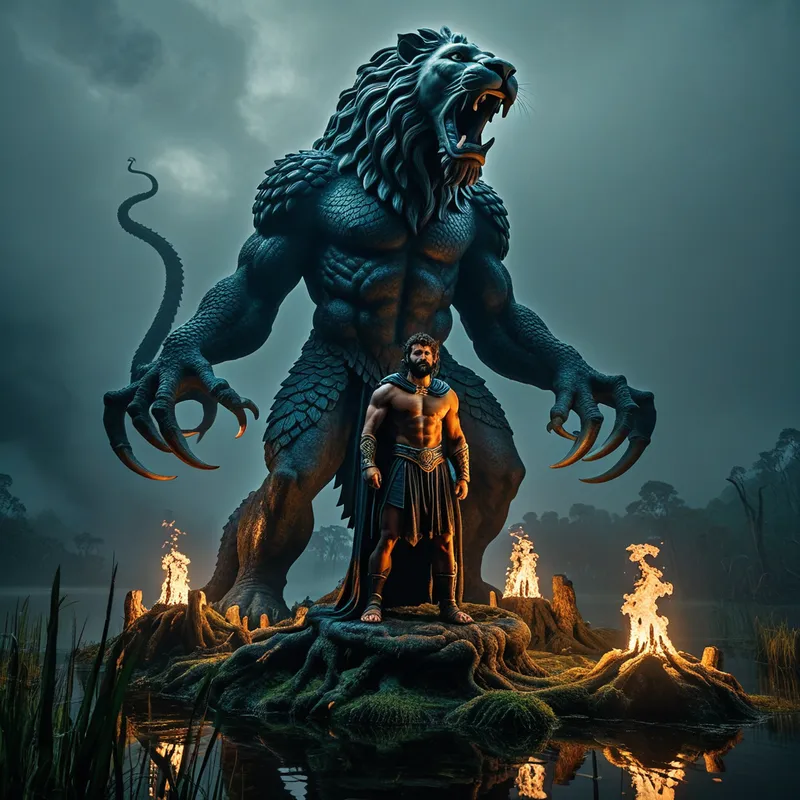
His first breath in the Nemean valley was met with a roar that shook the earth. The lion’s hide was impervious to bronze and iron. Heracles’s arrows fell useless. In the close, suffocating dark of its cave, man and beast became a single, snarling entity of struggle. When his club proved futile, his hands found the creature’s throat, and strength met invulnerability in a primal chokehold until the beast fell silent. From its pelt, he fashioned a second skin, a cloak of conquered fear.
Then came the Hydra of Lerna, a nightmare born in the swamp’s foul breath. For every head he crushed with his club, two more hissed into life, and a giant crab scuttled to aid the monster. The stench of marsh gas and venom filled his lungs. Despair was a colder poison than the Hydra’s own. Fire became his answer—searing the bloody necks to blackened stumps, burying the one immortal head beneath a mountain of stone. He dipped his arrows in the gall, and his weapons now carried the taint of death.
The labor followed labor, a geography of terror. He chased the Ceryneian Hind for a year, a pursuit not of violence but of exhausting reverence. He faced the Erymanthian Boar in deep winter snow, driving it into a drift to capture it alive. He diverted rivers to wash a lifetime of filth from the Augean Stables in a single day, a triumph of wit over brute force. He drove away the Stymphalian Birds with deafening bronze rattles, scattering them from their metallic nest.
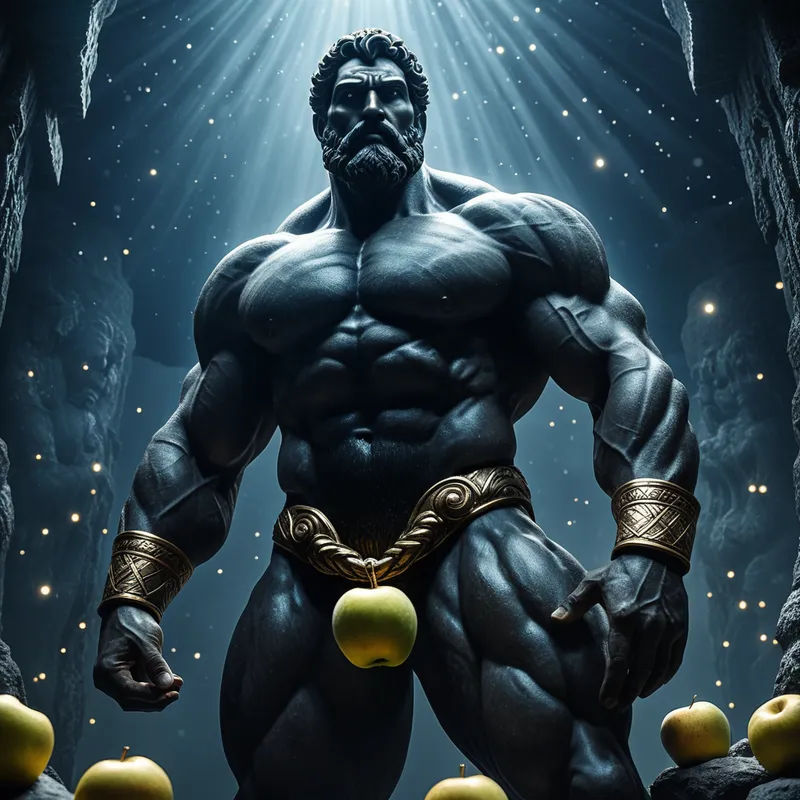
The world itself seemed to conspire against him. He descended into the sunless realm of Hades to leash Cerberus, feeling the chill of the dead on his skin. He journeyed to the edge of the world, where the titan Atlas held up the heavens, and for a moment, the crushing weight of the cosmos pressed upon his own shoulders so that he might obtain the golden apples of the Hesperides. Through fire, water, earth, and the realm of death, he moved, a man performing the work of destiny.
When the twelfth labor was done, and Cerberus was returned to the shadows, Heracles stood, not as a servant, but as something else. The blood-guilt was burned away in the fires of his trials. The man who had entered the service of a coward king had traversed the circumference of the known and unknown world. He was no longer just a son of Zeus; he had become, through suffering and unimaginable effort, a legend ready for the pyre and the stars.
Cultural Origins & Context
The myth of Heracles is a foundational pillar of Hellenic storytelling, with roots stretching back into the Mycenaean Bronze Age. Unlike the tightly woven narratives of Homer, the Heracles cycle is a sprawling, episodic tradition, likely amalgamated from local hero-cults and folktales across the Greek world. Bards and poets would have sung of his exploits in royal halls and public festivals, each recitation adding layers and regional variations. His figure served multiple societal functions: as a paragon of physical might and endurance (arete), as a symbol of the struggle against chaotic wild forces (embodied in the monsters), and as a deeply relatable figure of suffering and ultimate redemption. His apotheosis—his ascent to Olympus after death—offered a potent narrative of hope, suggesting that even the most burdened mortal could achieve a form of immortality through great deeds and the favor of the gods, a concept that resonated deeply in a culture keenly aware of human fragility.
Symbolic Architecture
The twelve labors are not a random checklist of monster-slaying. They represent a complete, alchemical curriculum for the heroic psyche. Heracles begins his journey in a state of miasma—ritual pollution and psychic disintegration from his unwitting crimes. The labors are his katharsis, his purification.
The hero’s journey is always an interior one; the monsters are the externalized forms of the unintegrated self.
The initial labors (Nemean Lion, Lernean Hydra) are confrontations with the raw, untamed shadow: brute aggression and regenerative, poisonous deceit. The middle labors often require a shift from pure force to strategy, endurance, and cleansing (the Hind, the Stables). The final labors push him beyond the human sphere entirely—to the feminine mysteries of the Girdle of Hippolyta, to the divine bounty of the Golden Apples, and finally into the underworld itself to face the ultimate fear of death in Cerberus. Each labor is a step in mastering a different aspect of the world and, by extension, the self. The iconic Nemean Lion’s pelt is the ultimate symbol of this process: he takes the attribute of his conquered foe (invulnerability) and makes it part of his own identity.
The Dreamer's Resonance
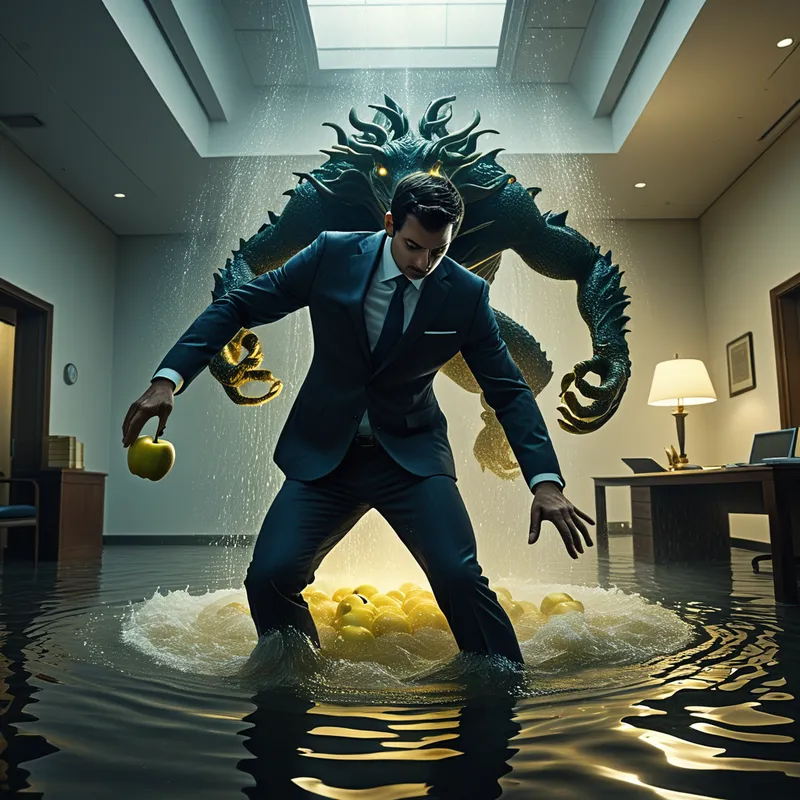
When the pattern of the Labors echoes in a modern dream, it signals a profound period of obligatory transformation. The dreamer is not embarking on a chosen adventure but is faced with a series of seemingly impossible, non-negotiable tasks. Dreaming of facing a multi-headed problem (a Hydra) that grows when attacked suggests feeling overwhelmed by a situation where every solution creates new complications. Wrestling a powerful, untouchable beast (the Lion) may reflect a struggle with one’s own anger, pride, or a seemingly impervious life challenge.
Somatically, this can feel like a heavy burden, a literal weight on the shoulders (Atlas’s duty), or the exhausting, year-long chase of an elusive goal (the Hind). The dream psyche is enacting the Heraclean ordeal: a deep, often painful process where the conscious ego is being broken down and rebuilt through relentless challenge. It is the psyche’s way of forcing a confrontation with aspects of life—or of the self—that have been avoided but must now be mastered for growth to occur.
Alchemical Translation
The alchemy of the Labors is a perfect map for the Jungian process of individuation. Heracles begins in a state of identification with his divine lineage and physical power, which leads to hubris and catastrophe (the murder of his family). This is the nigredo, the blackening, the descent into madness and guilt.
The labor is the crucible; the suffering is the fire; the transformed self is the philosopher’s stone.
The twelve tasks are the long, arduous stage of albedo and citrinitas—the whitening and yellowing. Each labor is a confrontation with a content of the unconscious (a complex, an archetype) that must be made conscious, wrestled with, and integrated. Capturing the Boar alive represents bringing a destructive, chthonic force under conscious control. Cleaning the Augean Stables symbolizes the necessary, often inglorious work of purging a lifetime of accumulated psychic filth and neglected duties.
The final labor, retrieving Cerberus from the underworld, is the ultimate rubedo, the reddening. It is the conscious descent into the deepest layers of the psyche, the confrontation with the primal guardian of the threshold between life and death, consciousness and the unconscious. By facing this ultimate fear and returning, Heracles achieves wholeness. He has mastered not just the outer world, but the entire spectrum of his inner world. His subsequent apotheosis is the symbolic result of this completed individuation: the mortal ego, having integrated the shadow and navigated the depths, is now capable of a timeless, symbolic existence. He is no longer a man plagued by passions, but a coherent, complete archetype—the Hero who has earned his place among the eternal principles of the psyche.
Associated Symbols
Explore related symbols from the CaleaDream lexicon: