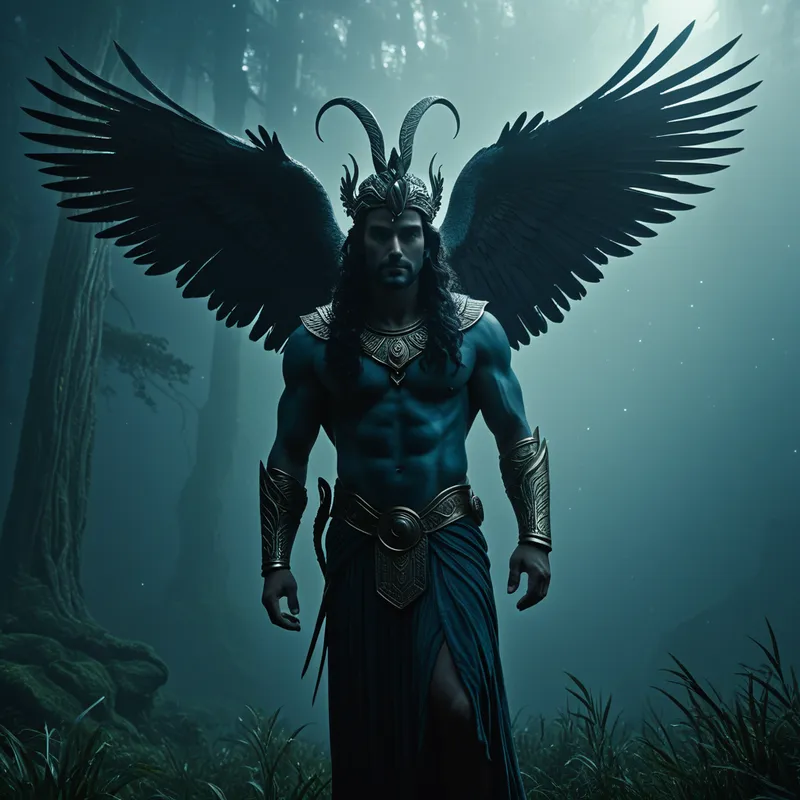
The Jinn in Islamic Cosmology
Mysterious beings of smokeless fire in Islamic tradition, possessing free will and existing in parallel to humanity, with their own societies and hidden influences.
The Tale of The Jinn in Islamic Cosmology
Before the first dawn broke upon [the world](/myths/the-world “Myth from Tarot culture.”/), before the clay of Adam was kneaded by divine hands, there existed another creation. From the scorching breath of a desert wind, from the heart of a smokeless fire, they were brought into being. They are [the Jinn](/myths/the-jinn “Myth from Pre-Islamic Arabian / Islamic culture.”/). Iblis, who would become their fallen prince, was among them, a being of such devotion that he ascended to the company of angels. Yet when the command came to bow before the newly fashioned human, a fire of pride and envy ignited within him. “I am made of superior fire,” he declared, “and he is of lowly clay. I shall not prostrate.” For this defiance, he was cast out, but not annihilated. His punishment was respite until the Final Day, and with him went a host of his kind, those who chose the path of arrogance and misguidance.
Thus began the eternal, parallel story of humanity and jinn. They walk the same earth, breathe the same air, yet inhabit a dimension just beyond [the veil](/myths/the-veil “Myth from Various culture.”/) of ordinary sight. They build kingdoms in the desolate wastes, in the ruins of forgotten places, and in the whispering depths of the untamed wild. They marry, bear children, form complex societies with kings and laws, and face the same ultimate choice: to submit to the Divine or to rebel.
Their interactions with humanity are the stuff of legend and whispered caution. A traveler, lost in the emptiness between dunes, might stumble upon a glittering palace that vanishes with the morning sun—a jinn celebration glimpsed for a moment. A poet, in a fever of inspiration, might find verses flowing unbidden, a gift or a trick from an unseen listener. But there is also the malevolent whisper that coils around the heart in moments of anger, the sudden shiver in a lonely place, the object that moves without cause. These are the works of the Shayateen, the devils from among the jinn, followers of Iblis, whose sole aim is to lead humanity astray.
Yet not all are adversaries. The Quran tells of a company of jinn who, upon hearing its recitation, were struck with awe and accepted faith, becoming believers and warners to their own kind. There are tales of [Solomon](/myths/solomon “Myth from Biblical culture.”/), granted dominion over [the wind](/myths/the-wind “Myth from Various culture.”/) and the jinn, who enlisted them in building his temple and fetching treasures from the deep. In these narratives, the jinn are not conquered, but compelled by a divine mandate, their immense power channeled through a prophet’s wisdom. The relationship is forever one of tension and possibility, a hidden dance of influence, test, and occasional, fragile [covenant](/myths/covenant “Myth from Christian culture.”/).
Cultural Origins & Context
The concept of the jinn is deeply rooted in the pre-Islamic Arabian worldview, where they were the capricious spirits of [the desert](/myths/the-desert “Myth from Biblical culture.”/), responsible for madness, poetic inspiration, and unexplained phenomena. Islam did not erase this belief but systematized and theologized it, integrating the jinn into a rigorous monotheistic framework. They were transformed from vague desert sprites into a distinct creation with a defined ontology and moral purpose.
In the Islamic cosmos, creation is tiered. Above are the angels, beings of pure light and obedience. Below are animals, driven by instinct. In between, sharing the middle world of [the earth](/myths/the-earth “Myth from Hindu culture.”/), are humanity and the jinn—the two rational, volitional creations burdened with free will and the consequent responsibility of choice. This makes the jinn integral to the Islamic understanding of trial and temptation. Evil is not an abstract force; it has agents, and among the most potent are the rebellious jinn. Their existence explains the internal whisper of sin (waswas) and the external, unseen obstacles on the spiritual path. Conversely, the belief in believing jinn expands the notion of the Ummah (community) beyond the human, creating a cosmic fellowship of submission.
Symbolic Architecture
The jinn represent the [psyche](/myths/psyche “Myth from Greek culture.”/)’s own hidden, fiery dynamics. They are the personification of the [unseen forces](/symbols/unseen-forces “Symbol: Unseen Forces symbolize the invisible influences in one’s life, representing external and internal factors that direct thoughts, behaviors, and fate.”/) that shape [perception](/symbols/perception “Symbol: The process of becoming aware of something through the senses. In dreams, it often represents how one interprets reality or internal states.”/), [emotion](/symbols/emotion “Symbol: Emotion symbolizes our inner feelings and responses to experiences, often guiding our actions and choices.”/), and [fate](/symbols/fate “Symbol: Fate represents the belief in predetermined outcomes, suggesting that some aspects of life are beyond human control.”/). Made of “smokeless fire,” they symbolize the raw, transformative [energy](/symbols/energy “Symbol: Energy symbolizes vitality, motivation, and the drive that fuels actions and ambitions.”/) of emotion and desire before it is given form—anger that has not yet erupted, [passion](/symbols/passion “Symbol: Intense emotional or physical desire, often linked to love, creativity, or purpose. Represents life force and deep engagement.”/) that has not yet been directed, creativity that has not yet been articulated.
They are the psychological reality of the ghayb (the unseen): all that operates within and upon us that remains outside our conscious control or understanding. To acknowledge the jinn is to acknowledge that the world is not merely material, and the self is not merely ego.
Their invisibility is not a lack but a different mode of being. They see us from angles we cannot perceive, just as the unconscious sees the conscious mind. Their [ability](/symbols/ability “Symbol: In dreams, ‘ability’ often denotes a recognition of skills or potential that one possesses, whether acknowledged or suppressed.”/) to assume forms speaks to the protean [nature](/symbols/nature “Symbol: Nature symbolizes growth, connectivity, and the primal forces of existence.”/) of psychic complexes—how a buried fear can shape-shift into a physical [symptom](/symbols/symptom “Symbol: A physical or emotional sign indicating an underlying imbalance, distress, or message from the unconscious mind.”/), a repressed desire into a compelling fantasy, or a guiding [intuition](/symbols/intuition “Symbol: The immediate, non-rational understanding of truth or insight, often described as a ‘gut feeling’ or inner knowing that bypasses conscious reasoning.”/) into a sudden [vision](/symbols/vision “Symbol: Vision reflects perception, insight, and clarity — often signifying the ability to foresee or understand deeper truths.”/). The jinn’s free will mirrors our own inner conflict; their societies are the intricate, often chaotic, internal polity of drives, subpersonalities, and archetypal forces.
The Dreamer’s Resonance
To encounter the jinn in dream or vision is to confront the autonomous, numinous life of the psyche. A jinn in a dream is rarely a simple visitor; it is an emissary from the shadowed, fiery depths of one’s own being. A benevolent or guiding jinn may represent a connection to ancestral wisdom, intuitive knowledge (‘ilm ladunni), or a creative daimon that offers inspiration. It is the inner magician, the aspect of [the self](/myths/the-self “Myth from Jungian culture.”/) that can work with unseen forces and transform reality from within.
A malevolent or threatening jinn, however, is the embodiment of a psychic parasite—a complex of fear, rage, shame, or addiction that has taken on a life of its own and seeks to possess the dreamer’s consciousness. It is the whispering doubt that erodes faith, the compulsive thought that hijacks the will, the ancestral trauma that repeats its pattern. The struggle against such a jinn in a dream is the soul’s struggle for integration and sovereignty. The dream becomes the battleground where these hidden influences are made visible and can be engaged.
Alchemical Translation
The alchemical work with the jinn archetype is the work of mastering the inner fire. The “smokeless flame” of the jinn is the [prima materia](/myths/prima-materia “Myth from Alchemical culture.”/) of the soul—the passionate, chaotic, and potent energy that must be recognized, contained, and transmuted. To ignore it is to be at its mercy, subject to possession by unchecked impulses. To fear and repress it is to give it power in the shadows, where it becomes the Shaytan that whispers from within.
The goal is not extermination, but integration—to become like Solomon, who could command the jinn through divine wisdom. This is the sovereignty of the Self over the autonomous complexes. The fiery energy of the jinn, once harnessed, becomes the driving force for artistic creation, spiritual aspiration, and the courage to face the unseen.
The believer’s practice of seeking refuge in God from the “evil of the whisperer” is a profound psychological technique: it is the conscious dis-identification from a toxic thought-form, the re-centering of identity in a transcendent principle stronger than the complex. The jinn thus become the ultimate test of tawakkul (trust in God), for one must navigate a world alive with hidden influences without being consumed by paranoia or arrogance. The alchemy is complete when the individual can stand in the knowledge of the unseen, respect its power, but not be ruled by its terror or seduction, having transformed the inner fire into the light of consciousness.
Associated Symbols
Explore related symbols from the CaleaDream lexicon:
- Fire — The primordial substance of the jinn, representing raw emotion, transformative energy, and the invisible heat of passion and will that precedes all action.
- Whisper — The primary mode of jinn influence, symbolizing subtle persuasion, the birth of doubt or inspiration in the mind, and the intimate, unseen dialogue between the psyche and its hidden occupants.
- Shadow — The realm of the jinn and the psychological domain of the repressed, the unseen, and the autonomous complexes that operate outside the light of conscious awareness.
- Mirror — A surface that can capture or reveal the unseen; symbolizing the interface between worlds, the capacity for self-reflection that exposes hidden influences, and the jinn’s ability to mimic or reflect reality.
- Cave — A traditional dwelling of jinn and a symbol of the subconscious, the hidden recesses of the earth and the mind where primal forces and ancient knowledge reside.
- Trickster — The archetype embodied by many jinn, especially the Shayateen, representing ambiguity, [chaos](/myths/chaos “Myth from Greek culture.”/), testing, and the disruption of order to provoke growth or expose folly.
- Wind — The element associated with the jinn’s movement and subtlety, symbolizing unseen forces that shape events, the carrier of whispers, and the breath of inspiration or madness.
- Mask — The assumed forms of the jinn, representing deception, the many faces of the psyche, and the [persona](/myths/persona “Myth from Greek culture.”/) behind which true nature—both benevolent and malevolent—can be hidden.
- Key — The means to access or bind the jinn, symbolizing esoteric knowledge, spiritual authority, and the wisdom required to unlock or control the powerful forces of the unseen world.
- Dream — A primary plane of interaction with the jinn, representing the liminal state where the veil is thin, and the contents of the personal and [collective unconscious](/myths/collective-unconscious “Myth from Jungian culture.”/) become manifest.