The Hydra's Blood Myth Meaning & Symbolism
Heracles slays the many-headed Hydra, but its immortal blood becomes a poison that both destroys and forges his ultimate, tragic destiny.
The Tale of The Hydra's Blood
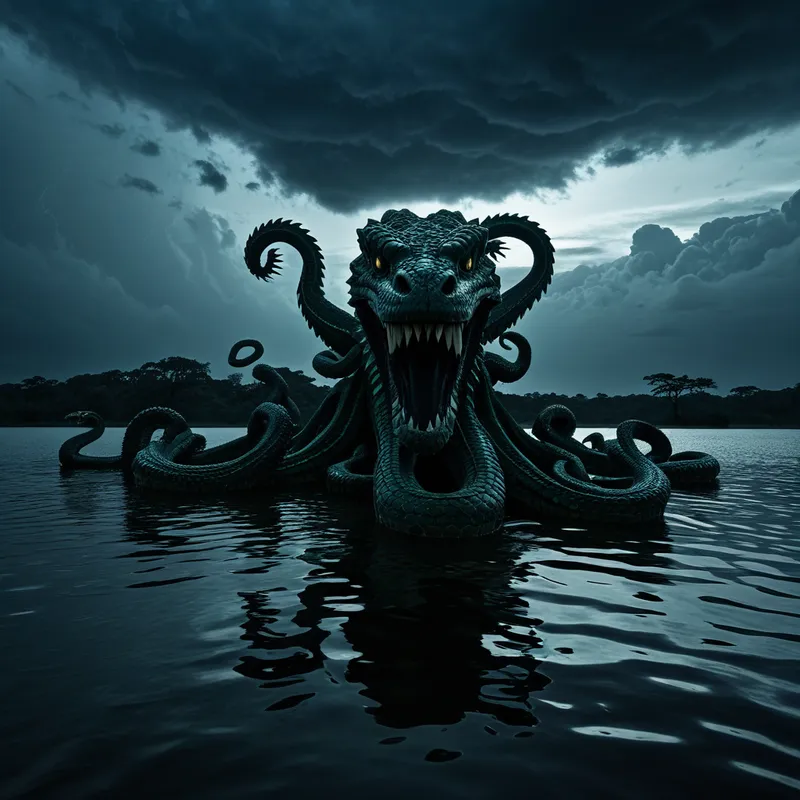
Hear now of a labor not of earth, but of the deep, wet dark. In the sunken, forgotten places of the world, where the reeds whisper secrets and the water does not reflect the sky, there festered the Hydra of Lerna. It was a child of monsters, born of Echidna and Typhon, a creature of such profound wrongness that the very land around its swamp became a blighted threshold to the underworld. Its breath was a visible poison, a green mist that killed flowers and hope alike.
The hero, Heracles, son of Zeus, was sent to this place not for glory, but for penance. His task, the second of his infamous labors, was simple in command and impossible in fact: cleanse the land. Kill the beast. He entered the marsh with his lion-skin upon his shoulders and a sword of bronze in his hand, his loyal nephew Iolaus at his side. The air was thick with the smell of decay and the silence of prey.
Then, the water erupted. Not one head, but nine—each a serpent of gleaming scales and eyes like polished jet—rose hissing. The central head was immortal, a fact written in the cold stars. Heracles swung. A head fell, severed clean. But from the bleeding stump, two more sprouted, wet and furious, snapping at the air. He struck again, and again, and with each blow the monster grew, a grotesque hydra-garden of rage and regeneration. The hero was being overwhelmed not by strength, but by a terrible, fecund logic: violence bred more violence.
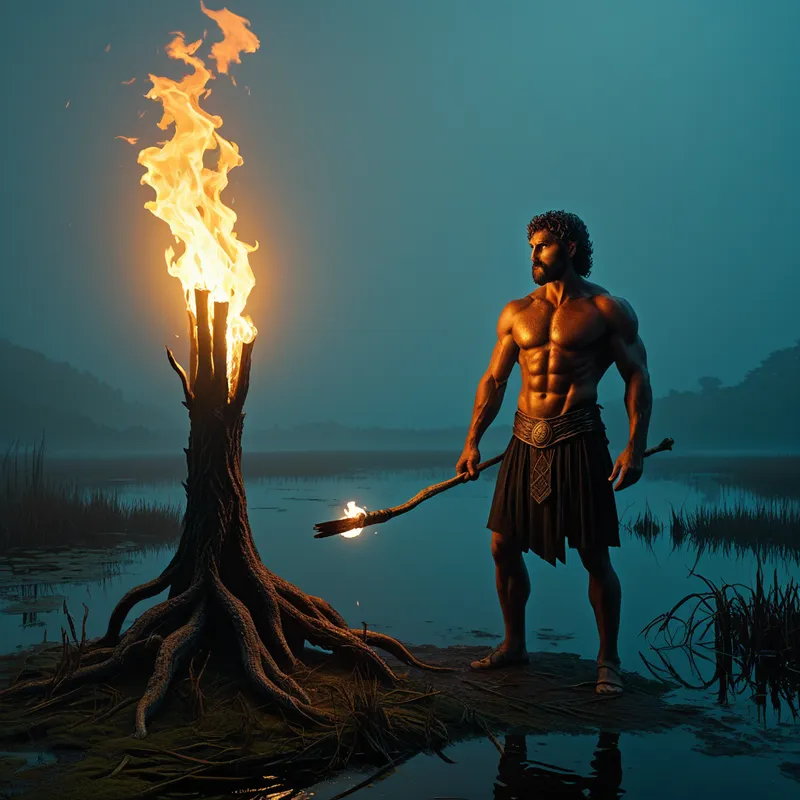
Desperation birthed cunning. Heracles called to Iolaus. As he lopped off a head, his nephew seared the bleeding neck with a blazing torch, cauterizing the wound with fire. Creation was halted by purification. Head after head, they repeated this grim surgery—the cut, the sizzle of flesh, the smell of burning venom. Finally, only the immortal head remained. Heracles buried it beneath a great stone, a weight to hold eternity down. The monstrous body stilled.
But the tale does not end with the beast's death. In its death-throes, the Hydra’s blood, a black and viscous fluid, soaked the earth and Heracles’s weapons. He dipped his arrows into the poison, an act that would seal his fate. This blood, the essence of the Hydra’s regenerative curse, became a weapon of absolute, incurable death. It was a victory, but the prize was a poison that would, in time, climb the shaft of the arrow and burn the hand that loosed it.
Cultural Origins & Context
This myth comes to us from the deep well of the Mycenaean world, crystallized in the epic cycles and later systematized by poets like Hesiod in his Theogony and chroniclers like Apollodorus. It was not merely a fireside monster story. As one of the Twelve Labors of Heracles, it functioned as a foundational narrative of cultural identity. Heracles was the proto-hero, the civilizing force who confronted the chaotic, untamed wilds—represented by the primal swamp and its monstrous inhabitant—on behalf of the ordered human world.
The myth was performed, recited, and depicted on pottery, serving as a lesson in the cost of order. It taught that confronting the wild (the Hydra) requires not just brute force (the sword) but intelligent, adaptive strategy (fire and cooperation). Furthermore, it was deeply intertwined with chthonic, or underworld, cults. The spring of Amymone at Lerna was considered an entrance to Hades; the Hydra was its guardian. Thus, Heracles’s labor was a symbolic harrowing of the land of the dead, a theme that resonated with initiation rituals and mysteries concerning life, death, and what regenerates from decay.
Symbolic Architecture
The Hydra is not a simple monster. It is the archetypal image of the proliferating problem, the dilemma that grows stronger the more directly you attack it. Each head represents a facet of a complex, entrenched issue—be it a psychological complex, a systemic injustice, or a personal addiction. To confront it with simplistic, binary force (cutting) only causes it to multiply.
The true adversary is not the monster, but the law of its being: the reflexive regeneration of shadow.
The immortal head signifies the core, irreducible pattern—the root trauma or archetypal core of a complex. It cannot be destroyed, only contained and integrated ("buried under a great stone"). Iolaus, the companion with the fire, represents the necessary transcendent function—the insight, the supportive other, or the conscious application of a transformative principle (fire) that allows for real progress. The labor is never a solo act.
Finally, the blood. This is the myth’s most profound alchemical ingredient. The Hydra’s essence, once the beast is overcome, does not vanish. It adheres. It becomes a pharmakon—a Greek word meaning both poison and cure. Heracles’s arrows, tipped in this blood, become weapons of fate. The victory over the monster yields a power that is inherently ambivalent, carrying the seed of future tragedy (it would eventually cause his own agonizing death). The blood symbolizes the lasting imprint of a conquered shadow; it is the knowledge, the strength, and the poison we acquire by facing our deepest struggles.
The Dreamer's Resonance
When this myth stirs in the modern unconscious, it rarely appears as a classical Hydra. The dreamer may find themselves in a tangled bureaucratic process where solving one issue creates two more, or facing a person whose criticisms seem to multiply. Somaticly, it can feel like fighting exhaustion, a fatigue that regenerates as quickly as it is rested away. The dream landscape is often a swamp, a cluttered basement, or a tangled network—places of stagnation and uncontrolled growth.
Psychologically, this is the psyche signaling a confrontation with a complex—a knot of emotions, memories, and perceptions rooted in a traumatic pattern. The dreamer is using a "cutting" approach: rationalization, suppression, or direct, willful opposition. The dream shows this is failing spectacularly. The feeling upon waking is one of futility and dread. The invitation of such a dream is to look for the "Iolaus" function—what is the transformative fire? What insight, what new perspective, what acceptance could cauterize the wound of this pattern and stop its endless regeneration?
Alchemical Translation
The journey of Heracles at Lerna is a precise map for the process of individuation. The first step is the descent into the swamp—the confrontation with the murky, emotional, and instinctual shadow-self (the Hydra). The ego’s initial impulse is to conquer it by force of will, to sever the unwanted parts. This is the nigredo, the blackening, a state of despair and confusion as the problem seems to grow.
The introduction of fire by Iolaus is the albedo, the whitening. Fire represents consciousness, discrimination, and the application of a principled, transformative energy. It is not destruction, but purification. It is the moment we stop reacting and start applying a conscious, sustained practice to the root of a behavioral pattern.
The alchemy occurs not in the slaying, but in the stewardship of the remains. The poison must be consciously taken up, not discarded.
Burying the immortal head is the act of containment—recognizing that some core wounds or drives cannot be erased, only acknowledged and held in check. Finally, the dipping of the arrows is the rubedo, the reddening. This is the integration. The hero does not walk away clean. He takes the essence of his struggle—the resilience, the hard-won knowledge, the capacity to set fierce boundaries—and makes it part of his arsenal. This integrated power is double-edged. It grants immense strength (the arrows that never miss their mark) but carries a sacred responsibility, for it is born of poison. For the modern individual, this translates to the wisdom that our greatest strengths are often forged in our deepest struggles, and they must be wielded with awareness of their potential to harm, lest we are destroyed by the very power that defines us. The labor is complete only when we acknowledge that we are now, forever, the keeper of the Hydra’s blood.
Associated Symbols
Explore related symbols from the CaleaDream lexicon: