The Somatic Echo
Before the dream images form, regeneration announces itself in the body as a deep, cellular hum. It is not the sharp pang of a fresh wound, but the profound, almost nauseating ache of a bone knitting itself back together beneath the skin. It feels like a hollowing out—a strange, internal vacancy where a familiar structure once stood. There is a weight of silt, the sense of being buried in the aftermath of your own collapse. And yet, beneath that silt, a subtle, insistent vibration. It is the somatic paradox of regeneration: the feeling of being both a ruin and the blueprint for what will be built upon it. The breath feels shallow, as if the lungs are remembering how to expand into a new, unfamiliar chest cavity. The old emotional reflexes—the quick anger, the familiar sadness—feel distant, like echoes in an empty hall. The body is waiting. It is a chrysalis state, where every nerve ending is tuned not to the outside world, but to the silent, seismic shift happening within.
The Dreamer's Log
The dreamer stands in a room that was once a library. All the books have dissolved into a fine, grey ash that coats every surface. In the center of the room sits a single, cracked ceramic pot. From its fractures, a dense tangle of bioluminescent roots and delicate copper wires is emerging, coiling and fusing into a single, pulsing system that begins to slowly climb the walls, writing new, luminous text onto the bare stone.
This is not a dream of restoring the lost library, but of the intelligence that grows from its ashes becoming the new, living scripture.

The False Lead
Regeneration is not self-improvement. It is not a software update or a motivational reboot. Do not mistake it for the simple relief of a hardship ending, or the passive hope that "things will get better." That is recovery—a return to a previous state. Regeneration is annihilation followed by genesis. It is the permanent death of a way of being, a belief system, or a self-concept you thought was foundational. The false lead is to interpret the dissolving phase—the ash, the hollow feeling—as failure or eternal loss. It is not. That dissolution is the non-negotiable first ingredient. Regeneration is structural, not cosmetic. It is the difference between patching a cracked wall and discovering that the entire house was built on a sinkhole, necessitating a wholly new foundation.
Psychological Architecture
To understand regeneration psychologically is to witness the Shadow work of the ecosystem. It is not one exiled part returning, but the entire internal family system entering a state of collapse so a new governance can form. The old rulers—the inner critic that motivated you, the pleaser that kept you safe, the orphan that learned to survive—have abdicated or been deposed. Their strategies have led to a silent, internal famine. The work now is not to reassemble that old council, but to sit in the terrifying silence of the throne room and listen. What emerges from the shadows is not a monster, but the raw, unformed potential that was suppressed to maintain the old kingdom. This is the Individuation process in its most visceral form: the conscious ego, the "you" you know, must consent to its own deconstruction. It must feel the grief of the lost identity without rushing to build a new one. This is the slow, painful cultivation of a center that can hold paradox: you are both the architect and the building site, the sculptor and the clay being utterly remixed by the rain.
Mythic Resonance
This process echoes in the myth of the Phoenix, but we often misunderstand its fire. The fire is not an external catastrophe; it is the internal combustion of a life that has become unsustainable. The bird builds its own pyre from the spices of its lived experience—the regrets, the triumphs, the worn-out stories—and then ignites it from within. The alchemy happens in the total surrender to the flames, not in the eager anticipation of the rebirth. Similarly, in the Norse myth of Yggdrasil, the World Tree, regeneration is constant. The great ash tree is perpetually decaying—its trunk rotting, its leaves falling, an eagle and a serpent gnawing at its roots and branches. Yet, it remains eternally vital, fed by the well of fate and the dew of potential. The myth shows us that life and decay are not opposites but partners in the dance of sustaining a vast, living system. Your psyche is this tree. Regeneration is not waiting for the rot to stop; it is learning to draw nourishment from the very process of decay.
Symbolic Nodes
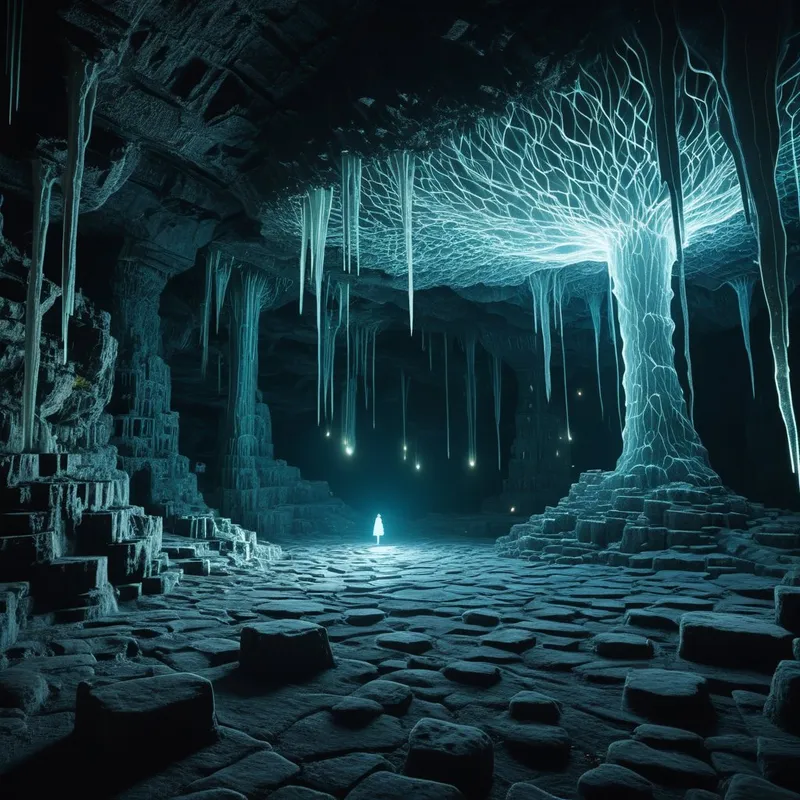
- Bioluminescent Fungi/Mycelium: The silent, connective intelligence growing in darkness, creating networks where none seemed possible.
- Cracked Vessels & Seedlings: The fertile breakage. A pot cracks, and from the fracture, not from the center, new life emerges.
- Geometric Crystalline Growth: New psychic structures forming with an inherent, precise order, often in caverns or ruins.
- Subterranean Caverns & Roots: The subconscious as a fertile dark space where foundational growth occurs, unseen.
- Shedding Skin/Molting: The literal sloughing off of an outgrown identity, leaving a tender, new surface exposed.
- Burning Libraries/Ashes that Glow: The conscious knowledge is consumed, leaving not nothing, but a fertile, phosphorescent base for a new kind of knowing.
Archetypal Resonance
The core energy of regeneration is most powerfully embodied by The Magician Archetype. Not the stage illusionist, but the deep alchemist. The Magician’s domain is the hidden substrate of reality, the fundamental laws that govern transformation. In regeneration, you are not fixing; you are transmuting. The somatic echo of hollowing out is the Magician’s crucible being prepared. The dissolution of old forms is the solve (to dissolve), and the slow, emergent new growth is the coagula (to coalesce). The Shadow Magician—the Manipulator or Illusionist—is the part that tries to fake the process, to paint over the cracks or summon a quick, impressive rebirth through force of will. The true Magician archetype demands you submit to the authentic, often agonizingly slow, process of the work. Its gift is the realization that you contain the latent knowledge for your own renewal; you are both the formula and the experiment.
The Alchemical Process
The alchemy of regeneration is Putrefaction followed by Cibation. Putrefaction is the stage modern psychology flees from: the necessary rot. It is allowing the old identity, the failed project, the broken relationship to decompose within you. This is the intense heat and pressure. It is the grief that feels like it will dissolve your very bones, the rage that simmers without an outlet, the vacuum of meaning. This is not pathology; it is the fertile mulch being created. To rush from dissolution to rebirth is to abort the process, creating a fragile facsimile. Only after full Putrefaction comes Cibation—the mysterious feeding. This is not you "doing" something positive. It is the psyche, from its deepest wells, beginning to secrete a nourishing dew onto the black, fertile mass. It might feel like a sudden, irrational moment of peace in the grief. A dream of roots in darkness. A line of poetry that arrives unbidden. This dew is the nascent new self, feeding on the truth of what has died. The transmutation is the realization that the "you" being born is not better than the old, but truer—forged in the authenticity of having fully metabolized an ending.
The Integration Protocol
Question 1: Where in my life do I feel a profound, hollow ache—not a sharp pain, but a deep vacancy? Can I name what structure (a belief, an identity, a hope) once occupied that space and has now dissolved?
Question 2: What is one small, old habit or automatic thought that has quietly lost its power over me recently? This is not a big victory, but a subtle sign of internal decay making way for new ground.
Question 3: If my current sense of self were a building, what room has been completely sealed off? And if I listened at the door, what sound—not an image, but a sound—might I hear from within?
Action 1 (Somatic Grounding): For three minutes each day, place your hands on your lower abdomen. Breathe into that space, not trying to fill it with light or positivity, but simply acknowledging its current state: "This is the hollow. This is the fertile dark." Feel the temperature, the density. Just be with it.
Action 2 (Creative Expression - Ash Mapping): Take a large sheet of black paper. With a white pencil or chalk, draw not an image, but a map of your internal landscape. Where are the ruins? Where is the soft, ashy soil? Where might there be, even as a single dot, a point of faint, subterranean light? Let it be abstract. The act is one of cartography, not art.
Action 3 (Outward Ritual): Find a small, natural object that represents something that has ended for you—a dried leaf, a stone, a piece of bark. Hold it and acknowledge its role. Then, bury it or place it in a body of moving water. Do not plant a seed in its place. Simply perform the act of returning the old form to the cycle, consciously making room, without forcing what comes next.
Final Validation
This is perhaps the most demanding work the psyche can undertake. To feel yourself dissolve and to choose not to panic, not to grasp at the nearest, familiar identity to stop the fall, requires a courage that feels like madness. The loneliness of the chrysalis is absolute. So let this be a validation: if you are in the ash, you are not lost. You are in the most sacred and vulnerable phase of becoming. The regeneration dream is your psyche’s proof of life, a signal from the depths that the blueprint exists and the growth has already begun, unseen. You are not rebuilding the old house. You are learning, nerve by nerve, to inhabit the new, wild, and more resilient architecture of your soul. The sovereignty gained is not over your world, but over the entire process of your own becoming. You become the keeper of your own mysteries, the witness to your own endless, necessary, and magnificent transformations.