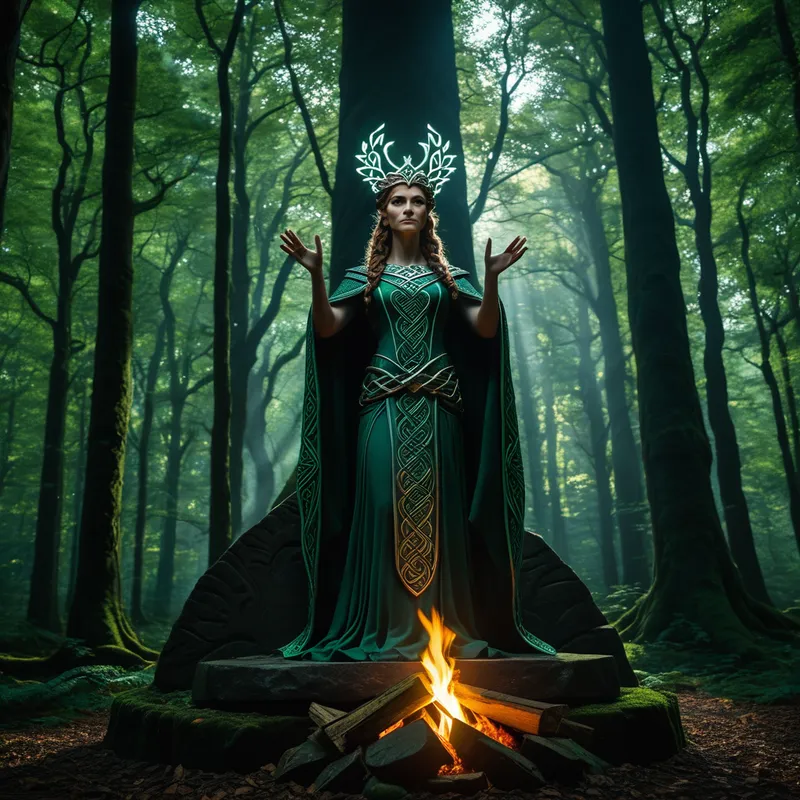
The Hearth Stone Myth Meaning & Symbolism
A myth of a sacred stone holding the undying hearth-fire of the tribe, guarded by a goddess and reclaimed through a journey of memory and sacrifice.
The Tale of The Hearth Stone
Listen. In the time before memory, when the world was a cloak of forest and mist, the heart of a people was not in their king’s hall, but in the low, warm glow of the hearth. And the heart of that hearth was a stone.
It was no ordinary rock, pulled from a stream. This was the Cloch na Teine, the Stone of Fire, gifted in the dawn of days by Brigid herself. She placed it in the care of the first family, with a whisper that became law: “So long as this fire burns, unquenched, your people shall endure. Its flame is your memory; its heat, your courage; its light, your path.”
For generations, it was so. The Stone sat at the literal and spiritual center of the fine. Each night, the eldest woman—the bean an tí—would feed it with peat and oak, and its light would weave the shadows of storytellers and the laughter of children into a single, living tapestry. The smoke carried prayers to the aos sí. Its embers were carried to kindle new fires for new homes, a branching tree of light from a single, sacred root.
But chaos, in the form of a rival clan, came with iron and torch. In the panic of attack, the hall was overrun. The keeper, an old woman named Fionnuala, saw the warriors at the door. There was no time to save the wealth, the cattle, or even all the children. Her eyes fell on the Hearth Stone, its fire dancing calmly amidst the screaming. The law echoed: unquenched.
With bare, scorched hands, she did not lift the blazing stone. Instead, she took the iron poker and, with a cry that was both grief and invocation, struck the stone’s center. A single, perfect ember, white-hot and pulsating like a tiny star, fell into a clay cup of dry moss she held. She sealed it with a flat stone. As the roof beams crashed down, she fled into the deep, trackless forest, the last warmth of her world clutched to her breast.
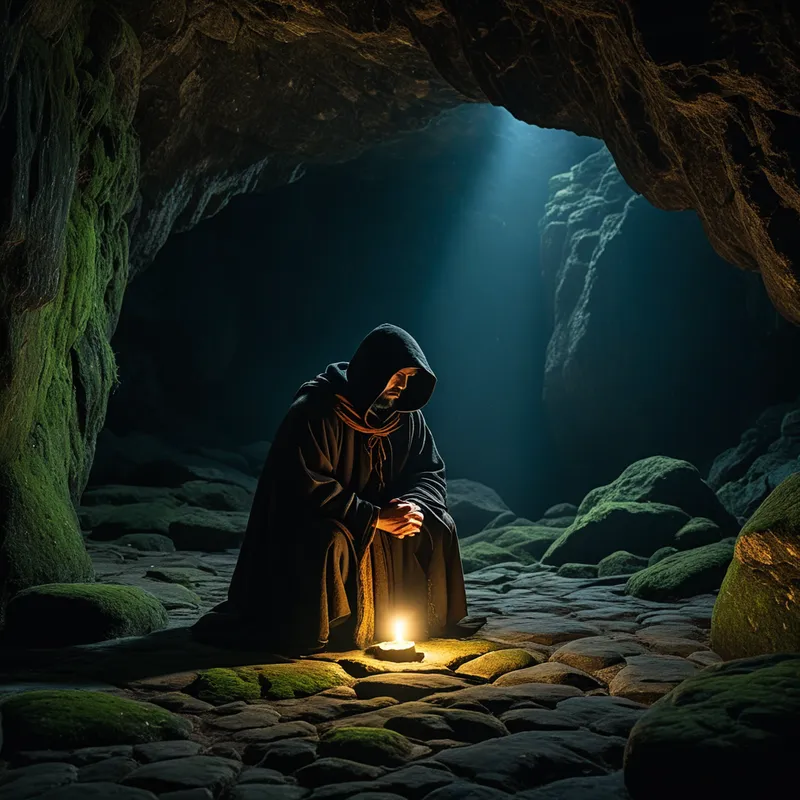
The clan was scattered, the hall a blackened ruin. The great Hearth Stone was lost, buried under ash and sorrow. Fionnuala wandered, a ghost with a living secret. She found a hidden cave, a womb of damp earth, and there she placed the clay cup. The ember glowed, but faintly. It was a heartbeat without a body.
Years folded into years. Fionnuala’s hair turned to frost, her steps slowed. The ember’s light grew dimmer, a secret fading with its keeper. On the edge of a final sleep, she whispered its story to the wind, to the stones, to the roots of a great hawthorn. The myth says the land itself remembered when the people could not.
Generations later, a descendant, a young man named Dáire, born in exile with a longing for a home he’d never known, began to dream of a warm stone and a woman with fire-scarred hands. He followed the dreams into the wilderness, guided by an inexplicable pull. He found the cave, now shrouded in moss and silence. And there, beneath the roots of the hawthorn, he found the clay cup, cold to the touch.
Despair gripped him. But remembering the old tales, he did not seek to blow on dead ash. Instead, he gathered the driest tinder, the most resinous pine, and built a tiny nest around the sealed cup. He then took the cup and pressed it not to his lips, but to his forehead, closing his eyes. He poured not breath, but attention. He poured memory—the fragments of song, the ghost of a story, the shape of a longing he carried. He offered the only fuel he had: his own yearning for connection.
For three days and nights, he sat in vigil. On the third night, as the cold bit deepest, a thin, almost invisible wisp of smoke curled from the cup’s seal. With trembling hands, Dáire opened it. There, in the nest of tinder, the ember glowed—a single, persistent pinprick of orange light. He wept. Gently, so gently, he breathed. The tinder caught. A tiny flame, no bigger than a berry, leapt to life.
He had not found the great Hearth Stone. But he had found its undying seed. Carrying this new, fragile flame back to the scattered remnants of his people, he kindled a new fire in a new place. The first law was fulfilled: the fire was unquenched. It burned not on a grand, legendary stone, but on a simple one, chosen with care. Yet in its light, the stories returned. The songs found their tune. The people remembered they were a people. The hearth was not a place; it was a living memory, carried in the heart and rekindled by willing hands.
Cultural Origins & Context
The motif of the sacred hearth fire is a deep stratum in Celtic, particularly Gaelic, tradition. While no single, standardized “Myth of the Hearth Stone” exists in a primary text like the Mythological Cycle, its components are archaeologically and folkloristically ubiquitous. The hearth was the domestic altar, the axis mundi of the family. The prohibition against the fire dying was a widespread geis, a matter of spiritual and practical survival.
This narrative is a composite, drawn from the ethos of the Brehon Laws which sanctified the home fire, from folk practices of carrying “needfire” between settlements, and from the persistent role of goddesses like Brigid as guardians of the sacred flame. It was a story told not by bards in royal courts, but by the bean an tí at the fireside. Its function was initiatory and binding: to teach each generation that their identity was not merely biological, but carried in the ritual and responsibility of tending the communal soul-fire. The myth encoded the trauma of displacement (a historical constant for the Celtic peoples) and provided the psychic template for cultural resilience—the idea that the essence of home is portable, an internal ember.
Symbolic Architecture
The Hearth Stone is the axis mundi of the self. It represents the core of identity, the central, nourishing truth around which a psyche organizes its experiences. It is not the ego, but the deeper, often unconscious, source of warmth, value, and meaning.
The true hearth is not where the fire is lit, but where the memory of fire is kept alive.
Fionnuala, the keeper, embodies the Anima in her most ancient, custodial form. Her sacrifice is not of life, but of form. She shatters the visible, monumental stone (the outer identity, the cultural edifice) to preserve the essential, hidden ember (the irreducible core of the soul). This is the critical movement from identification with the container to the preservation of the content.
Dáire, the dreamer, represents the ego-consciousness born into alienation. His journey is one of introversion. He does not conquer; he remembers. His act of fueling the ember with “attention” and “yearning” is a perfect symbol for active imagination—the psychological process of engaging with inner contents not through force, but through devoted, receptive focus. The flame answers not to his breath, but to his sincere engagement.
The fire’s transmutation—from public blaze to hidden ember to new, humble flame—models the soul’s journey through trauma, dormancy, and renewal. The myth asserts that the core Self cannot be destroyed, only forgotten, and that its rekindling is always possible through a turn toward the inner world and a willingness to become its new keeper.
The Dreamer's Resonance
When this myth stirs in the modern dreamer, it often manifests as dreams of searching for a lost, warm, or glowing object in a ruined or labyrinthine house. One may dream of a cold fireplace they are compelled to tend, or of carrying a fragile, vital light through a threatening landscape. Somatic sensations accompany these dreams: a literal chill, a feeling of hollow emptiness in the chest, or conversely, a sudden, localized warmth in the hands or heart-center upon finding the dream-object.
Psychologically, this signals a process of re-collection. The dream-ego is navigating the ruins of outworn identities, collapsed life-structures, or inherited familial/cultural complexes (“the burnt hall”). The search for the hearth stone is the psyche’s imperative to locate its own central, nourishing principle amidst the debris. The dream is an invitation to become the bean an tí of one’s own soul—to take custodianship of one’s inner warmth, values, and creative spark, which may have been neglected, betrayed, or seemingly extinguished by life’s exigencies. The dream insists that the ember is always there, waiting for the fuel of conscious attention.
Alchemical Translation
The alchemical opus mirrored in this myth is the process of nigredo followed by a concealed albedo. The attack and the burning hall are the nigredo—the devastating dissolution of a once-coherent psychic structure. The ego’s world is reduced to ash (despair, meaninglessness, depression). Fionnuala’s act of capturing the ember is the first, crucial turn: in the midst of chaos, a part of the psyche (the ancient, instinctual Self) performs the separatio, isolating the precious scintilla—the divine spark—from the burning ruin.
Individuation begins not with building a new tower, but with honoring the faint glow in the cup of exile.
The long dormancy in the cave is the neglected, unconscious incubation period. The ember is the Self in a state of potential, unrecognized by the conscious personality. Dáire’s journey is the ego’s dawning awareness of this inner poverty and its call to quest. His vigil is the meditatio and imaginatio of alchemy. He does not apply brute force (bellows); he applies the gentle, persistent heat of focused consciousness.
His success—the kindling of a new, humble flame—is the albedo, the dawning of a new, authentic consciousness born from direct relationship with the Self. It is not a return to the old, grand stone (regression), but the creation of a new, living center (individuation). The myth thus provides a complete map for psychic renewal: the courage to let old forms die, the wisdom to preserve the essence, the patience to endure the dark incubation, and the devoted action required to rekindle a life of meaning from within. We are all, perpetually, both Fionnuala in the moment of crisis and Dáire on the threshold of the cave, tasked with the eternal return of the fire.
Associated Symbols
Explore related symbols from the CaleaDream lexicon: