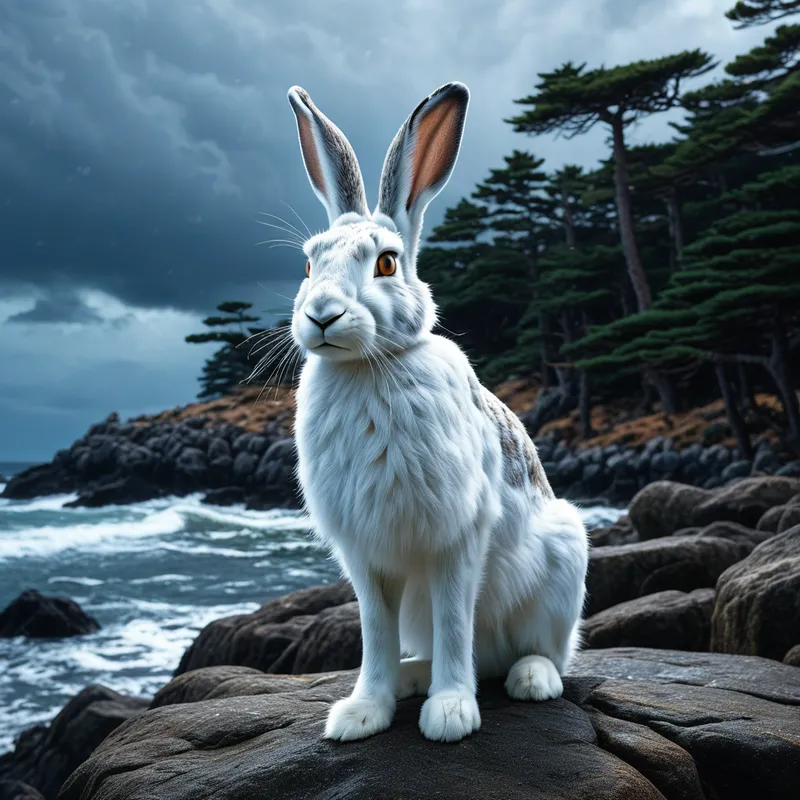
The Hare of Inaba Myth Meaning & Symbolism
A wounded hare, tricked by crocodiles, is healed by a compassionate deity, revealing that true power lies in kindness and authentic feeling.
The Tale of The Hare of Inaba
Listen now, to the tale that whispers from the ancient shores of Inaba. Once, in a time when the world was still speaking directly to the kami, there lived a clever hare. Not an ordinary creature, but one whose heart held a spark of ambition and a touch of pride. He gazed across the churning sea, its waters a deep, forbidding blue, and yearned for the distant land he could see—the land of Inaba.
Between him and his desire lay a vast, impassable strait. The hare’s clever mind devised a plan. He called out to the crocodiles of the sea, who rose from the depths, their scaled backs like islands of living stone. “Oh, mighty ones of the deep!” cried the hare, his voice carrying over the waves. “Let us see whose kin is more numerous—the crocodiles of the sea, or the hares of the land. Line up, one after the other, from this shore to the distant one, and I shall count you as I run across your backs.”
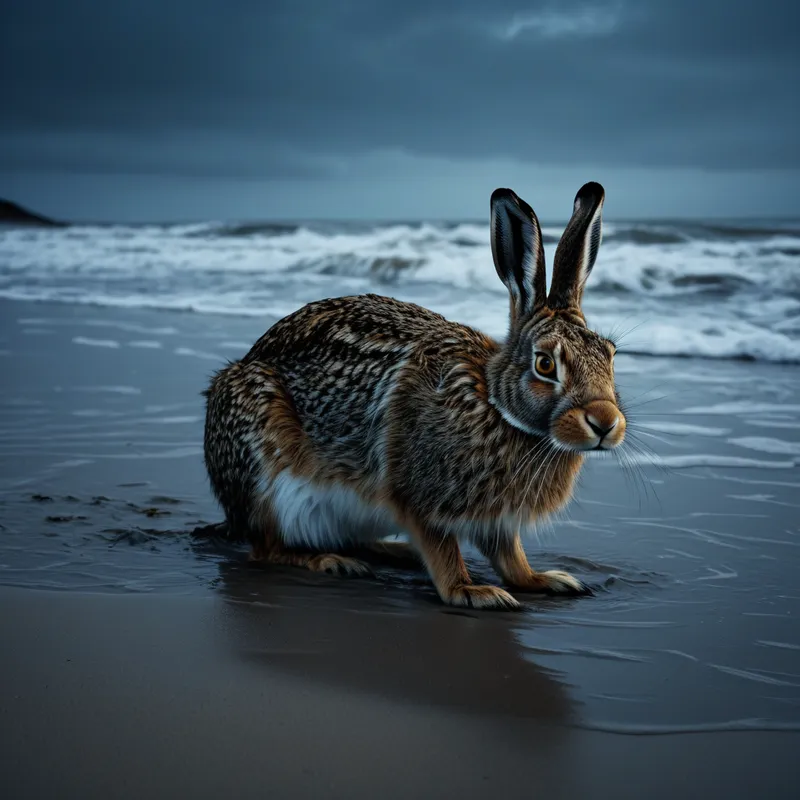
Flattered, the crocodiles agreed. They formed a great, living bridge of tooth and scale across the heaving sea. The hare, triumphant, began to leap from one hard, cold back to the next. As he reached the far shore, his pride overflowed. He could not resist a final boast. “You foolish creatures!” he laughed. “I have tricked you! I needed but a bridge, and you provided it!” In that moment of hubris, the final crocodile, enraged, lunged. Its powerful jaws seized the hare, not to devour, but to punish. It stripped the hare of every last piece of his beautiful white fur, leaving him raw, pink, and screaming in agony on the barren, stony beach.
The sun was a merciless eye. The wind was a knife of salt. The hare lay exposed, his skin burning, every grain of sand a torment. He wept, not just from pain, but from the utter ruin of his cleverness. As he lay dying, a procession approached. Eighty brothers, proud and resplendent, were journeying to court a princess. They saw the wretched, mewling creature. “A pitiful sight,” they sneered, their hearts closed. “Bathe in the saltwater and let the wind dry you. That is your cure.” And they passed by, leaving the hare in deeper despair.
Then came the eighty-first. His name was Ōkuninushi, the “Great Land Master.” He walked not with the arrogance of his brothers, but with a different quality—a listening presence. He saw the same suffering, but his heart did not turn away. He knelt in the coarse sand. “Little one,” he said, his voice as soft as the first rain. “Tell me your sorrow.”
Through sobs, the hare told his tale of trickery and ruin. Ōkuninushi did not judge. He instructed the hare with true compassion. “Go to the river mouth. Wash your body in the fresh water. Then gather the pollen of the kama reed, spread it upon the ground, and roll in it. Your skin will be made whole.”
The hare did as he was told. The fresh water soothed his burning flesh. As he rolled in the golden pollen, a miracle unfolded. New fur sprouted—not just fur, but a coat of the purest, most brilliant white, luminous and whole. The hare, transformed, bounded back to Ōkuninushi. He proclaimed a prophecy from the depths of his gratitude: “The princess will not choose your eighty brothers. She will choose you, Ōkuninushi, for you possess the heart that heals.” And so it came to pass. The one who attended to the wound became the master of the land, and the one who was wounded became the messenger of destiny.
Cultural Origins & Context
This myth is preserved in Japan’s oldest extant chronicles, the Kojiki (Records of Ancient Matters, 712 CE) and the Nihon Shoki (Chronicles of Japan, 720 CE). These texts were compiled under imperial auspices to codify a national mythology and lineage, weaving regional folktales and clan legends into a grand narrative that connected the imperial family to the divine kami. The Hare of Inaba is believed to be a local legend from the Izumo region (modern-day Shimane Prefecture), home to the great Izumo Taisha, which was incorporated into this state mythology.
The tale functioned on multiple levels. On one hand, it served as a divine justification for the political and spiritual authority of the Izumo lineage, represented by Ōkuninushi. On a deeper, cultural level, it transmitted core Shinto values. Shinto is fundamentally animistic, viewing the natural world—animals, rivers, rocks—as imbued with spirit (kami). The hare is not a mere animal but a kami in animal form (yaoyorozu no kami). The myth illustrates that interaction with these spirits requires not dominance or cunning, but makoto (sincerity, true heart) and kannagara (living in accordance with the way of the kami). The eighty brothers fail because they lack empathy; Ōkuninushi succeeds because his actions are in harmony with the natural order of healing and compassion.
Symbolic Architecture
The myth presents a profound map of psychological and spiritual [error](/symbols/error “Symbol: A dream symbol representing internal conflict, perceived failure, or a mismatch between expectations and reality.”/) and correction. The hare begins in a state of inflated [consciousness](/symbols/consciousness “Symbol: Consciousness represents the state of awareness and perception, encompassing thoughts, feelings, and experiences.”/)—the [Trickster](/symbols/trickster “Symbol: A boundary-crossing archetype representing chaos, transformation, and the subversion of norms through cunning and humor.”/) [archetype](/symbols/archetype “Symbol: A universal, primordial pattern or prototype in the collective unconscious that shapes human experience, behavior, and creative expression.”/) using cleverness to bypass legitimate struggle. The sea represents the unconscious, vast and unknown. His plan to cross on the backs of the crocodiles is a classic act of puer (eternal boy) [inflation](/symbols/inflation “Symbol: A dream symbol representing feelings of diminishing value, loss of control, or expansion beyond sustainable limits in one’s life or psyche.”/), attempting to conquer the deep, instinctual world through intellect alone.
The wound is not the punishment; it is the necessary dissolution of the false self. The stripped skin is the brutal, grace-less gift of raw exposure.
The crocodiles, creatures of the primal deep, represent the instinctual world’s retaliation against arrogant consciousness. They do not kill him; they render him utterly vulnerable. This is the critical turning point. His cleverness is flayed away, leaving only pure, undefended feeling—the essential, suffering self. The eighty brothers symbolize the collective, conventional [attitude](/symbols/attitude “Symbol: Attitude symbolizes one’s mental state, perception, and posture towards life, influencing emotions and actions significantly.”/): cold, dismissive, offering only the harsh, abrasive “cure” of [salt](/symbols/salt “Symbol: Salt represents purification, preservation, and the essence of life. It is often tied to the balance of emotions and spiritual cleansing.”/) and wind (more of the same cruelty that caused the wound). It is the [logic](/symbols/logic “Symbol: The principle of reasoning and rational thought, often representing order, structure, and intellectual clarity in dreams.”/) of the unfeeling ego.
Ōkuninushi embodies the [Caregiver](/symbols/caregiver “Symbol: A spiritual or mythical figure representing nurturing, protection, and unconditional support, often embodying divine or archetypal parental energy.”/) and the true Sovereign. His [prescription](/symbols/prescription “Symbol: A medical directive for healing, representing external authority, dependency, or a need for correction in one’s life.”/) is alchemical: first, the fresh [water](/symbols/water “Symbol: Water symbolizes the subconscious mind, emotions, and the flow of life, representing both cleansing and creation.”/) of [emotion](/symbols/emotion “Symbol: Emotion symbolizes our inner feelings and responses to experiences, often guiding our actions and choices.”/) (the [river](/symbols/river “Symbol: A river often symbolizes the flow of emotions, the passage of time, and life’s journey, reflecting transitions and movement in one’s life.”/), not the salty sea of [bitterness](/symbols/bitterness “Symbol: A taste or sensation associated with unpleasantness, resentment, or unresolved emotional pain, often signaling toxicity or a need for acceptance.”/)) to cleanse and soothe. Then, the golden pollen of the [reed](/symbols/reed “Symbol: A flexible plant symbolizing resilience, adaptability, and vulnerability. It bends without breaking, representing survival through yielding.”/)—a substance from the liminal [space](/symbols/space “Symbol: Dreaming of ‘Space’ often symbolizes the vastness of potential, personal freedom, or feelings of isolation and exploration in one’s life.”/) between [water](/symbols/water “Symbol: Water symbolizes the subconscious mind, emotions, and the flow of life, representing both cleansing and creation.”/) and land, a [medicine](/symbols/medicine “Symbol: Medicine symbolizes healing, transformation, and the pursuit of knowledge, addressing both physical and spiritual health.”/) from the [margin](/symbols/margin “Symbol: The boundary between what is included and excluded, representing thresholds, edges, and liminal spaces between defined areas.”/). By rolling in it, the hare actively participates in his own healing, reintegrating with the fertile, generative [earth](/symbols/earth “Symbol: The symbol of Earth often represents grounding, stability, and the physical realm, embodying a connection to nature and the innate support it provides.”/). His new white fur is not a return to his old state, but a [symbol](/symbols/symbol “Symbol: A symbol can represent an idea, concept, or belief, serving as a powerful tool for communication and understanding.”/) of a higher, purified wholeness earned through suffering and compassionate intervention.
The Dreamer’s Resonance
When this myth stirs in the modern psyche, it often manifests in dreams of profound exposure and unexpected healing. You may dream of being naked in a public place, not in anxiety, but in a stark, raw vulnerability that demands witness. You may dream of a beloved pet or animal being injured, reflecting a wounded, instinctual part of your own nature crying out for care. The crocodiles may appear as bureaucratic obstacles, cruel words from authority figures, or a series of relentless life events that seem to “strip you bare.”
The somatic experience is one of burning sensitivity—as if the psychic skin is gone, and every interaction is felt with unbearable intensity. This is the “hare on the beach” phase. The dreamer is in a state of acute disequilibrium, where old defenses (the “fur” of persona, achievement, or intellect) have failed. The psychological process is the terrifying, yet necessary, confrontation with the naked self. The dream is asking: Will you listen to the part of you that is wounded and ashamed? Or will you, like the eighty brothers, pass it by with a harsh, dismissive judgment?

Alchemical Translation
The journey of the Hare of Inaba is a perfect model for the process of individuation, specifically the transformation of suffering into meaning. The initial “cunning plan” represents the ego’s attempt to navigate life through strategy and control, bypassing genuine engagement with the depths (the unconscious). This inevitably leads to a crisis—the “flaying”—where the constructed identity is shattered.
The alchemical solve et coagula (dissolve and coagulate) is enacted: the old, inflated personality is dissolved in the salt of suffering, and the new self is coagulated in the golden pollen of compassionate attention.
Ōkuninushi represents the emergent function of the Self. He is the inner voice that knows the true medicine. His instructions are the alchemical recipe: First, ablutio—the washing in the fresh water of self-acceptance and feeling. This is the often-overlooked step of simply tending to the pain without immediately trying to fix it. Second, citrinitas—the yellowing, or illumination, represented by the golden pollen. This is the application of insight, meaning, and creative spirit to the wound. The act of “rolling” in it is active participation; healing is not passive reception but embodied integration.
The final transformation—the radiant white fur—symbolizes the albedo, the whitening stage of alchemy, signifying purity and clarity. But this purity is not innocence regained; it is a higher synthesis. The hare becomes a guide, a psychopomp who can now prophesy true sovereignty. For the modern individual, the myth teaches that our deepest wounds, when met with inner compassion (the Ōkuninushi within), do not merely scar over. They become the very sites from which our authentic authority and capacity to guide others—our own “mastery of the inner land”—can emerge.
Associated Symbols
Explore related symbols from the CaleaDream lexicon:
- Water — The sea represents the treacherous, unconscious depths, while the river’s fresh water symbolizes the cleansing flow of true emotion and healing that follows suffering.
- Wound — The hare’s flayed skin is the essential, raw vulnerability that must be exposed and tended to for any true transformation to begin.
- Healing — The entire narrative arc models a profound process of healing that moves from arrogant self-reliance, through devastating wounding, to compassionate intervention and holistic restoration.
- Journey — The hare’s physical crossing mirrors the internal journey from clever deception, through the agony of exposure, to a destination of wholeness and prophetic clarity.
- Trickster — The hare begins as a classic Trickster, using cunning to manipulate the natural order, an archetype that must be dissolved for deeper wisdom to emerge.
- God — Ōkuninushi represents the divine principle of compassionate sovereignty, the archetype of a ruler whose power is rooted in empathy and the capacity to heal.
- River — As the source of fresh water, it is the liminal boundary where healing is prescribed, representing the flow of life and the specific, gentle remedy for psychic burns.
- Shame — The hare’s raw exposure on the beach is a pure depiction of the somatic and psychological experience of profound, debilitating shame.
- Compassion — The active, empathetic response of Ōkuninushi is the catalytic force that transforms a situation of despair into one of destiny and wholeness.
- Rebirth — The hare’s new, luminous white fur signifies not a return to a prior state, but a complete rebirth into a higher, more integrated form of being.