The Greek god Aeolus Myth Meaning & Symbolism
The myth of Aeolus, keeper of the winds, explores the psyche's struggle to contain primal chaos within the sacred, bounded space of the self.
The Tale of The Greek god Aeolus
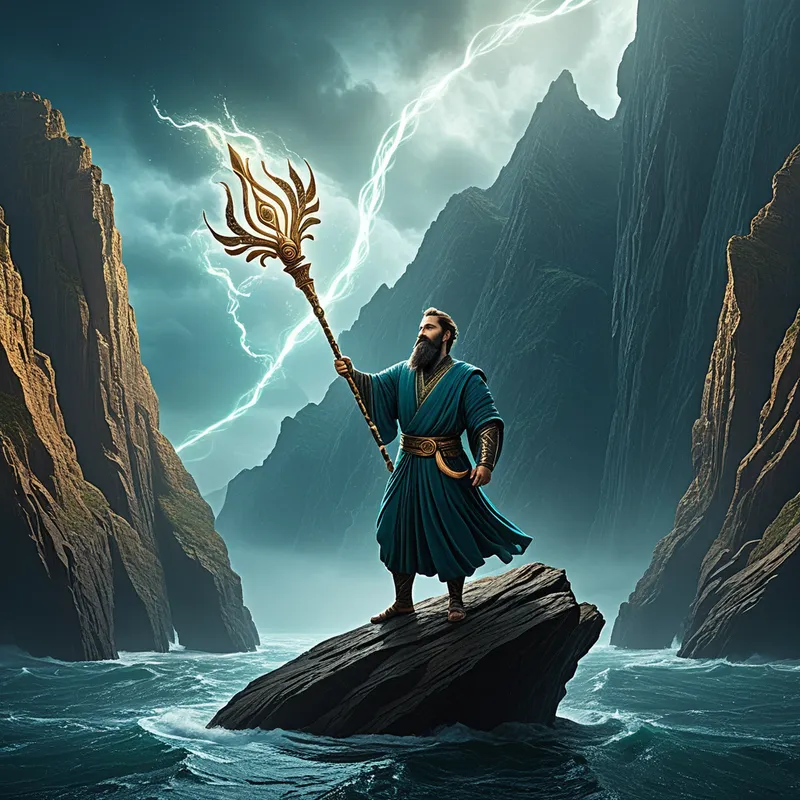
Hear now the tale not of a god who dwells on high Olympus, but of one who rules the liminal breath between worlds. His name is Aeolus, son of a mortal and a nymph, yet granted a kingdom by the great Zeus himself. His domain is a floating island, a fortress of sheer, polished bronze cliffs that rise from the ever-shifting sea. Here, at the very edge of the known world, he does not command armies or harvests, but the very breath of the cosmos—the Anemoi, the wild winds.
Within his palace, carved into the living rock, the air is still and sweet. The laughter of his six sons and six daughters, wed to each other in a perfect, closed circle of harmony, echoes in the halls. But beneath the foundations, in a cavernous hollow that groans with a deep, primordial pressure, the winds are imprisoned. They are not one, but many: Boreas the bitter, Zephyrus the kind, Eurus the turbulent, and Notus the desiccating. They howl and shriek, straining against their bonds, a chaos of potential that would scour the earth bare if unleashed.
One fateful day, a ship unlike any other approaches the island. It is scarred and weary, bearing a man with eyes as old as the sea—Odysseus, the far-wanderer. Aeolus receives him not as a supplicant, but as a fellow ruler of a difficult realm. For a month, they feast and speak of journeys and the art of governance. Aeolus sees in Odysseus a kindred spirit, a man who seeks to impose the order of a homeward path upon the chaos of the deep. In a gesture of profound trust, Aeolus harnesses the winds. He corrals the screaming tempests into a vast ox-hide bag, tying it with a silver cord so bright it seems woven from moonlight itself. Into this bag goes all that is contrary and destructive—every gale, every squall. He leaves only the gentle breath of Zephyrus to fill their sails and guide them home to Ithaca.
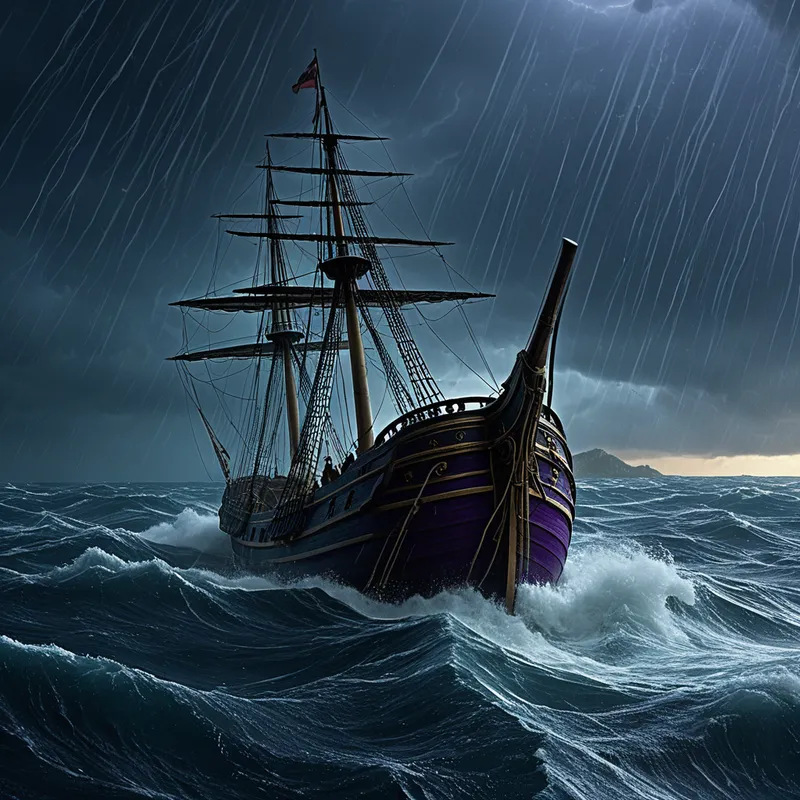
For nine days and nights, the ship flies across a placid sea, the cliffs of home a growing promise on the horizon. The crew, however, hears the muffled roar from the bulging bag at the mast. They smell the salt-spray and ozone leaking from its seams. Greed and suspicion whisper that their king has been given a treasure of gold and silver, hoarding it for himself. On the tenth day, as Odysseus sleeps, exhausted by his vigil, they cut the cord.
The explosion of sound is the world tearing apart. The winds, betrayed and furious, shriek forth in a single, catastrophic hurricane. In an instant, the clear sky is ripped into black tatters, the sea becomes a vertical wall. The ship is hurled back across the vast expanse it had just crossed, past the floating island, past all hope. Odysseus wakes to the screams of his men and the mocking laughter of the gale, watching the bronze cliffs of Aeolia vanish once more into the mist. The keeper’s gift, violated, has become the wanderer’s doom.
Cultural Origins & Context
The figure of Aeolus emerges from the oral epic tradition of ancient Greece, most famously immortalized in Homer’s Odyssey. He is a fascinating anomaly in the Greek pantheon—a mortal-ascended, a viceroy appointed by Zeus to a specific, critical function. His myth served as a powerful etiological narrative for the ancient Mediterranean world, a people utterly at the mercy of the sea’s moods. The story explained the origin of storms and the seemingly capricious nature of the winds, attributing them not to pure chaos, but to a contained force that could be, however temporarily, bargained with or managed.
Aeolus’s myth was passed down by bards and poets, a cautionary tale embedded within the greater saga of Odysseus’s journey. Its societal function was multifaceted. On a practical level, it underscored the peril of the sea and the importance of respecting its hidden rules (the themis, or divine law, of hospitality and gifts). On a deeper level, it explored the tension between human agency and cosmic forces. Aeolus represents the human aspiration to control the uncontrollable, to build a palace of order in the midst of chaos—a aspiration that is both noble and fraught with existential risk.
Symbolic Architecture
Aeolus is the archetype of the Cosmocrator, but his kingdom is the interior landscape of the psyche. He does not create the winds; he contains them. His floating bronze island is the symbol of the conscious ego—a bounded, fortified structure that exists precariously amidst the vast, unconscious sea of instinct and emotion (the winds).
The gift of the bound winds is the greatest temptation and the gravest test: it is the illusion of a perfected self, a psyche from which all conflict has been neatly excised and sealed away.
The four winds represent the totality of psychic energy in its raw, undifferentiated form: passion (Notus), intellect (Boreas), intuition (Eurus), and sensation (Zephyrus). Aeolus’s act of tying them into the leather bag symbolizes the ego’s attempt at repression, at creating a false peace by locking away anything turbulent or contradictory. The silver cord is the fragile thread of conscious will and discipline that holds this repression in place. Odysseus’s crew, representing the untamed, shadowy aspects of the psyche (greed, curiosity, distrust), cannot tolerate this sealed treasure. Their act of releasing the bag is the inevitable return of the repressed—the psychic explosion that occurs when we try to deny our full, stormy nature.
The Dreamer's Resonance
To dream of an Aeolus figure or his symbols is to dream of a critical moment of internal containment or its catastrophic failure. Dreaming of a sealed bag or box that hums with dangerous energy suggests the dreamer is actively, and perhaps unsustainably, repressing a powerful emotional complex—a rage, a grief, a wild creative impulse. The dream is a somatic warning of mounting pressure.
Dreaming of a figure on a high, isolated place (a cliff, a tower) calmly directing chaotic forces below mirrors the dreamer’s attempt to maintain intellectual or emotional control in a tumultuous life situation. Conversely, dreaming of a sudden, devastating windstorm erupting from a small, opened container is the psyche’s dramatic enactment of a breakdown, a moment where long-held control shatters and buried feelings erupt into waking life. The body may resonate with this as a feeling of being physically overwhelmed, breathless, or scattered.

Alchemical Translation
The alchemical journey modeled by the Aeolus myth is not about defeating chaos, but about undergoing a sacred transmutation of relationship with it. The initial state is chaos (the wild winds). The first, flawed operation is coercive containment (the bag), which corresponds to the ego’s inflation—the "ruler" archetype in its tyrannical mode, believing it can and must imprison all opposition.
The necessary catastrophe is the rupture (the opened bag). This is the painful but essential nigredo, the darkening, where the repressed shadow floods the conscious landscape. It feels like failure, like being blown hopelessly off course.
The alchemical goal is not to re-bag the winds, but to become the island itself—not a prison warden, but a grounded, resilient presence that can withstand the gales, learn their languages, and harness their differentiated energies for propulsion.
The final, individuated state is symbolized by Aeolus in his palace before the bag is given: a conscious self that lives in dynamic tension with the inner forces. His twelve children, married in harmony, represent the potential for the complex, opposing energies of the psyche (thinking/feeling, sensation/intuition) to be related, not repressed. The modern individual’s triumph is to move from wanting a magic bag to silence their inner storms, towards developing the inner authority (the true "ruler") that can acknowledge, name, and navigate those storms without being destroyed by them. One learns to sail by understanding the wind, not by wishing it away.
Associated Symbols
Explore related symbols from the CaleaDream lexicon: