The Gorgon Myth Meaning & Symbolism
The tale of Medusa, a once-beautiful maiden transformed into a snake-haired Gorgon whose gaze turns men to stone, and the hero Perseus who must face her.
The Tale of The Gorgon
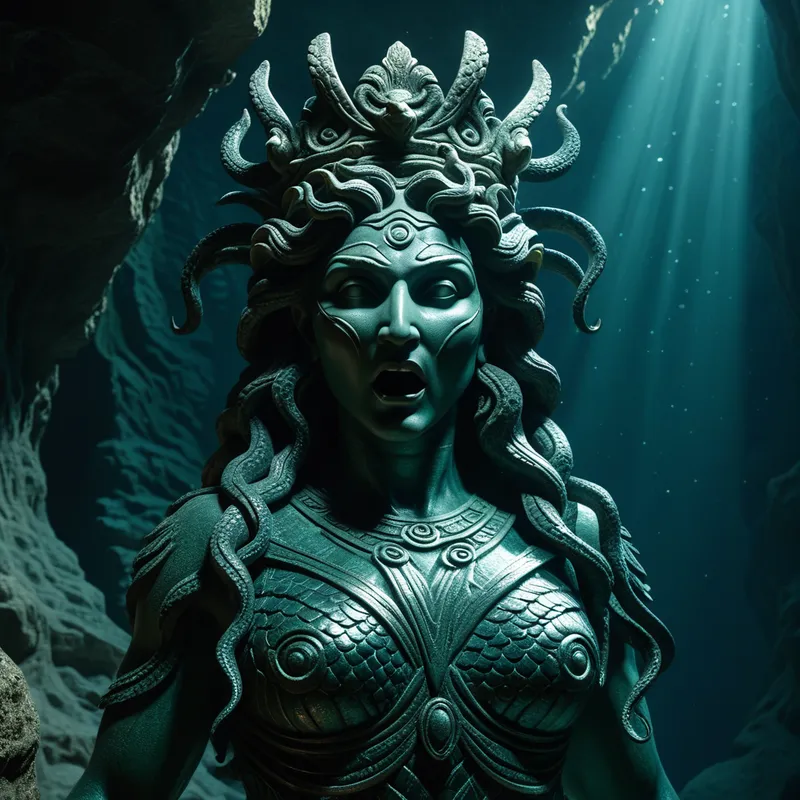
Hear now a tale from the age when gods walked with mortals, and the line between beauty and terror was as thin as a razor’s edge. In the sun-drenched lands of Hellas, there whispered a name that chilled the blood: the Gorgons. Of them, one was mortal, and her story is a tempest of divine wrath and mortal fate.
She was Medusa, and once, she was not a monster. Her hair was not a nest of vipers but a cascade darker than a midnight sea, her face a marvel that could still the waves. She served as a priestess in the temple of Athena, a vessel of the goddess’s own sacred order. But the gaze of Poseidon, the Earth-Shaker, fell upon her. In the very sanctuary of Athena, an act of violation occurred—a desecration that stained marble and soul. And the goddess’s wrath, when it came, did not fall upon the god, but upon the mortal woman. A curse, terrible and complete, was woven: Medusa’s lovely hair hissed into a tangle of living serpents; her gaze, which once inspired awe, now carried a petrifying doom. Whosoever looked upon her face directly was turned to cold, unseeing stone. Cast out, she fled to the ends of the earth, to a cavern by the shore of the night-shrouded ocean, where she dwelt with her two immortal sisters, Stheno and Euryale, their forms forever echoing her terrible new majesty.
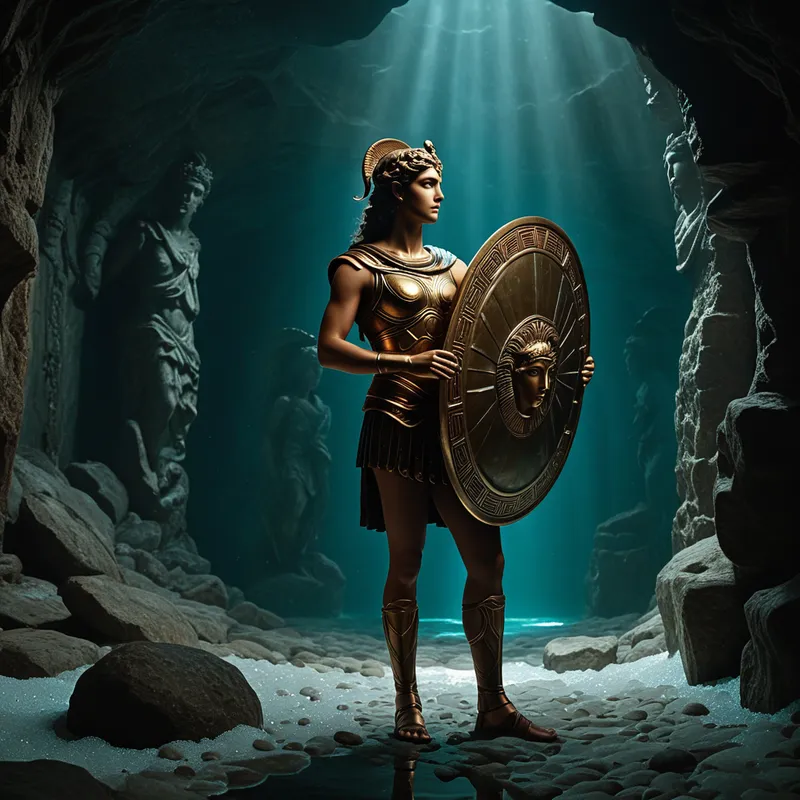
The call for a hero came from a distant island, where a tyrant demanded the Gorgon’s head. The youth was Perseus, son of Zeus, armed not with brute strength but with cunning gifts from the gods. From the Nymphs, he received winged sandals to fly, a cap of darkness to become invisible, and a magical sack. From Hephaestus, a sword sharper than a thought. And from Athena herself, a shield of bronze, polished to a mirror’s sheen.
His journey was a descent into the land of the forgotten. He flew beyond the river Oceanus, to the grey, whispering cliffs where the Gorgons slept. The air grew heavy, silent but for the distant sigh of the sea and the soft, sinister rustle of scales. The entrance to the cave was littered with statues—men, beasts, birds caught in mid-flight, all frozen in an eternal, silent scream, their faces masks of ultimate horror. Using the mirrored shield, Perseus did not look at Medusa, but at her reflection. He moved as a shadow, the cap of darkness upon him. He saw her, asleep amidst the stone garden of her victims, the serpents on her head coiling slowly in dream. In that mirrored glance, he saw not just a monster, but a profound and tragic power. With Athena guiding his hand, he struck. From the severed neck sprang the winged horse Pegasus and the giant Chrysaor, symbols of the life that persists even in death. Perseus seized the head, its eyes still deadly, and fled as the immortal sisters awoke with a wail that cracked the stones of their cave.
Cultural Origins & Context
The myth of the Gorgon, and Medusa specifically, is a bedrock story of ancient Greek culture, with roots likely stretching back into pre-Greek, possibly Minoan, earth goddess cults where serpent imagery symbolized chthonic power and regeneration. In the classical Greek context, the story was codified by poets like Hesiod in his Theogony and later vividly dramatized in the Roman poet Ovid’s Metamorphoses, whose version emphasizing Medusa’s victimhood and transformation became particularly influential.
This was an oral tradition, told by bards and depicted on temple pediments, vases, and protective amulets called Gorgoneia. The Gorgon’s face was apotropaic—meant to turn away evil, much like her gaze turned men to stone. The myth functioned on multiple societal levels: as a thrilling hero narrative validating cunning over brute force, as a theological explanation for the origins of creatures like Pegasus, and as a profound, unsettling parable about divine justice, pollution (miasma), and the terrifying power of the feminine that exists outside patriarchal control. It asked the audience to contemplate where true monstrosity lies: in the cursed woman, or in the acts that cursed her?
Symbolic Architecture
The Gorgon is not merely a monster to be slain; she is one of the most potent psychological symbols ever conceived. She represents the ultimate face of the Shadow—that which we cannot bear to look at directly within ourselves. Her petrifying gaze is the paralyzing effect of unacknowledged fear, shame, or trauma.
To look directly at the Gorgon is to be frozen in one's own unresolved conflict, becoming a monument to avoidance.
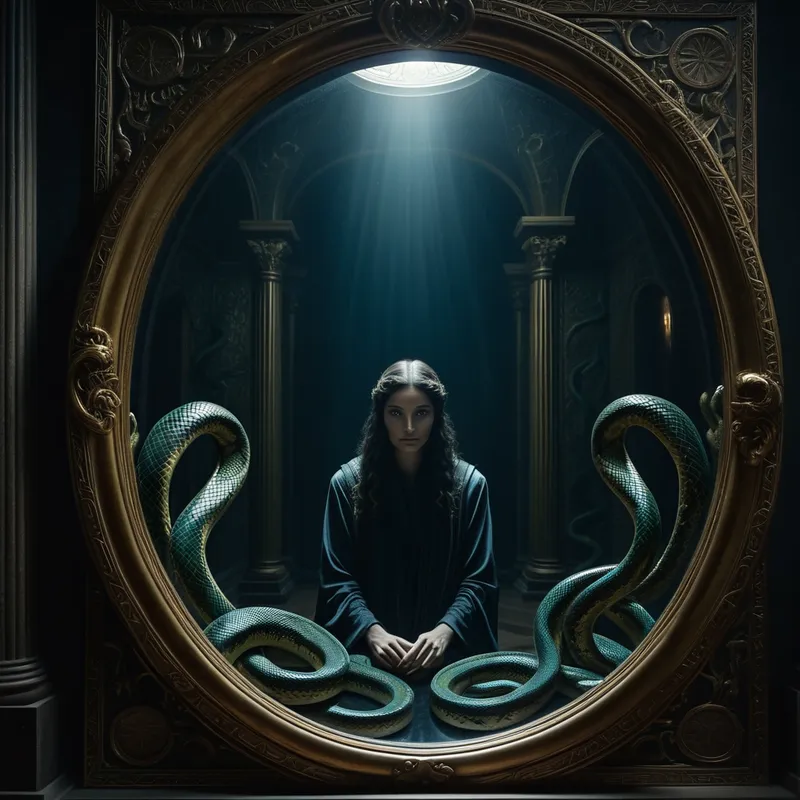
Medusa’s transformation from beautiful maiden to monstrous being symbolizes how violated innocence can calcify into rage and a protective, yet isolating, power. The serpents are ancient symbols of both death and rebirth, wisdom and primal instinct, linking her to the deep, unconscious forces of life. Perseus’s strategy is the blueprint for confronting such profound inner material: he does not face it head-on (which leads to paralysis), but indirectly, through reflection. The polished shield of Athena represents the mediating, discerning function of consciousness and wisdom—the ability to observe our darkest aspects without being identified with or destroyed by them.
The Dreamer's Resonance
When the Gorgon appears in the modern dreamscape, she heralds a critical encounter with a petrifying complex. The dreamer may not see a classical Medusa, but will experience the essence of the myth: a figure, a situation, or a gaze that induces utter somatic paralysis within the dream. This is the psyche signaling a core fear or a buried trauma that has the power to halt one’s psychological development.
The somatic experience is key—a feeling of being frozen, weighted down, turned to stone. Psychologically, the dreamer is at the threshold of a shadow integration process. The “Gorgon” in the dream is the embodied form of something they have been refusing to see: perhaps a deep-seated rage (especially linked to violation or injustice), a profound grief that feels unmanageable, or a aspect of their own power or sexuality that feels monstrous and unacceptable. The dream is presenting the terrifying face of what must be acknowledged for growth to continue.
Alchemical Translation
The myth of Perseus and the Gorgon is a precise alchemical map for the process of individuation. The initial state is one of petrificatio—being stuck, paralyzed by a life problem or neurosis (the kingdom turned to stone). The hero’s call is the stirring of the Self, demanding engagement.
The divine gifts represent the latent psychic tools we must assemble: the winged sandals (elevated perspective, intuition), the cap of darkness (the ability to withdraw conscious ego for a time), the sword (discriminating intellect), and, most crucially, the mirrored shield (self-reflection, often aided by therapy, art, or journaling). The journey to the cave is the descent into the unconscious. The confrontation is not an annihilation of the shadow (the Gorgon), but a necessary separation.
The goal is not to destroy the monster, but to sever its autonomous, paralyzing power from the conscious self, thereby liberating the creative life force (Pegasus) that was bound within it.
Perseus does not destroy the Gorgon’s head; he contains it in the magical sack (integrating its power in a managed way) and later uses it as a weapon—a symbol that once integrated, our once-paralyzing wounds can become sources of potent defense and discernment. The triumph is the liberation of life from the stronghold of stone, the transformation of a paralyzing complex into a usable, conscious power. The modern individual undergoing this alchemy learns to behold their own Medusa—not with a direct, identifying stare, but through the reflective shield of conscious awareness, thus turning stone back into living flesh.
Associated Symbols
Explore related symbols from the CaleaDream lexicon: