
The Forty Thieves
A poor woodcutter stumbles upon a secret cave filled with treasure, unleashing a dangerous conflict with a band of ruthless thieves.
The Tale of The Forty Thieves
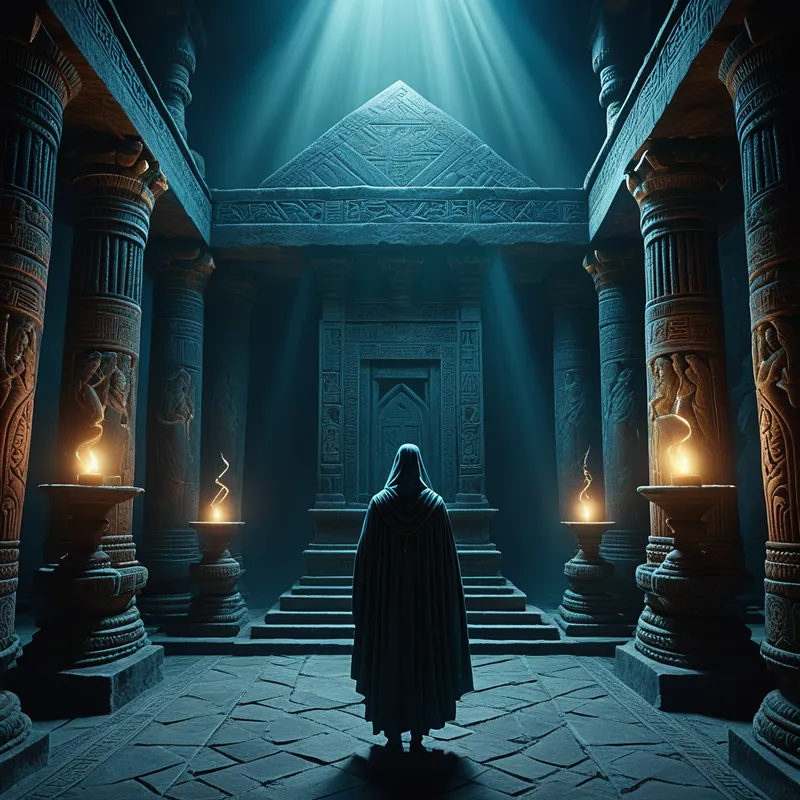
In a land of sun-baked earth and whispering date palms, there lived a poor woodcutter named Ali Baba. While gathering wood in the desolate hills, he witnessed a strange and fearsome sight: a band of forty mounted thieves approaching a sheer rock face. Their leader, a man of grim countenance, stood before the stone and uttered the incantation, “Open, Sesame!” To Ali Baba’s astonishment, a hidden door yawned open in the rock, and the men vanished inside with their spoils. When they had departed, repeating the words “Close, Sesame!” to seal [the cave](/myths/the-cave “Myth from Platonic culture.”/), curiosity overcame fear. Ali Baba stepped forward and spoke the magic phrase.
The cave that opened to him was not a dark hollow but a cavernous palace of stolen dreams. Piled from floor to ceiling were treasures beyond imagining: silks that held the memory of looms, coins that whispered of forgotten markets, jewels that captured light from a hundred different suns. It was a hoard of frozen time, a physical manifestation of avarice. Ali Baba, a simple man, took only a few modest sacks of gold coins, enough to relieve his poverty but not enough, he thought, to be noticed.
But the treasure was a sleeping beast, and its guardians were vigilant. The captain of the thieves soon discovered the theft. The purity of their hidden world had been violated. A deadly hunt began. The thieves, masters of deception and violence, sought the one who knew their secret. Through cunning and mercilessness, they traced the gold to Ali Baba’s home.
Here, the tale’s true heroine emerges: Morgiana, Ali Baba’s enslaved and fiercely intelligent servant. When the thieves mark the house with chalk, it is Morgiana who marks every house in the neighborhood with the same sign, confounding them. When the captain himself arrives, disguised as an oil merchant with his thirty-nine men hidden in large jars, it is Morgiana who discovers the lethal secret. With calm, terrible resolve, she pours boiling oil into each jar, silently executing the ambush in its womb.
The final confrontation is a dance of masks. The captain, the sole survivor, returns, ingratiating himself into Ali Baba’s household. But Morgiana, whose eyes see through illusion, recognizes him in the guise of a guest. During a ceremonial dance, she plunges a dagger into his heart. The last thief falls, and the secret of the cave, along with its boundless treasure, passes fully into Ali Baba’s keeping. [Justice](/myths/justice “Myth from Tarot culture.”/), swift and cunning, is delivered not by a prince or a soldier, but by the keen eye and steady hand of an enslaved woman.
Cultural Origins & Context
The tale of [Ali Baba and the Forty Thieves](/myths/ali-baba-and-the-forty-thieves “Myth from Arabian culture.”/) is one of the most famous narratives from the One Thousand and One Nights (often known in the West as the Arabian Nights). Unlike core stories like those of [Scheherazade](/myths/scheherazade “Myth from Global culture.”/) or Sinbad, Ali Baba was not part of the earliest Arabic manuscripts. Scholars believe it was a later addition, possibly a folk tale of Persian or Mesopotamian origin incorporated into the corpus by European translators like Antoine Galland in the 18th [century](/myths/century “Myth from Biblical culture.”/), who heard it from a Syrian storyteller. Despite this complex lineage, it has been thoroughly embraced and is now considered a quintessential part of the Islamic-world storytelling tradition.
Its cultural grounding is profound. It reflects a world where vast disparities in wealth existed, where a man’s fortune could change in an instant through fate (nasib), and where cunning (kayd) was often more vital than brute strength. The social hierarchy is clear: Ali Baba is a humble, honest laborer; his wealthy brother Cassim is greedy and arrogant; the thieves exist outside the social order as predators; and Morgiana occupies the lowest rung as a bonded servant. The story is a fantasy of inversion, where the lowly are elevated not by birthright, but by a combination of accidental fortune, moral relativism, and superior wit. It is a narrative deeply concerned with the ethics of wealth—is the treasure truly Ali Baba’s, given its bloody provenance?—and the nature of true intelligence, which resides in the marginalized Morgiana.
Symbolic Architecture
The myth constructs a profound psychic [landscape](/symbols/landscape “Symbol: Landscapes in dreams are powerful symbols representing the dreamer’s emotional state, personal journey, and the broader context of life situations.”/). The Cave is the central [symbol](/symbols/symbol “Symbol: A symbol can represent an idea, concept, or belief, serving as a powerful tool for communication and understanding.”/): it is the hidden [vault](/symbols/vault “Symbol: A secure, enclosed space for storing valuables or secrets, often representing hidden aspects of the self or protected resources.”/) of the unconscious, the repository of all that is repressed, stolen, or hoarded—both [material](/symbols/material “Symbol: Material signifies the tangible aspects of life, often representing physical resources, desires, and the physical world’s influence on our existence.”/) [wealth](/symbols/wealth “Symbol: Wealth in dreams often represents abundance, security, or inner resources, but can also symbolize burdens, anxieties, or moral/spiritual values.”/) and shadowy desires. To enter it requires the Key of a secret [word](/symbols/word “Symbol: Words in dreams often represent communication, expression, and the power of language in shaping our realities.”/) (“Sesame”), representing the power of directed [consciousness](/symbols/consciousness “Symbol: Consciousness represents the state of awareness and perception, encompassing thoughts, feelings, and experiences.”/) to access hidden realms.
The thieves represent the raw, undifferentiated forces of the shadow—acquisitive, violent, and tribal. Their destruction by Morgiana symbolizes the necessary integration and transformation of these chaotic energies by the discerning, attentive psyche (the servant who manages the household).
Ali Baba himself is the archetypal [Orphan](/symbols/orphan “Symbol: Represents spiritual abandonment, primal vulnerability, and the quest for belonging beyond biological ties. Often signifies a soul’s journey toward self-reliance.”/), the naive ego stumbling upon a power far greater than itself. His initial passivity—he takes [treasure](/symbols/treasure “Symbol: A hidden or valuable object representing spiritual wealth, inner potential, or divine reward.”/) but does not actively fight for it—places him in perpetual [danger](/symbols/danger “Symbol: The symbol of ‘Danger’ often indicates a sense of threat or instability, calling for caution and awareness.”/). The conflict is ultimately resolved not by him, but by the animating, resourceful, and protective feminine principle embodied by Morgiana. She is the active intelligence of the [soul](/symbols/soul “Symbol: The soul represents the essence of a person, encompassing their spirit, identity, and connection to the universe.”/), performing the necessary Sacrifice (the act of killing) to preserve the whole. The boiling oil is a chillingly efficient symbol of transformative, purifying Fire applied to a hidden [threat](/symbols/threat “Symbol: A threat in dreams often reflects feelings of vulnerability, anxiety, or fear regarding one’s safety or well-being. It can indicate unresolved conflicts or the presence of external pressures.”/).
The Dreamer’s Resonance
For the individual [psyche](/myths/psyche “Myth from Greek culture.”/), this tale maps the sudden, often destabilizing encounter with unconscious content. The “treasure” could be a nascent talent, a repressed memory, or a burst of creative energy that surfaces unexpectedly. Like Ali Baba, we may be tempted to take it and pretend life can continue unchanged. But the “thieves”—the complexes, old wounds, or self-sabotaging patterns that guard this treasure—will inevitably seek to reclaim it. The dreamer’s journey here is one of moving from accidental discovery to conscious stewardship.
Morgiana’s role is crucial for modern interpretation. She represents the inner figure of vigilant awareness, the part of us that notices the “marks on the door” (the signs of impending psychological crisis) and takes proactive, sometimes drastic, measures to ensure survival. Her actions, though violent, are in service of [the ego](/myths/the-ego “Myth from Jungian culture.”/)’s continued existence and hard-won stability. The tale reassures that we possess an inner resourcefulness capable of outwitting our most entrenched inner predators, but it requires acknowledging and empowering that often-overlooked part of ourselves.

Alchemical Translation
The narrative is a perfect allegory for the alchemical opus. The base material is the rough, unrefined Forest of Ali Baba’s impoverished life. The [prima materia](/myths/prima-materia “Myth from Alchemical culture.”/) is discovered in the Cave (the [vas hermeticum](/myths/vas-hermeticum “Myth from Alchemical culture.”/) or sealed [vessel of transformation](/myths/vessel-of-transformation “Myth from Alchemical culture.”/)). [The first stage](/myths/the-first-stage “Myth from Alchemical culture.”/), [nigredo](/myths/nigredo “Myth from Alchemical culture.”/), is represented by the dark, murderous intent of the thieves and the blackness of the hidden cave.
The thieves’ gold is aurum non vulgi—the common, unperfected gold of worldly desire. Morgiana’s actions, particularly the use of boiling oil, symbolize the separatio and calcinatio—the burning away of impurities (the murderous thieves) from the substance. The final killing of the captain is the mortificatio, the necessary death of the old, predatory consciousness.
Ali Baba’s journey is one of exaltatio—he is raised from poverty. But the true alchemical gold, the [lapis philosophorum](/myths/lapis-philosophorum “Myth from Alchemical culture.”/), may not be the treasure itself, but the achieved state of secure consciousness, protected by the integrated cunning (Morgiana) and tempered by the ordeal. The secret word “Sesame,” which opens the mountain, is the verbum ignotum, the lost or secret formula that initiates the entire transformative process.
Associated Symbols
Explore related symbols from the CaleaDream lexicon:
- Cave — The hidden chamber of the unconscious, a repository of repressed treasures, memories, and primal fears, accessible only through a secret key.
- Key — The precise knowledge, word, or insight that unlocks hidden realms of the psyche or material world, granting access to what was sealed away.
- Shadow — The unconscious aspect of the personality composed of repressed weaknesses, desires, and instincts, often perceived as a threatening “other.”
- Fire — A transformative and purifying force that consumes the old and impure, enabling rebirth; here, it is the boiling oil that destroys hidden threats.
- Sacrifice — The necessary act of surrendering or destroying one [thing](/myths/thing “Myth from Norse culture.”/), often a part of [the self](/myths/the-self “Myth from Jungian culture.”/) or an old pattern, to ensure a greater survival or gain.
- Mask — The facade of identity worn for deception or protection; the thieves and their captain use literal and social disguises to infiltrate and attack.
- Justice — The moral principle of fairness and retribution, achieved here not by law but by cunning and the violent rebalancing of scales.
- Trickster — The archetypal figure who uses wit and deception to overturn the established order; Morgiana embodies this role to defeat a greater evil.
- Wealth — Material abundance that tests character, acts as a catalyst for conflict, and symbolizes both potential blessing and profound moral danger.
- Forest — The untamed, unknown periphery of the known world where fateful discoveries are made and the ordinary rules of society are suspended.
- Door — [The threshold](/myths/the-threshold “Myth from Folklore culture.”/) between worlds—the visible and hidden, safety and danger, ignorance and knowledge—activated by a magical command.
- Servant — The overlooked, undervalued force whose loyalty, perception, and action ultimately determine the fate of the nominal master and the household.