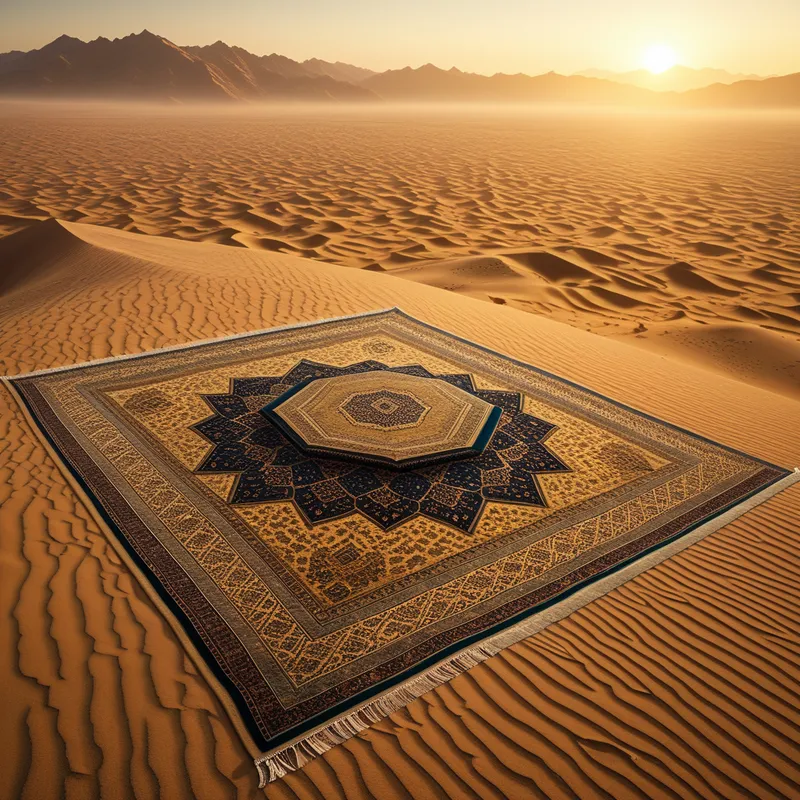
The Flying Carpet Myth Meaning & Symbolism
A tale of a humble weaver who, through faith and forgotten craft, creates a carpet that carries him beyond the confines of his earthly existence.
The Tale of The Flying Carpet
Listen, and let the wind carry you back to a time when the world was woven from stories. In a city of baked clay and whispering minarets, where the air smelled of saffron and dust, there lived a weaver named Khalid. His fingers were gnarled like old roots, but they danced upon the loom with a grace that spoke of decades listening to the silent language of thread and color. He was a man of little word and less wealth, his world bounded by the four walls of his workshop and the market square.
Yet, Khalid harbored a secret ache, a longing not for riches, but for the horizon. Each night, he would climb to his flat roof and watch the stars wheel in their silent caravan across the black velvet of the sky. He felt the call of the Rub' al Khali, the Empty Quarter, and the legendary cities beyond the mountains—Samarkand with its turquoise domes, the spice ports of the Indian coast. His body was earthbound, but his soul was a migratory bird with no wings.
One evening, as the call to prayer faded into twilight, a stranger appeared at his door. He was an old man, lean and weathered as a desert stone, his eyes holding the deep stillness of a well. He carried no goods, only a small, oiled leather pouch. “They say you weave the dreams of the earth into your carpets, Khalid,” the stranger said, his voice like dry leaves. “I have no coin, but I have a story. A story of the First Weaver, who learned the craft from the Jinn of the winds. In return for your hospitality, I will tell it to you.”
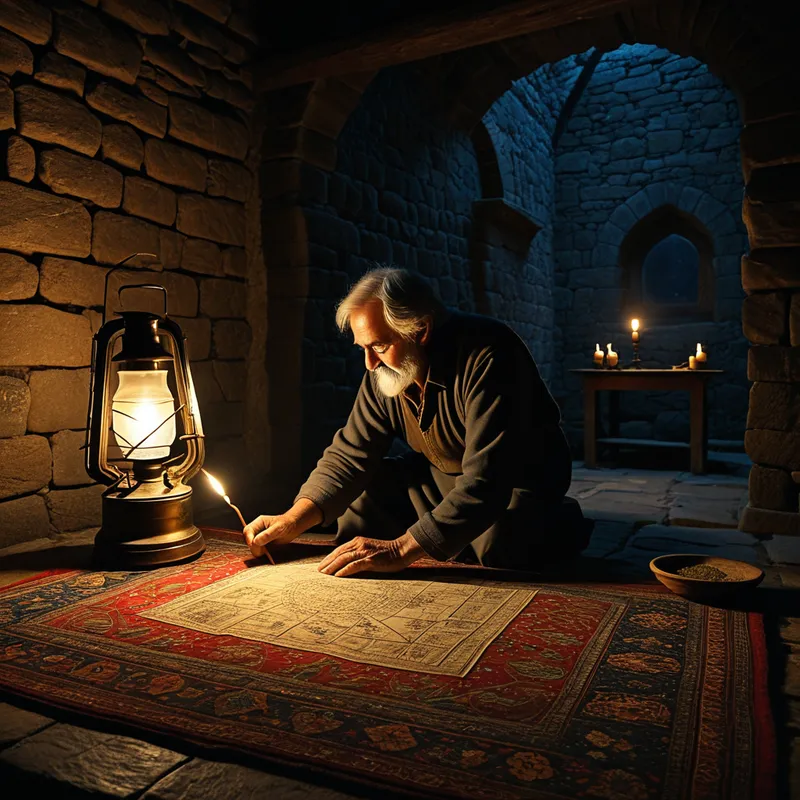
For three nights, Khalid fed the stranger dates and flatbread, and in return, the old man spun a tale not of patterns, but of intention. He spoke of weaving not just with wool and dye, but with breath and prayer, of tying each knot as a sacred syllable, of embedding the desire of the heart into the very warp and weft. The final night, the stranger placed a handful of iridescent threads into Khalid’s palm—threads that shimmered like captured moonlight and desert mirage. “These are for the border,” he said. “Weave your deepest longing into the center. But remember: the carpet will only fly for one whose faith is stronger than his fear.” With that, the stranger vanished into the pre-dawn gloom, as if he were mist.
Khalid worked for forty days and forty nights. He fasted and prayed. He did not weave scenes of gardens or palaces. Instead, he wove the feeling of the wind on his face, the scent of distant rain, the dizzying void of the open sky. Into the center, with the luminous threads, he wove a single, perfect symbol: the yearning of his own heart.
The night he tied the final knot, a strange vibration hummed through the workshop. The carpet lay complete, glowing softly on the stone floor. Trembling, Khalid stepped onto it. He thought of the horizon, of the stars, of the story. He whispered the name of the Divine, not as a plea, but as an affirmation. And then, with a sigh like the world taking a deep breath, the edges of the carpet curled. It lifted, floating a hand’s breadth above the ground. Khalid’s fear screamed at him to step off, to cling to the known world of clay and loom. But his faith, a small, bright ember nurtured over forty nights, burned brighter. He thought, “Forward.”
The carpet rose. It slid through the open window like a silent fish through water and into the cool night air. Khalid, the earthbound weaver, soared. He passed over the sleeping city, a tapestry of shadow and the occasional lantern glow. He climbed above the mountains, where the air was thin and sharp, and the carpet bore him steadily. He was not riding; he was part of the journey, a single note in a hymn of motion. He flew until the first thread of dawn stretched across the east, a golden line on the loom of the sky, a weaver witnessing the grand pattern from the outside, finally free.
Cultural Origins & Context
The motif of the Flying Carpet is a migratory myth, finding its most famous articulation in the woven narratives of the One Thousand and One Nights, but its roots tap into a much older, pan-Eurasian soil. It is a folktale of the mercantile and nomadic worlds, traveling along the Silk Road with caravans and storytellers. While often associated with Persian and Arabic storytelling traditions, its essence appears in various forms—from the magic sails of Celtic lore to the mystical blankets of Native American traditions.
This was not a myth confined to palace courts (though it was told there); it was a story of the artisan, the merchant, the dreamer. It was told in caravanserais under vast, starry skies, in humble workshops, and in family courtyards. Its societal function was multifaceted: it was a fantasy of liberation from social and physical constraints, a celebration of sublime craftsmanship (Ihsan), and a metaphorical map for spiritual aspiration. The carpet itself symbolized the pinnacle of human art, infused with a spark of the supernatural, suggesting that when craft is married to pure intention, it can transcend its material nature.
Symbolic Architecture
At its core, the flying carpet is an emblem of liberated imagination. It represents the human capacity to create a vehicle—an idea, a art, a belief system—that can transport consciousness beyond the literal and limiting terrain of the “given” world.
The carpet is the soul’s vehicle, woven from the threads of experience, dyed with the colors of emotion, and given flight only by the breath of unwavering intent.
The weaver, Khalid, is the archetypal ego who feels trapped in a mundane reality. His workshop is the confined self. The mysterious stranger is the catalyst, the emissary from the unconscious who provides the missing knowledge—the symbolic “luminous threads” of insight or inspiration that border and define a new possibility. The act of weaving is the disciplined, focused work of integrating this unconscious material into a conscious structure (the carpet/ the nascent self). The flight is not an escape, but an ascent into a broader perspective, a viewing of one’s life and the world from a transcendent vantage point.
The Dreamer's Resonance
When the flying carpet appears in a modern dream, it seldom manifests as a literal, ornate rug. More often, it is the sensation: a sudden, buoyant lift in a familiar place—a bed, a car, an office chair—that begins to float. Or it may be a blanket, a yoga mat, or a piece of flooring that detaches and carries the dreamer.
This dream signals a profound psychological process: the somatic feeling of release from an entrenched pattern. The dreamer is, often unconsciously, weaving a new “vehicle” for their identity. The flight represents the nascent, thrilling, and terrifying experience of this new structure bearing weight. The common fear of falling reflects the ego’s anxiety about abandoning old, solid ground. A successful, joyous flight in the dream indicates a psyche that is successfully integrating a transcendent function—allowing a greater, more liberated aspect of the Self to carry it beyond a previous limitation. It is the dream of the soul in mid-transformation, feeling the first currents of its own newfound capability.

Alchemical Translation
The myth of the flying carpet is a precise allegory for the alchemical process of individuation. The base material (prima materia) is the weaver’s confined life and his longing. The nigredo, or blackening, is his despair and isolation on the rooftop. The stranger’s story is the influx of the ignis—the enlightening, inspiring spark from the unconscious.
The forty days of weaving are the albedo, the whitening—the arduous, conscious work of purification and construction. Khalid must distill his diffuse longing into a focused, woven pattern. He must purify his intention (fasting, prayer) to remove the “lead” of doubt and fear.
The moment the carpet lifts is the citrinitas, the dawning of a new conscious attitude. The full flight into the starry night is the rubedo, the reddening—the glorious, lived experience of the liberated Self.
For the modern individual, the “carpet” is any deeply personal creation—a relationship, a career path, a philosophical understanding, a work of art—into which one has woven their truest intention and most disciplined effort. The “flight” is the moment that creation ceases to be a burden or a project and instead becomes the very vehicle that expands your world, carrying you to perspectives you could not have reached by walking the old, familiar roads. The myth teaches that liberation is not found by fleeing the loom, but by mastering it so completely that your craft becomes your wings.
Associated Symbols
Explore related symbols from the CaleaDream lexicon: