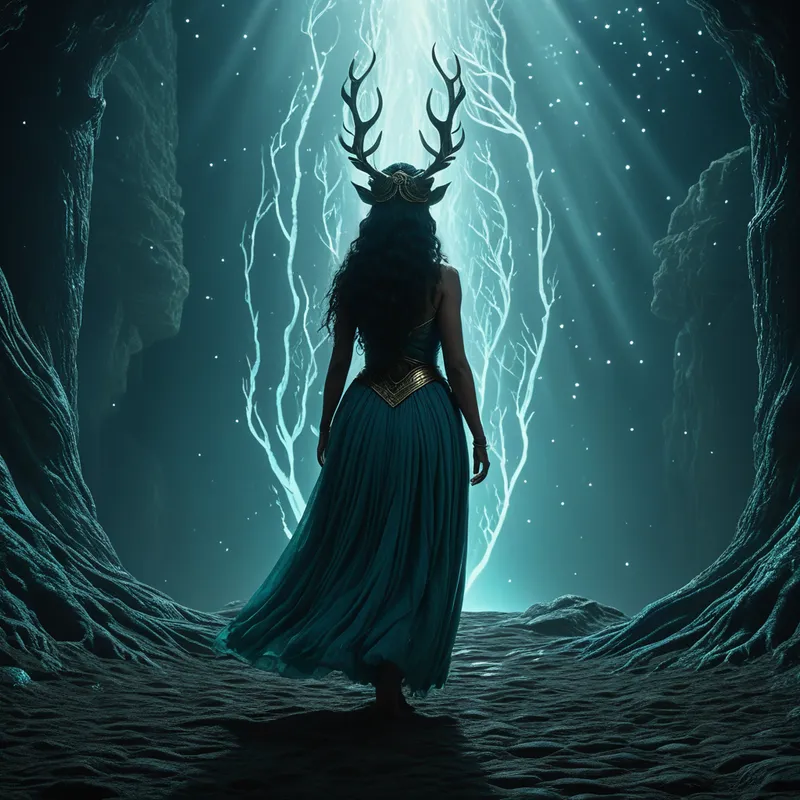
The First Shaman Amazon
The legendary first shaman of Amazonian lore who bridged the spirit world and warrior society through forbidden rituals and profound spiritual insight.
The Tale of The First Shaman Amazon
In the beginning, there was only the rhythm of the spear and [the law](/myths/the-law “Myth from Biblical culture.”/) of the bow. The Amazon nation was a perfect circle of warriors, a society honed to a single, gleaming edge. Their gods were gods of strength and victory; their rituals, the stamping of feet and the clashing of shields. [The world](/myths/the-world “Myth from Tarot culture.”/) beyond [the campfire](/myths/the-campfire “Myth from Universal culture.”/) was a realm of enemies and prey, and [the world](/myths/the-world “Myth from Tarot culture.”/) within was one of unbroken tradition. There was no language for the whispers that came on [the wind](/myths/the-wind “Myth from Various culture.”/), no ceremony for the visions that visited in the stillness of the hunt.
Her name is lost, or perhaps it was never spoken, for to name her would be to confine what she became. She was a warrior like any other, her body a map of scars, her spirit forged in the communal fire. But during a solitary hunt deep in the green cathedral of the forest, a silence fell upon her so complete it had a sound of its own. A jaguar, spirit of the tangled undergrowth, regarded her not as prey, but as an equal. In its eyes, she did not see a threat, but a Mirror. In that moment, the boundary between her flesh and the flesh of the world grew thin.
She returned to the village carrying not game, but a sickness. It was not a sickness of the body, but of the soul—a profound dislocation. The familiar chants of war sounded hollow; the faces of her sisters seemed like masks. At night, the forest entered her dreams not as a territory to be mastered, but as a living, breathing entity with a thousand voices. She began to hear the lament of [the river](/myths/the-river “Myth from Buddhist culture.”/), the ancient memory of the stones, the secret language of the healing plants. This knowledge was a form of treason in a culture that valued actionable intelligence and physical prowess above all else.
Driven by a compulsion she could not name, she began to slip away at dusk. She sought out places of power: the lone ceiba tree that touched the Sky, the black pool where the moonlight pooled like liquid silver, the hidden Cave behind the waterfall. There, alone, she began to experiment. She fasted. She ingested the bitter brews of certain vines and fungi, guided by the plants themselves. She danced until her warrior’s discipline shattered and a raw, untamed movement emerged—a Dance not of [triumph](/myths/triumph “Myth from Roman culture.”/), but of dissolution and re-formation.
In these states, she journeyed. She descended into the dark, moist belly of the Earth and met the ancestors, not as glorious warriors on eternal plains, but as complex spirits tangled in the roots of memory. She ascended and wrestled with the storm gods, learning that Lightning could cleanse as well as destroy. She discovered that the great Bridge between the worlds was woven from attention, sacrifice, and song.
When she returned to her people, she was irrevocably changed. She spoke of healing wounds that no spear had made, of interpreting the dreams that visited the camp, of negotiating with the spirits of the land for bounty and protection. To the warrior council, this was dangerous madness. Her knowledge was forbidden, her practices a threat to the clear, hierarchical Order. They saw her not as a bridge, but as a crack in their foundational stone.
Yet, when a plague of silence fell upon the children, and when the game disappeared from the forest, their strength proved useless. In desperation, they turned to her, the broken one. She did not pick up a weapon. Instead, she gathered the community. She led them in a new kind of Ritual. She used a gourd filled with seeds—the first [Shaman’s Rattle](/myths/shamans-rattle “Myth from Indigenous American culture.”/)—to call the scattered souls of the sick back home. She showed them how to offer gratitude to the spirit of the hunted animal. She became the translator for the unseen, and in doing so, she did not destroy the warrior’s way. She deepened it. She gave it a soul. She became [the First Shaman](/myths/the-first-shaman “Myth from Mongolian culture.”/), the one who heard the world’s heartbeat and taught her people to listen.
Cultural Origins & Context
The myth of the First Shaman Amazon arises from the rich spiritual soil of various Amazonian cultures, where [the shaman](/myths/the-shaman “Myth from Siberian culture.”/) (pajé, curandero) is a central, albeit often ambivalent, figure. Unlike the structured priestly classes of Andean or Mesoamerican civilizations, the Amazonian shaman is typically an individual who has undergone a radical, personal, and often traumatic transformation. This narrative perfectly mirrors that archetypal calling.
The story is grounded in the very real tension between the communal, survival-oriented life of the village and the solitary, perilous path of the shaman. Amazonian societies, while often depicted solely as warrior cultures, possessed complex relationships with their environment, necessitating experts in ecological and spiritual mediation. The shaman fills this role, but their power is inherently unstable and personal, derived from direct spirit contact rather than institutional sanction. The myth reflects the historical reality that the first shamans were likely individuals who stood outside normative social roles, their authority wrested from the spirit world itself, often in defiance of human tradition. It speaks to a cultural understanding that true spiritual power is not inherited or appointed, but earned through a harrowing, individual Journey that redefines the traveler.
Symbolic Architecture
The myth constructs a profound symbolic [landscape](/symbols/landscape “Symbol: Landscapes in dreams are powerful symbols representing the dreamer’s emotional state, personal journey, and the broader context of life situations.”/) where the values of the [warrior](/symbols/warrior “Symbol: A spiritual archetype representing inner strength, discipline, and the struggle for higher purpose or self-mastery.”/) society—[clarity](/symbols/clarity “Symbol: A state of mental transparency and sharp focus, often representing resolution of confusion or attainment of insight.”/), [strength](/symbols/strength “Symbol: ‘Strength’ symbolizes resilience, courage, and the ability to overcome challenges.”/), boundaries—are confronted by the shamanic values—fluidity, negotiation, and permeability.
The Forest is not merely a setting but the primal, undifferentiated psyche itself. It is the chaotic, fecund source of all life and knowledge, which the warrior seeks to control and the shaman seeks to commune with. Her entry into its deepest heart symbolizes a descent into the unconscious.
The Sickness she brings back is the sacred illness, the archetypal crisis that precedes initiation. It represents the death of the old, socially-constructed identity (the warrior) and the agonizing gestation of the new, more complex self (the shaman). It is the Cocoon Transformation made visceral.
The community’s initial rejection and eventual reliance upon her illustrates the eternal tension between the Traditional structure, which maintains stability, and the transformative individual, the Shaman, who brings renewal but also chaos. The shaman is the immune system of the culture, but the fever of healing is often mistaken for the disease.
The Dreamer’s Resonance
For the modern [psyche](/myths/psyche “Myth from Greek culture.”/), the First Shaman Amazon is a powerful figure of individuation. She embodies the courage to heed a call that makes no sense to one’s tribe, to value the intelligence of the body and the intuition over the consensus of the conscious mind. Her journey validates the experience of those who feel a profound alienation from the dominant “warrior” values of their culture—be it hyper-rationality, materialism, or relentless productivity.
Her myth speaks to anyone who has encountered a psychological or spiritual crisis that shattered their old identity. The “green sickness” she carries is akin to depression, creative block, or a sudden, disorienting awakening that renders former goals meaningless. The myth assures us that this rupture is not an end, but the difficult beginning of a deeper integration. It suggests that true wholeness requires us to leave the campfire of collective certainty and venture alone into the interior Forest, to learn the languages of our own unseen wounds and wild inspirations. She is the archetype of the healed healer, whose authority comes from having navigated her own darkness.

Alchemical Translation
Psychologically, the myth maps the alchemical process of [solve et coagula](/myths/solve-et-coagula “Myth from Alchemical culture.”/)—dissolve and reconstitute. The warrior identity, a compound of social expectations and personal discipline, is dissolved in the bitter waters of her visionary experiences. The rigid ego-structure is broken down.
This dissolution is the nigredo, the blackening, represented by her isolation, her sickness, and her journeys into the cave—the underworld of the psyche. She confronts her Shadow, the un-warrior-like parts of herself and her culture: vulnerability, receptivity, mystery.
The subsequent stage is the [albedo](/myths/albedo “Myth from Alchemical culture.”/), the whitening, where new insights are purified and integrated. She learns to translate the chaotic visions into practical Healing and guidance. The final [rubedo](/myths/rubedo “Myth from Alchemical culture.”/), the reddening, is her return to the community. She does not return as a purified spirit, but as a synthesized being: the warrior’s will now serves the shaman’s vision, and the shaman’s knowledge empowers the warrior’s world. She becomes the living Bridge, the embodied Ritual that holds the tension between opposites, turning the lead of tribal conflict into the gold of cultural depth.
Associated Symbols
Explore related symbols from the CaleaDream lexicon:
- [Shamanic Journey](/myths/shamanic-journey “Myth from Siberian culture.”/) — The archetypal voyage into non-ordinary reality to retrieve knowledge, heal, or negotiate with spiritual forces, defining the shaman’s purpose and power.
- Transformation Cocoon — A state of seclusion, crisis, or incubation where the old self dissolves so a new, more complex identity can form.
- Forest — The realm of the untamed psyche, primal mystery, and unlimited potential, representing both danger and the source of all wisdom.
- Mirror — A tool for deep reflection, revealing not the surface image but the true nature of the soul or the spirit world.
- Bridge — A perilous and essential connector between the known world and the unknown, the conscious and the unconscious, the human and the divine.
- Ritual — A prescribed, symbolic act performed to mediate between realms, transform reality, and anchor spiritual power in the physical world.
- Cave — A place of descent into [the underworld](/myths/the-underworld “Myth from Greek culture.”/) of the psyche, a womb for incubation, and a site of confrontation with primal truths.
- Dance — Ecstatic, trance-inducing movement used to shatter ordinary consciousness, embody spirit, and enact cosmic patterns.
- Sickness — The sacred illness or initiatory crisis that dismantles the old identity, creating the necessary void for a new vocation or consciousness.
- Shaman’s Rattle — The instrument of invocation and travel, its sound creating [the bridge between worlds](/myths/the-bridge-between-worlds “Myth from Sufi culture.”/) and calling fragmented spirits home.
- Lightning — Sudden, devastating illumination that clears away old structures and brings a forceful, transformative awakening.
- Healing — The restoration of wholeness on individual or communal levels, often involving the reintegration of lost soul parts or the balancing of spiritual relationships.