The First Humans from the Womb of the Earth
An Amazonian creation myth where humanity emerges from the Earth's womb, exploring themes of birth, connection to nature, and the primal origins of life.
The Tale of The First Humans from the Womb of the Earth
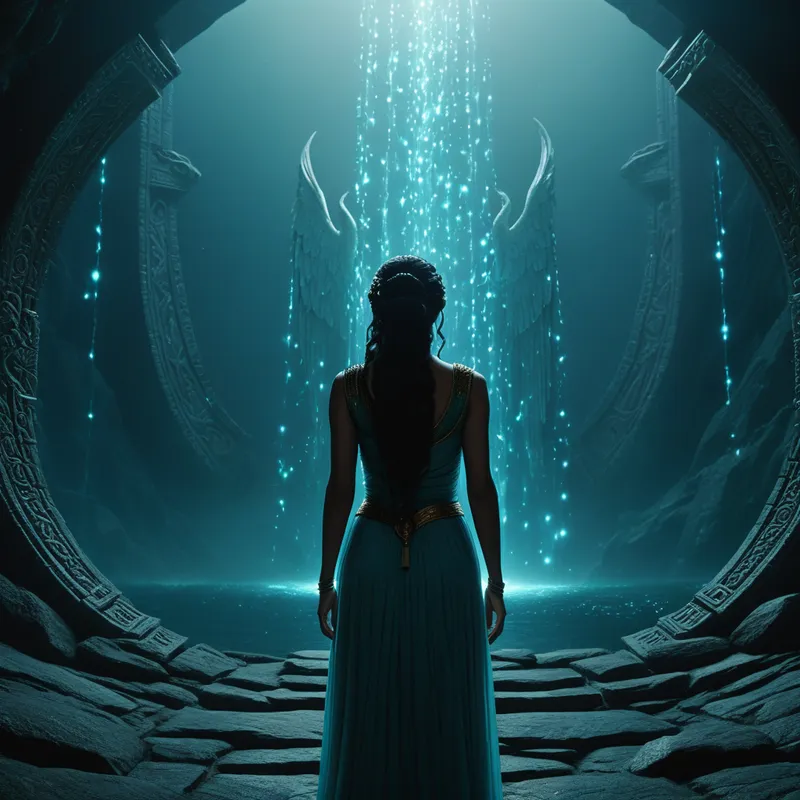
In the time before time, when [the world](/myths/the-world “Myth from Tarot culture.”/) was a great, living body, [the Earth](/myths/the-earth “Myth from Hindu culture.”/) was not a [thing](/myths/thing “Myth from Norse culture.”/) to be walked upon, but a vast, dreaming mother. She was [Pachamama](/myths/pachamama “Myth from Incan culture.”/), her forests a tangled mantle of hair, her rivers the pulsing veins, her mountains the bones of her sleeping form. Within her deepest, most secret place, there existed not a heart of stone, but a womb of warm, dark clay, moist and fertile. This was the Uterus of All Beginnings.
There was no light there, only the profound, comforting darkness of potential. The elements swirled in a primordial embrace: the heat of the deep fire, the coolness of underground waters, the richness of minerals, and the breath of the spirit-winds that traveled through her caverns. This mixture was not inert; it was a dreaming sludge, a clay that held the memory of what could be. The Earth Mother dreamed of companions, of beings who would know the taste of rain and the touch of wind, who would sing back to the birds and trace the paths of the rivers. Her longing was not a thought, but a slow, tectonic pressure, a gathering ache in her fertile core.
This pressure grew until it became a rhythmic, contracting pulse. The walls of the great womb trembled. The clay within, infused with her dreaming essence, began to stir. It did not take shape by the hand of a distant god, but through the intimate, straining effort of birth itself. The first forms were soft, unformed—lumps of earth that held within them the spark of the mother’s dream. With each contraction of the Earth, they were pressed closer to the world above, pushed through the dark, root-threaded passages that were her [birth canal](/myths/birth-canal “Myth from Various culture.”/).
The journey was arduous. Some forms dissolved back into the clay, their potential returning to the source. Others were shaped by the passage, molded by the pressure of stone and the caress of mineral-rich [water](/myths/water “Myth from Chinese culture.”/). They emerged not in a sunlit meadow, but into the dim, humid twilight of the primordial forest floor, from a great opening in the side of a clay-rich riverbank or from the mouth of a sacred cave—the vulva of the world. They were covered in the mud of their origin, gasping not with air from lungs they did not yet possess, but with the first shock of separation.
They were the First People: soft, earthen, and utterly vulnerable. The light, filtered through a million leaves, was a searing revelation. The cacophony of the forest—the shriek of birds, the rustle of beasts, the endless drone of insects—was a terrifying symphony. They had known only the silent, pressing unity of [the womb](/myths/the-womb “Myth from Various culture.”/); now they knew the brilliant, painful diversity of life. They wept tears of mud, and where their tears fell, the first edible tubers sprouted. They trembled with fear, and their trembling taught them the rhythm of the dance. They reached for each other with clumsy hands of clay, and in that touch, they learned connection.
They were not finished beings. The sun baked their skins harder. The rains washed them cleaner, revealing the subtle variations the womb’s contractions had given them. They learned to eat from the mother’s body—fruits from her hair, fish from her veins—and in doing so, they completed the circuit of life. They were born of her, and they would live from her, a truth etched into their very substance. The primal tension was born in that moment of emergence: the eternal pull between the longing to return to the warm, undifferentiated darkness of the womb, and the drive to walk forward into the bright, demanding reality of the forest, carrying the memory of the clay within them.
Cultural Origins & Context
This narrative is woven from the cosmological understandings of numerous Indigenous peoples across the Amazon Basin, including but not limited to the Uitoto, the Yanomami, and the Shuar. For these cultures, the Earth is not a passive resource but a sentient, generative entity. The concept of humanity emerging from a literal terrestrial womb reflects a worldview of absolute kinship and interdependence. There is no “creation ex nihilo” (from nothing) by a detached deity; there is only transformation and birth from the substance of the living world.
This origin story is the foundational logic for ecological and social ethics. If humans are literally born from the Earth’s body, then clear-cutting the forest is not forestry—it is matricide. Poisoning [the river](/myths/the-river “Myth from Buddhist culture.”/) is not pollution—it is poisoning the communal bloodstream. The myth establishes a relationship of profound obligation and reciprocity. Rituals, from planting ceremonies to funerary practices (where the body is often returned to the earth), are acts of conversation with the Mother, ways of giving back to the womb from which all came. The story is not about a past event but a continuous, present-tense reality; every human life is a re-enactment of that first, muddy emergence.
Symbolic Architecture
The myth’s power lies in its visceral, bodily metaphors. The [Earth](/symbols/earth “Symbol: The symbol of Earth often represents grounding, stability, and the physical realm, embodying a connection to nature and the innate support it provides.”/)’s [womb](/symbols/womb “Symbol: A symbol of origin, potential, and profound transformation, representing the beginning of life’s journey and the unconscious source of creation.”/) is the ultimate [symbol](/symbols/symbol “Symbol: A symbol can represent an idea, concept, or belief, serving as a powerful tool for communication and understanding.”/) of immanent creation—divinity is not in a distant [heaven](/symbols/heaven “Symbol: A symbolic journey toward ultimate fulfillment, spiritual transcendence, or connection with the divine, often representing life’s highest aspirations.”/) but in the very [soil](/symbols/soil “Symbol: Soil symbolizes fertility, nourishment, and the foundation of life, serving as a metaphor for growth and stability.”/) underfoot. The [birth](/symbols/birth “Symbol: Birth symbolizes new beginnings, transformation, and the potential for growth and development.”/) [canal](/symbols/canal “Symbol: A canal in dreams can symbolize pathways through which emotions, ideas, or experiences flow, often relating to the direction of life’s journey.”/), often depicted as a cave or a [muddy riverbank](/symbols/muddy-riverbank “Symbol: The muddy riverbank symbolizes transition, emotional grounding, and the messy realities of life in the context of ancient food preparation.”/), represents the traumatic but necessary threshold between the unconscious unity of potential and the conscious complexity of individual [life](/symbols/life “Symbol: The symbol of ‘Life’ represents a journey of growth, interconnectedness, and existential meaning, encompassing both the joys and challenges that define human experience.”/).
The emergence into the forest’s sensory overload symbolizes the primordial human condition: the shock of consciousness itself. We are born into a world we did not make, overwhelmed by data, longing for the peace of the pre-conscious state, yet compelled to engage.
The unfinished state of the first humans—their soft, [clay](/symbols/clay “Symbol: Clay symbolizes malleability, creativity, and the potential for transformation, representing the foundational aspect of life and the ability to shape one’s destiny.”/) bodies—is crucial. It signifies that our “humanity” is not a pre-programmed gift but a process of co-creation with the world. We are hardened by experience (the sun), cleansed by [emotion](/symbols/emotion “Symbol: Emotion symbolizes our inner feelings and responses to experiences, often guiding our actions and choices.”/) (the rain), and shaped by [relationship](/symbols/relationship “Symbol: A representation of connections we have with others in our lives, often reflecting our emotional state.”/) (the touch of others). Our [nature](/symbols/nature “Symbol: Nature symbolizes growth, connectivity, and the primal forces of existence.”/) is not fixed at birth but is continually fired in the kiln of lived experience.
The Dreamer’s Resonance
From a depth psychological perspective, this myth speaks directly to [the collective unconscious](/myths/the-collective-unconscious “Myth from Jungian culture.”/). The Earth’s Womb corresponds to the primal, nurturing, and containing aspect of the archetypal Great Mother. Our emergence from it mirrors [the ego](/myths/the-ego “Myth from Jungian culture.”/)’s painful birth from the unconscious—a necessary separation that brings both the gift of individual awareness and the enduring wound of alienation from the source.
The dream of the Earth Mother can be seen as the [anima mundi](/myths/anima-mundi “Myth from Greek culture.”/), [the world soul](/myths/the-world-soul “Myth from Various culture.”/), yearning for reflection and relationship. In our own psyches, this translates as a deep, often unconscious longing for meaning, connection, and a sense of belonging to something greater than our individual selves. The terror of the First Humans upon emerging resonates with every life transition that thrusts us from a known, contained state (the womb of childhood, a familiar job, a relationship) into the unknown. The myth validates that fear as an intrinsic part of the creative process.
Alchemical Translation
In alchemical terms, the myth describes the entire opus. The [prima materia](/myths/prima-materia “Myth from Alchemical culture.”/) is the dreaming clay within the Earth’s womb—the chaotic, potential-filled substance of the soul. The contractions of birth are the [nigredo](/myths/nigredo “Myth from Alchemical culture.”/), the dark, painful, pressurizing stage of dissolution and despair that necessarily precedes formation.
The emergence into the forest is the albedo, the washing by the moon’s tears (rain) and the first dawning of conscious awareness. The baking by the sun and the shaping by experience represent the citrinitas and rubedo—the yellowing and reddening, the integration of the solar principle of consciousness and the final “fixing” of the transformed self in the world.
The ultimate goal is not to escape the earth, but to recognize oneself as a conscious, differentiated part of it—the [lapis philosophorum](/myths/lapis-philosophorum “Myth from Alchemical culture.”/) (philosopher’s stone) is the realized human who knows they are made of earth and spirit, forever connected to the womb and forever walking in the world.
Associated Symbols
Explore related symbols from the CaleaDream lexicon:
- Womb — The dark, fertile, and sacred space of primal potential and gestation, from which all life is born and to which it conceptually returns.
- Cave — The natural aperture of the Earth, representing both the birth canal of the world and a portal to [the underworld](/myths/the-underworld “Myth from Greek culture.”/) or the unconscious.
- Clay — The primal, malleable substance of creation, symbolizing the human form as unfired potential awaiting the shaping forces of experience and spirit.
- Forest — The living, breathing mantle of the Earth Mother, a realm of both overwhelming complexity and nurturing abundance into which consciousness is born.
- River — The flowing veins of the Earth’s body, carrying the lifeblood and spiritual essence from the heart of the world to all its children.
- Mother — The archetypal source of all life, the nourishing, containing, and ultimately transformative power of nature and the unconscious.
- Root — The hidden, anchoring connection to the source, symbolizing the invisible but vital ties that bind an individual to their origin and community.
- Birth — The fundamental, traumatic, and creative act of passage from unity into separation, from potential into manifest existence.
- Earth — The living, sentient body of the cosmos, the ultimate ground of being and the substance from which all forms are composed.
- Dream — The generative state of potential within the womb of the unconscious or the world soul, where future forms are imagined before they are made manifest.
- Mud — The transitional substance of emergence, representing the messy, unresolved, and fertile state between non-being and being.