The Finger of God in Michelang Myth Meaning & Symbolism
A celestial being's touch ignites a mortal's creative fire, leaving a sacred wound that forever binds the human soul to the divine spark of making.
The Tale of The Finger of God in Michelang
Listen. In the time before memory, when the world was a lump of wet clay waiting for a name, there lived a being named Michelang. He was not a king, nor a warrior, nor a priest. He was a shaper of stone, a whisperer to wood, but his hands, though skilled, could only ever echo the forms he saw in the world. He carved the likeness of a leaf, but it held no secret of photosynthesis. He shaped the figure of a man, but it contained no breath of story. A profound melancholy lived in his chest, a hollow knowing that he was merely a copyist of a reality authored by another.
He wandered into the Desert of Unshaped Promise, a vast plain of seamless grey stone under a sky the color of unpolished lead. There, he sat for forty days and forty nights, his tools idle beside him, his eyes fixed on the seamless horizon. He did not pray. He did not plead. He simply held his emptiness up to the void, a silent cup begging to be filled or shattered.
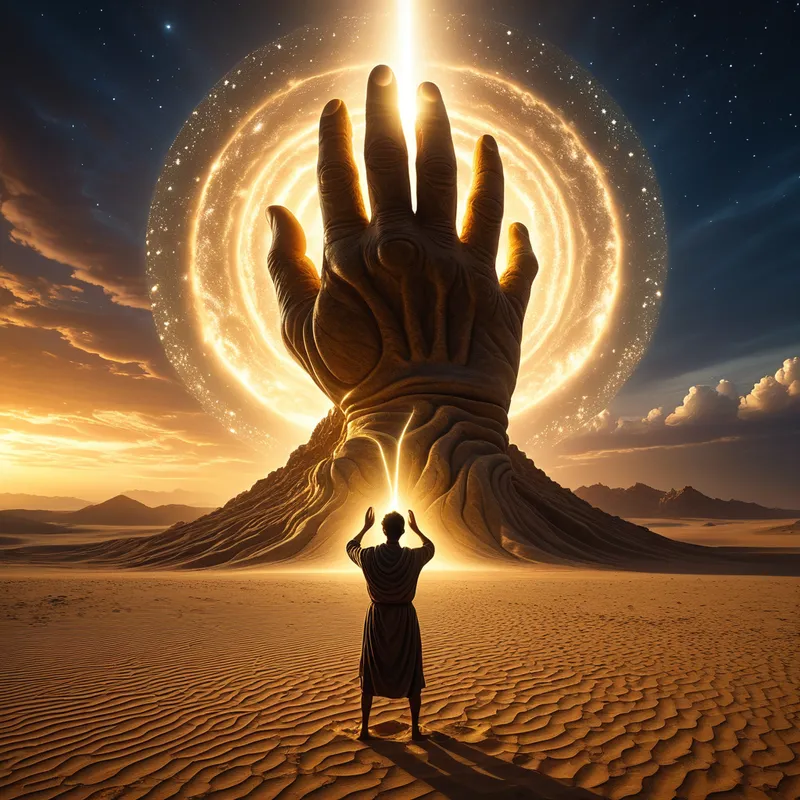
On the forty-first dawn, the seamless sky tore.
It did not thunder. It made a sound like the first inhalation of the universe—a vast, soft, rushing shhh. From the rent in the firmament, a presence descended. It was not a hand, not an arm, but a single, immense Finger. It was composed of condensed sunlight and solidified lightning, etched with geometries that made the mind ache. It moved with a terrifying, gentle inevitability, descending not upon the desert, not upon a mountain, but directly toward Michelang, who sat frozen, his hollow heart now a drum of terror and awe.
The Finger touched him. Not on the shoulder, not on the hand. It pressed its luminous tip against the center of his forehead.
The world vanished in a silent explosion of meaning. Michelang did not see new images; he was flooded with the principles of form. He understood the tension that holds an arch aloft, the sorrow that curves a willow’s branch, the joy that bursts in a fountain’s spray. He felt the memory of mountains being born and the dream of cities yet unbuilt. It was not knowledge given, but sight awakened. The hollow in his chest filled with a roaring, creative fire.
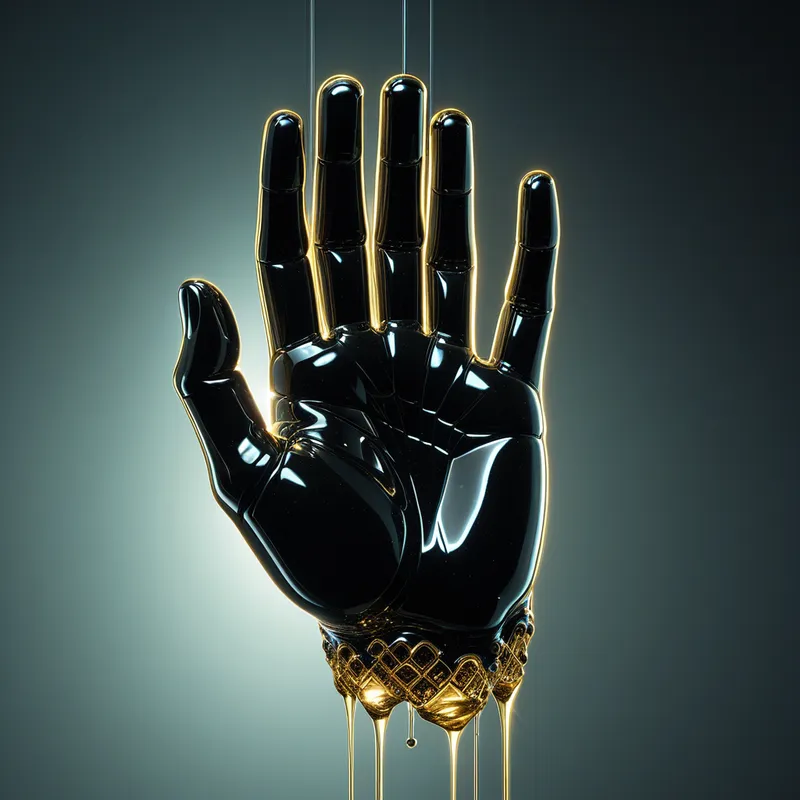
And then it was gone. The Finger withdrew into the mending sky, leaving no mark on the world—save one. On Michelang’s forehead, where the divine digit had made contact, a wound remained. It was not a scar of flesh, but a seared, spiraling sigil, like a fossilized vortex. It did not bleed light or gold; it was a perfect, dark aperture. From it, a constant, silent hum emanated, the sound of potential becoming form.
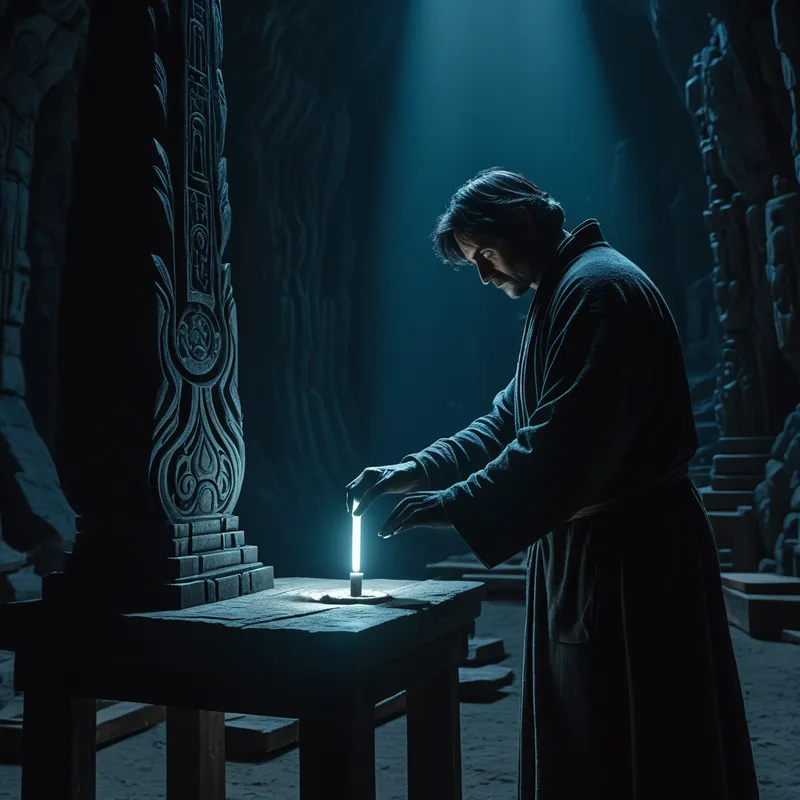
Michelang looked at his hands. They were ordinary. But when he reached for a piece of the desert stone, his touch now asked questions of the material. The stone answered. Where he once carved a man, he now released the story of a man from within the rock. He did not build palaces; he invited them to assemble themselves from his vision. He had become a conduit. The fire within him passed through the sacred wound on his brow and into the world, leaving behind not copies, but incarnations. He was no longer a maker of things. He was a place where the Unshaped chose to become shaped.
Cultural Origins & Context
The myth of the Finger of God in Michelang is a cornerstone of what scholars term the Global/Universal narrative tradition. It lacks a single geographic origin, appearing in fragmented forms in creation epics, artisan guild initiations, and mystical texts across disparate cultures. It was never a populist tale for the masses, but rather a Mysterium Traditionis, passed from master to apprentice in crafts of profound making—from stonemasons and smiths to composers and architects.
Its societal function was dual. Exoterically, it explained the uncanny genius of the rare, transformative creator—the one who doesn’t just improve but invents a new category of being. Esoterically, it served as a psychological map for the ordeal of inspiration itself. The tellers were often the "wounded" ones—those who had tasted the fire of a calling that sets them apart, marked by a creative obsession that is both gift and affliction. The myth provided a container for this experience, sanctifying the loneliness, the touch of madness, and the burden of the vision as part of a sacred, if terrifying, covenant.
Symbolic Architecture
At its core, the myth is not about art, but about the genesis of conscious creativity within the human psyche. The Desert of Unshaped Promise represents the latent, unconscious potential of the Self. Michelang’s melancholy is the ego’s painful awareness of its own derivativeness, its separation from the wellspring of authentic being.
The divine does not answer prayers; it responds to the unbearable tension of an authentic void.
The Finger of God symbolizes the irruption of the archetypal world (the numinosum) into the personal psyche. It is not a gentle guide but a transformative trauma—a direct infusion of transpersonal energy. The touch on the forehead, the seat of vision and identity, marks the dissolution of the old, imitative ego and its re-founding on a new basis.
The resulting Wound-Sigil is the central symbol. It is the sacred stigma of the creator. It represents the permanent opening, the vulnerability that allows the unconscious to flow into consciousness. It is not a trophy of power, but a reminder of channel-hood. The silent hum is the perpetual background radiation of the creative unconscious, now a constant companion. The hands remain human—the work is still done in sweat and time—but they are now directed by a voice from the deep.
The Dreamer's Resonance
When this myth pattern activates in the modern dreamer, it often manifests not as a grand biblical scene, but through potent somatic and symbolic imagery. The dreamer may experience:
- The Touch Dream: A sensation of profound pressure or burning on the forehead, often accompanied by a figure of immense, silent light or a disembodied, geometric form.
- The Hollow-Fullness: Dreams of a cavernous space inside the chest or head that first feels empty and desolate, then suddenly fills with a rushing, luminous substance—water, light, or swarm of symbols.
- The Tool Transformation: Ordinary objects (a pen, a keyboard, a kitchen knife) glow with an inner, purposeful light, or transform into unfamiliar, precise instruments in the dreamer’s hands.
Psychologically, this signals a profound shift in the relationship between the ego and the creative unconscious. The dreamer is undergoing what James Hillman called a "poetic basis of mind" coming online. It is the somatic recognition of a calling or a creative potential that demands expression, often arriving with a sense of fateful urgency and a concomitant fear of the responsibility and isolation it may bring. The "wound" in the dream is the psyche registering the irreversible change; one cannot "unsee" the vision once it has been granted.

Alchemical Translation
The myth of Michelang is a perfect allegory for the alchemical stage of Nigredo transforming into Albedo. The melancholic wandering in the grey desert is the nigredo—the depression and sense of meaninglessness that often precedes a major psychic renewal. The ego’s resources are exhausted.
The descent of the Finger is the lightning strike of the Transcendent Function. It performs the solutio (dissolution) and coagulatio (coagulation) simultaneously: it dissolves the old, imitative personality and coagulates a new one around the central, numinous wound.
Individuation is not about becoming perfect, but about becoming permeable—allowing the Self to create through you, with all the flawed, human tools at your disposal.
For the modern individual, the "alchemical translation" is the process of psychic transmutation from consumer to creator. It is the move from a life shaped by external influences (carving the leaf) to a life authored from an inner, archetypal source (releasing the story from the stone). The "sacred wound" is the ongoing cost: the vulnerability, the sensitivity, the sometimes-unwelcome clarity, and the burden of having to midwife visions into a resistant world. The triumph is not fame or completion, but the alignment with the daimon of one’s own existence. One becomes, like Michelang, not a sovereign ruler of one’s psyche, but its dedicated, awestruck servant—a place where the Unshaped chooses, through you, to take on form.
Associated Symbols
Explore related symbols from the CaleaDream lexicon: