The Unfinished Symphony: Dreams of Creativity as Psychic Alchemy
The Somatic Echo
It begins not as an idea, but as a pressure. A low, tectonic hum in the solar plexus, a restless electricity in the hands. It is the feeling of a vessel too full, not of emotion, but of potential—a chaotic, formless moreness that has not yet found its shape. The body becomes a crucible, sensing the ghost-limb of something that does not yet exist. There is a tension in the jaw, a tightness behind the eyes, as if you are straining to see in a spectrum just beyond visible light. This is the somatic prelude to creation: the visceral, often uncomfortable, awareness of the psyche’s raw material pressing against the membrane of the known self, demanding transmutation.
The Dreamer's Log
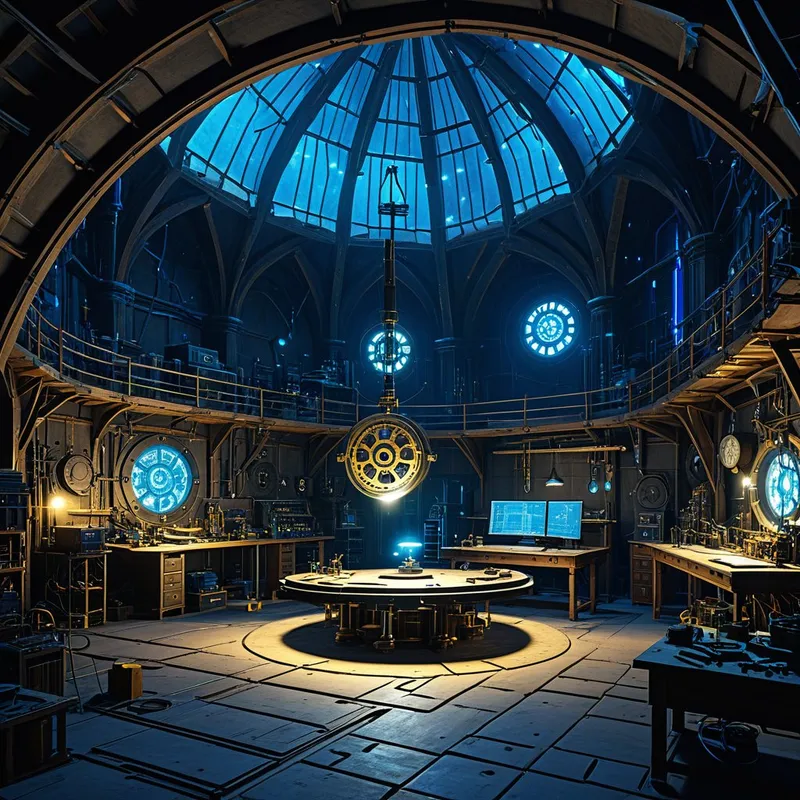
The dreamer stands in a vast, silent workshop, lit only by the cold glow of a single schematic hovering in the air. On a bench of dark wood lies a device of exquisite complexity—gears of brass, filaments of crystal, chambers of polished obsidian. It is half-built, breathtaking in its promise, yet utterly incomprehensible. The dreamer’s hands move, trying to assemble it, but the blueprints shift and dissolve like smoke the moment they are looked at directly. A profound frustration blooms, mixed with a terrible, awe-filled love for the unfinished thing.
The psyche presents the magnificent, impossible project of the Self, revealing that the instructions for its assembly must be written in the act of building, not followed from a pre-existing map.
The False Lead
This is not a dream about becoming an artist, a writer, or a musician. To mistake the creative impulse for a call to a specific hobby or career is to confuse the volcano with the pottery made from its ash. The dream is not about producing an external object for validation or consumption. It is, more fundamentally, about the internal process of generation itself—the psychic imperative to bring something new into being within the structure of your own consciousness. It is not a gentle muse whispering inspiration; it is the structural stress of growth, the necessary chaos that precedes a new order of mind.
Psychological Architecture
Beneath the dream of the unfinished device lies the shadow work of the un-lived life. The scattered blueprints are the inherited scripts, parental expectations, and cultural paradigms that have proven insufficient. The frustration is the friction between the old self—the one that follows instructions—and the emerging self that must author its own. This is the individuation process in its most active phase: the conscious ego, the workshop’s custodian, confronting the autonomous, archetypal energy of the unconscious, represented by the device. The work is to hold that tension, to tolerate the not-knowing, and to allow the hands (the doing, the experimenting) to learn a logic that the mind (the reading, the analyzing) cannot yet grasp. You are not building a thing; you are building the builder.
Mythic Resonance
We see this in the figure of Hephaestus, the lame god of the forge. Cast out from Olympus, his workshop was in the depths of the earth. His creativity was born not from grace and beauty, but from exclusion, pressure, and heat. He did not follow designs; from his isolation and pain, he generated automatons, weapons, and jewelry of divine power. His creativity was an alchemical response to his wound. Similarly, the Demiurge of Gnostic myth, often misunderstood, is a blind creator who fashions the material world from chaotic, pre-existing substance. This is not the story of creation ex nihilo, but of imposing a desperate, flawed, yet passionate order upon the roaring dark. Both myths tell us: true creation is often a limping, gritty, deeply imperfect process that begins in a place of fracture or profound limitation.
Symbolic Nodes
- Unfinished Buildings or Machines: The psyche-in-process.
- Blank Canvases, Empty Pages, or Silent Instruments: Potential in its most potent and terrifying form.
- Wild, Overgrown Gardens or Chaotic Workshops: The fertile, unedited contents of the unconscious.
- Malleable Substances (Clay, Wax, Molten Glass): The primal, shapeable material of the self.
- Labyrinths or Complex Blueprints: The confusing, non-linear path of inner development.
- A Tool That Transforms in the Hand: The evolving method of self-creation.
Archetypal Resonance
The core energy here is that of The Creator Archetype. Its shadow is the perfectionist or the mad scientist, forever tinkering in isolation, never daring to release a flawed creation into the world. The Creator’s somatic echo is that full-body pressure of unmanifested form; its alchemical potential is the courage to make the internal, external. This archetype does not seek to discover what is already there (the Explorer) or to master a known world (the Ruler). It seeks to generate a new reality from the substance of its own experience. In the dream, the Creator is active but blocked by its own shadow—the fear that the creation will be wrong, or that without a perfect blueprint, one is not allowed to begin. The dream is the archetype’s demand to move from the safety of planning to the vulnerability of making.
The Alchemical Process
The transmutation here is Chaos into Cosmos. The prima materia is the swirling, emotional, and imagistic chaos of the unconscious—the workshop’s clutter. The heat is applied through Sustained Attention. It is the act of sitting with the unfinished device, day after day in the dreamscape, feeling the frustration but not abandoning the bench. The pressure is Imperfect Action—the decision to solder one gear to another, even if it might be the “wrong” gear. The old state is the identity of the follower, the one who needs external validation and clear instructions. The heat of attention and the pressure of action cook this away. What precipitates is not a perfect product, but Generative Sovereignty: the internal authority to declare, “This, here, is what I am making of myself and my world.” The grief released is for the comforting illusion of a pre-ordained path. The gold gained is the terrifying freedom of being your own origin point.

The Integration Protocol
Question 1: Where in your waking life do you feel the most potent friction between a “blueprint” you feel you should follow and the intuitive, half-formed design emerging from within you?
Question 2: If the unfinished creation in your dream is not an object, but a quality of being, what might that quality be? What name would you give to the new “material” you are trying to become?
Question 3: What old, internal structure or belief must dissolve into chaos (be taken apart on the workbench) to provide the raw material for this new creation?
Action 1 (The Unfinished Gesture): For five minutes, engage in a creative act with the explicit goal of leaving it incomplete and “imperfect.” Draw without lifting the pen, write a paragraph and delete the last sentence, mold a bit of clay and then smash it flat. Observe the somatic echo that arises when you consciously relinquish control of the outcome.
Action 2 (Blueprint Collage): Gather images, words, and textures that resonate with the feeling of your dream, not its literal content. Assemble them on a page not as a plan, but as an energy map. Where is the tension? Where is the empty space? This externalizes the internal workshop.
Action 3 (The Daily Vessel): Choose a simple, repetitive daily task (making coffee, watering a plant). Perform it for one week as a sacred, creative act. Pour the water with the intention of “forming” the day. Grind the beans as if preparing the raw material of your attention. This ritual grounds the vast creative impulse in the alchemy of the mundane.
Final Validation
The frustration is real. The ache of seeing the magnificent, unbuilt thing within you is a profound and lonely burden. It is easier to close the workshop door and live in the furnished rooms of a borrowed life. But that hum in your core, that pressure behind your eyes, is the signature of your particular genius—not as talent, but as necessity. Your psyche is not broken; it is pregnant. The dream is your invitation to become both the womb and the midwife, to dare the messy, glorious, and utterly personal act of bringing forth what only you can. The world does not need your perfect product. It needs the evidence of your becoming.