
The enchanted forest of Brocél Myth Meaning & Symbolism
A sentient forest tests all who enter, offering profound wisdom only to those who surrender their will to its ancient, dreaming heart.
The Tale of The enchanted forest of Brocél
Listen, and let the veil between worlds grow thin. There is a place that exists not on any map drawn by human hand, yet it is known to every soul that has ever felt a longing for a truth deeper than stone. It is the Enchanted Forest of Brocél.
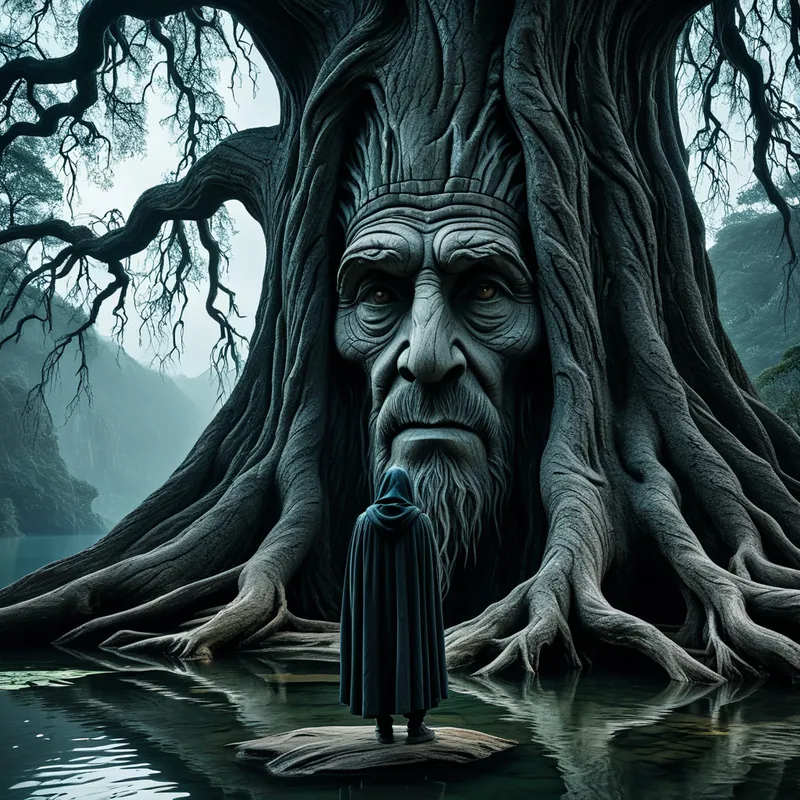
Do not think of it as mere trees and earth. Brocél is alive, a single, vast entity dreaming beneath a canopy of stars older than names. Its trunks are pillars of silver-grey bark, etched with runes of weather and time. Its floor is a tapestry of luminous moss and flowers that bloom only for the breath of a sincere question. The air is thick with the scent of damp soil, ozone, and the profound silence that comes before a revelation.
Many have sought its heart, drawn by tales of a Wisdom Wellspring that bubbles up from the world’s first dream. The proud king came with his knights, their armor clanking like discordant bells. Brocél responded not with beasts, but with mirrors—glades where each man saw not his reflection, but the hidden shape of his fear: the sycophant saw his emptiness, the warrior his rage, the king his fragile mortality. They fled, and the forest swallowed their path behind them.
The scholar came next, laden with scrolls and instruments to measure the magic. The forest gave him a labyrinth of identical trees, each bearing a leaf inscribed with a single, perfect paradox. He wandered for days, his logic turning in on itself until he sat down, wept, and let his precious parchments be taken by the patient roots.
Then came the one who was neither seeker nor conqueror, but a listener. Often a shepherd, an orphaned child, or one hollowed out by grief. They entered not to take, but because they had nowhere else to go. The forest tested them too. Paths vanished. Whispering voices offered sweet lies and bitter truths. Shadows with the faces of loved ones beckoned them towards oblivion.
The true trial was not to fight or solve, but to surrender. To lose the will to find. When the wanderer finally stopped, exhausted, and laid their forehead against the cool bark of the eldest tree, a change would stir. The oppressive silence would become a welcoming quiet. The confusing paths would resolve into a single, soft trail of glowing fungi.
It would lead to the Heart Glade. There, no majestic temple stood, only the Grand Sentinel, a tree of such gentle majesty it made the soul ache. At its roots, the Wellspring bubbled—a pool of water dark as space yet holding the light of every star. To drink was not to gain an answer, but to understand the question living within one’s own bones. The forest did not speak in words, but in a knowing that bloomed like a flower in the chest.
But the enchantment had a price, known only upon the return. The one who drank could never fully leave. A seed of Brocél’s dreaming silence took root in their spirit. They walked in the human world, but part of them forever listened to the rustling of those silver leaves in a wind no one else could feel, a quiet sage haunted by a beautiful, distant home.
Cultural Origins & Context
The myth of Brocél belongs to the Global/Universal tradition, meaning it is not the property of one tribe or nation, but a psychic pattern that emerges independently across cultures—in the sacred groves of the Druids, the deep woods of Slavic folklore, the spirit-inhabited forests of Shinto, and the dreamtime landscapes of Aboriginal songlines. It is a myth carried not in epics, but in whispers; told by grandmothers at hearths, hinted at in the tales of those who "went wandering and came back changed."
Its societal function was multifaceted. For communities, it served as a cosmological map of the Wild Unknown, teaching respect for forces greater than human will. It was a narrative container for the experience of radical transformation, explaining why some individuals returned from solitude or crisis profoundly altered. It also acted as a cautionary tale for the arrogant, asserting that the deepest truths cannot be seized by force of intellect or arms, only received through humility.
Symbolic Architecture
Psychologically, the Enchanted Forest of Brocél is a master symbol for the unconscious psyche in its totality—not as a dark cellar of repressed trauma, but as a living, intelligent, and deeply patterned ecosystem of the soul. The imposing, maze-like exterior represents the initial confusion and resistance we meet when we turn inward. The mirroring glades are the psyche’s innate capacity for projection; we first encounter not the forest itself, but the distorted reflections of our own unresolved selves.
The forest does not hide its heart to be cruel, but to ensure the seeker is capable of bearing the weight of its light.
The central ordeal—the surrender of will and intellect—symbolizes the ego’s necessary relinquishment of control. The conscious mind, the king and the scholar, must cease its dictatorship to allow a dialogue with the deeper Self. The Wisdom Wellspring is the nourishing source of this Self, the font of meaning and authentic identity. Drinking from it symbolizes the integration of unconscious contents, leading to a state of greater wholeness.
The poignant price of the return—being forever marked by the forest—speaks to the irreversible nature of true psychological awakening. Once one has consciously touched the Self, one can no longer fully identify with the collective norms of the "village." A sacred loneliness, or what the mystics called the unio mystica’s aftermath, becomes a permanent part of the individual’s constitution.
The Dreamer's Resonance
When this myth stirs in the modern dreamer, it often manifests not as a literal forest, but as a series of profound disorientations. One may dream of being lost in an endless, shifting office building, a labyrinthine library where books rearrange themselves, or a familiar neighborhood that becomes alien and watchful. The somatic feeling is key: a palpable anxiety of being tested, observed by the environment itself.
This is the psyche signaling that the conscious attitude has become too rigid, too oriented toward external conquest or logical control, and is now being called into the "woods" for recalibration. The dream-forest’s confusing paths reflect the dreamer’s own internal contradictions and unmet potentials. To dream of finally finding a still, sacred center—a quiet room, a clearing, a single meaningful object—indicates the beginning of that crucial surrender, the ego yielding to a process it does not direct. The emotional tone upon waking—a mix of awe, unease, and profound curiosity—is the signature of having brushed against the living Brocél within.

Alchemical Translation
The myth of Brocél is a perfect allegory for the alchemical opus, the journey of individuation. The seeker entering the forest is the prima materia—the raw, conflicted human condition. The forest itself, with its disorienting and mirroring phases, represents the nigredo, the blackening. This is a necessary descent into chaos and confrontation with the shadow, where all prior certainties dissolve.
The act of surrender at the foot of the Grand Sentinel is the pivotal moment of ablutio or albedo. The ego, humbled and stripped of its pretensions, becomes a vessel. Drinking from the Wellspring is the citrinitas, the illumination, where the light of the Self is consciously ingested and understood.
The gold is not found in the forest, but forged in the tension between the forest’s call and the human world’s claim.
The final stage, the return, embodies the rubedo. The alchemical gold is not a treasure kept in the forest, but the transformed individual who now carries the forest’s law—the law of the Self—back into ordinary life. The "seed" planted within is the philosopher's stone, the enduring, transformative core that allows one to live in the world without being entirely of it, to hold wisdom without arrogance, and to bear the creative solitude that is the hallmark of the individuated life. The myth teaches that the ultimate goal is not eternal residence in the unconscious paradise, but the difficult, sacred task of bridging its wisdom with the reality of human existence.
Associated Symbols
Explore related symbols from the CaleaDream lexicon: