Dreamtime Myth Meaning & Symbolism
The eternal, sacred time of creation when ancestral beings emerged, sang the world into existence, and became the land, law, and spirit of all things.
The Tale of Dreamtime
In the beginning, there was no beginning. There was only the Dreaming, a deep, silent, and potent everywhere. It was not an empty void, but a fullness pregnant with all possibilities, a timeless plain of pure spirit. Then, from beneath this eternal surface, they stirred.
The Ancestral Beings awoke. They were not gods in distant heavens, but immense presences—part human, part animal, part plant, part feature of the land itself. The Rainbow Serpent uncoiled from its sleep deep within the earth, its massive body stirring the formless ground. The Great Kangaroo Man rose on powerful legs, and the Wagilag Sisters emerged from the saltwater, carrying the first spark.
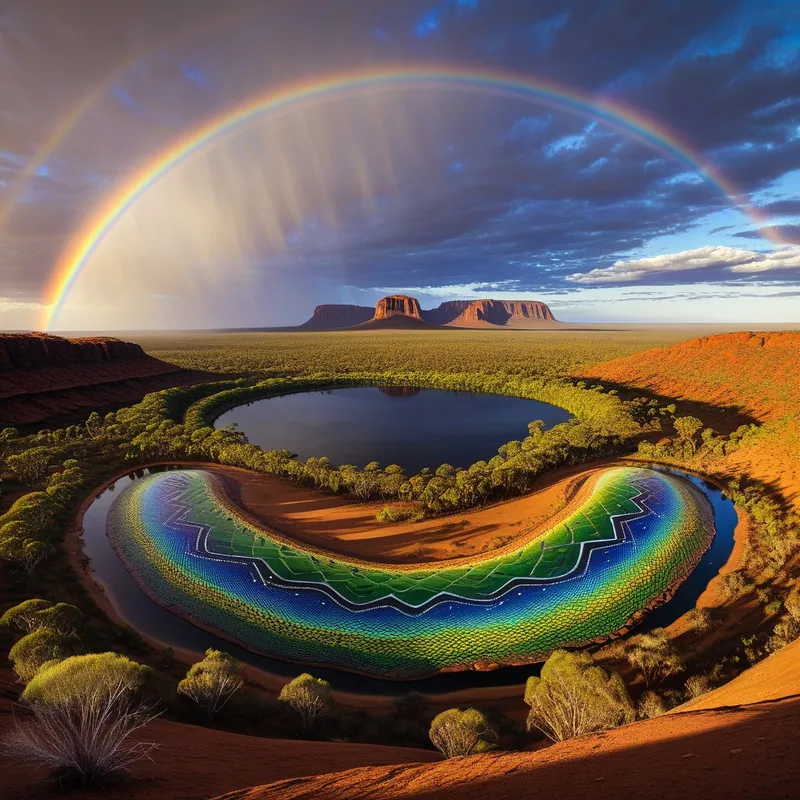
They did not build the world with hands, but with journey and song. They began to move across the featureless plain. Where the Rainbow Serpent slid, its body carved out mighty riverbeds and gorges. Where it rested, it left deep, life-giving waterholes. It sang, and the vibration of its song called forth the colors of the earth—the red ochre, the yellow sandstone, the green of the first shoots.
The Kangaroo Man journeyed far, his leaps defining the rhythm of the hunt and the vastness of the plains. In his weariness, he lay down, and his body became a mountain range, his spirit remaining in the rocks. The Wagilag Sisters walked, singing of the names of all things—every plant, every animal, every stone and star. Their song was a living map, a web of luminous threads that connected each created thing to its origin and purpose. These are the Songlines.
Their journeys were not without conflict. Beings fought, loved, hunted, and made terrible mistakes. The Rainbow Serpent might swallow beings whole, only to disgorge them transformed into new creatures. A great battle could create a scattering of boulders; a act of theft could form a peculiar rock formation. Every action was creative, every event eternal.
Finally, their work complete, their journeys at an end, the Ancestral Beings performed their last great act. They did not depart. They entered. They sank into the land, into the waterholes, into the very air. The Kangaroo Man became the mountain. The Rainbow Serpent became the river system. The Sisters became the cluster of stars in the night sky. Their bodies transformed into the physical features of the world, and their spirits remained there, alive and conscious, as the Dreaming.
Time, as we know it, began to flow. But the Dreaming did not end. It lies just beneath the surface of the waking world, an eternal, parallel reality. The land is not just a place; it is a living, sacred text, and every sunrise is a remembering.
Cultural Origins & Context
This is not a singular "myth" but the foundational cosmology of the world's oldest continuous cultures, encompassing over 250 distinct Aboriginal language groups across the Australian continent. The term "Dreamtime" or "Dreaming" is an English translation of concepts like Alcheringa (Arrernte) or Jukurrpa (Warlpiri).
The knowledge was and is transmitted through an intricate oral tradition: through song cycles that must be sung precisely to navigate the Songlines, through dance, through ceremonial body painting, and through sacred art. Elders are the custodians of specific stories tied to specific tracts of country. One does not own a Dreaming story; one is responsible for it. Its societal function is total: it is a spiritual compass, a legal constitution defining kinship and obligation, an ecological manual, and a historical record. It answers the profound questions of existence not with "once upon a time," but with "always and everywhere."
Symbolic Architecture
At its core, the Dreaming presents a universe where psyche and matter are one. The Ancestral Beings are archetypal forces in pure, personified form. Their journeys represent the process of potential becoming actual, of spirit taking form.
The world is not created ex nihilo; it is dreamed, sung, and walked into being. Creation is an act of embodiment.
The Songlines symbolize the interconnected web of all life and meaning. They represent the neural pathways of a cosmic mind, or the DNA of reality itself, where every element is linked to its origin story. The transformation of the Ancestors into the landscape is the ultimate symbol of immanence—the sacred is not above us, but within the very substance of our world. There is no separation between the creator and the creation, the past and the present. The land is a living memory.
Psychologically, this myth dismantles the Cartesian split between mind and body, self and world. It proposes that identity is not confined to the individual ego, but is extended into one's "country," one's kin, and the stories that bind them. The Ancestral Being represents the primal, undifferentiated Self before the birth of individual consciousness, whose "individuation" results not in a separate person, but in the creation of the entire objective world.
The Dreamer's Resonance
When a modern dreamer encounters patterns resonant with the Dreaming, they are often navigating a profound process of inner world-building or re-membering. Dreams of landscapes forming under one's feet, of singing objects into existence, or of merging with animals or geological features point to this archetypal layer.
Somatically, this might feel like a deep, tectonic shift in one's sense of grounding. It is the psyche working to incarnate—to translate nebulous feelings, potentials, or traumas into the specific, tangible "geography" of one's life. A dream of following a glowing path (Songline) may reflect the dreamer's search for their own authentic life-narrative, their personal myth. To dream of an ancestral animal-being is to commune with an instinctual force within, asking to be acknowledged and integrated into one's daily "landscape."
Alchemical Translation
For the modern individual, the alchemy of the Dreaming is the process of conscious incarnation and ethical relationship. The hero's journey here is not about slaying monsters "out there," but about undertaking the responsibility of creative embodiment.
The first stage is the recognition of the formless Dreaming within—the swirl of unlived potentials, complexes, and archetypal energies. The "Ancestral Being" is the undiscovered Self. The second stage is the "journey"—the often arduous, mistake-ridden, but creative act of living. This is where we "sing our world into being" through our choices, actions, and relationships. Our conflicts, like those of the ancestors, become the defining features of our character.
Individuation is not about rising above the world, but sinking into it so completely that you become a permanent, sacred part of its fabric.
The final, alchemical translation is the "entering into the land." This is the stage of wisdom, where one's life experiences, lessons, and hard-won consciousness are no longer seen as personal possessions, but are given back. They become a sustaining presence for others—a "waterhole" of insight, a "mountain" of stability, a "songline" that guides. The ego, having fully expressed its unique ancestral pattern, learns to reside as a spirit within the landscape of community and the cosmos. One becomes, in a psychological sense, a custodian of country—responsible for the psychic ecology one inhabits. The goal is to live so that your presence makes the world more sacred, more connected, and more deeply real, echoing the eternal now of the Dreaming.
Associated Symbols
Explore related symbols from the CaleaDream lexicon: