The Dragon Kings of the Four Seas
Four divine dragon rulers govern the oceans in Taoist mythology, commanding weather, tides, and marine life from their underwater palaces.
The Tale of The Dragon Kings of the Four Seas
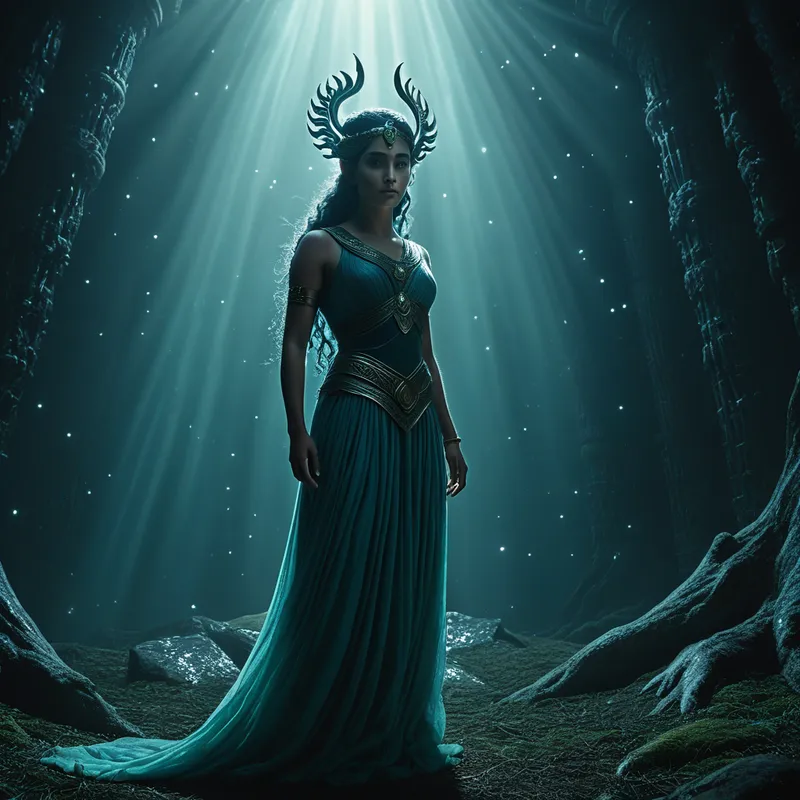
In the unfathomable depths, where sunlight dissolves into eternal twilight, lie the crystal palaces of the Four. They are not mere beasts of scale and sinew, but sovereigns of substance, celestial officials appointed to the most vast and turbulent ministry of all. Ao Guang, [Dragon](/myths/dragon “Myth from Chinese culture.”/) King of the East Sea, commands the rolling azure expanses that greet the dawn. His court, the Crystal Palace, is a nexus of order, where tides are measured and typhoons are born from whispered edicts. To the south, Ao Qin rules the warmer, fertile waters, his domain teeming with life both wondrous and strange. Ao Shun, in the frigid blackness of the North, governs the deep, silent currents and the patience of ice. Ao Run, of the West, oversees the sunset waters, a realm of reflection and gathering depth.
Their rule is absolute yet bound by a higher mandate from [the Jade Emperor](/myths/the-jade-emperor “Myth from Taoist culture.”/) himself. They command the rains, summon the storms, and still the waves. Schools of fish move as their living thoughts; pearls grow at their contemplation. Yet, for all their divine power, they are entangled in the dramas of both heaven and earth. The myth of the [Monkey King](/myths/monkey-king “Myth from Chinese culture.”/), [Sun Wukong](/myths/sun-wukong “Myth from Chinese culture.”/), lays bare their complex station. When the rebellious simian seeks a weapon worthy of his might, he descends to Ao Guang’s palace, not with reverence, but with disruptive, chaotic force. [The Dragon](/myths/the-dragon “Myth from Chinese culture.”/) King, a figure of immense temporal power, is thrown into disarray, forced to placate the monkey with the gift of the magical Ruyi Jingu Bang—a pillar that stabilizes the seas but becomes a rod of [chaos](/myths/chaos “Myth from Greek culture.”/) on land. Here, the celestial hierarchy is tested; the Dragon King, for all his oceanic dominion, must navigate the insolence of a terrestrial trickster, revealing that his power, while vast, exists within a web of cosmic obligations and vulnerabilities.
Their narratives are often of negotiation and hidden agendas. They appear in mortal dreams to demand proper worship or to bargain for a favored son’s soul lost at sea. A drought on land is not mere chance; it may be the calculated displeasure of a Dragon King whose temple has fallen into disrepair, a demonstration that their power extends over the fertile rains as much as the barren depths. They are rulers who must be petitioned, appeased, and respected, embodying the Taoist understanding that nature’s benevolence is not unconditional, but a dynamic exchange between the human and the divine.
Cultural Origins & Context
[The Dragon Kings](/myths/the-dragon-kings “Myth from Chinese culture.”/) emerge from the syncretic depths of Chinese folk religion, refined and bureaucratized within the framework of Taoist cosmology. While dragon lore is ancient, the formalization into four specific kings governing the cardinal directions and seas reflects the classical Chinese worldview of a correlated, orderly universe. They are a perfect fusion of primordial animism—the spirit of the [water](/myths/water “Myth from Chinese culture.”/) itself—and the later imperial bureaucratic model. Just as the earthly emperor ruled the Middle Kingdom, the [Jade Emperor](/myths/jade-emperor “Myth from Chinese culture.”/) ruled the heavens, and beneath him, the [Dragon Kings](/myths/dragon-kings “Myth from Chinese culture.”/) administered [the world](/myths/the-world “Myth from Tarot culture.”/)’s waters.
They served a vital psychological and social function. For an agrarian society dependent on timely rains and fearful of devastating floods, the seas were a source of both life and profound terror. The Dragon Kings personified this ambivalent power, making it intelligible and, crucially, negotiable. Temples were built at shores and river mouths; rituals and offerings were made to court their favor. They became divine intermediaries, explaining the why behind natural phenomena. A successful fishing voyage or a merciful change in a storm’s path was their benevolence; a shipwreck or a drought, their wrath. In this, they translated the chaotic, impersonal forces of nature into a relational drama of respect, obligation, and ritual propriety.
Symbolic Architecture
The [Dragon](/symbols/dragon “Symbol: Dragons are potent symbols of power, wisdom, and transformation, often embodying the duality of creation and destruction.”/) Kings represent the [psyche](/myths/psyche “Myth from Greek culture.”/)’s encounter with the vast, autonomous, and deeply patterned realms of the unconscious. They are not the [source](/symbols/source “Symbol: The origin point of something, often representing beginnings, nourishment, or the fundamental cause behind phenomena.”/) of the waters, but its regents—the organizing, personified principles that bring a face and a will to the formless deep. Their fourfold [division](/symbols/division “Symbol: Represents internal conflict, separation of self, or unresolved emotional splits. Often indicates a need for integration or decision-making.”/) maps the totality of the unconscious [life](/symbols/life “Symbol: The symbol of ‘Life’ represents a journey of growth, interconnectedness, and existential meaning, encompassing both the joys and challenges that define human experience.”/): the fertile and creative (South), the deep and coldly analytical (North), the reflective and assimilative (West), and the eruptive, initiative-taking forces (East).
Their underwater palaces are not just homes but symbolic centers of consciousness within the unconscious—realms where the raw stuff of instinct and archetype is given form, order, and purpose. To descend there is to engage the deep psyche on its own terms.
Their ambiguous [nature](/symbols/nature “Symbol: Nature symbolizes growth, connectivity, and the primal forces of existence.”/), both divine and subservient, benevolent and vengeful, mirrors the psyche’s own [relationship](/symbols/relationship “Symbol: A representation of connections we have with others in our lives, often reflecting our emotional state.”/) with its foundational powers. We depend on these deep currents for vitality and inspiration (the nourishing rains), yet we fear their potential to overwhelm [the ego](/myths/the-ego “Myth from Jungian culture.”/) (the cataclysmic flood). The Dragon [King](/symbols/king “Symbol: A symbol of ultimate authority, leadership, and societal order, often representing the dreamer’s inner power or external control figures.”/)’s demand for respect is the psyche’s warning that these forces cannot be ignored or dominated without consequence.
The myth of the Monkey King’s theft is a profound psychological drama: the unchecked, inflationary ego (Sun Wukong) plundering the treasures of the deep unconscious (the Dragon King’s armory), leading to a temporary empowerment that ultimately disrupts all cosmic (psychic) order.
The Dreamer’s Resonance
To dream of a Dragon King is to confront the ruling complexes of one’s inner depths. It signifies an encounter with a potent, structured authority within the psyche that governs emotions, instincts, and the flow of psychic energy. Which king appears? The nurturing Ao Qin may signal a time to connect with creative, life-giving waters. The stern Ao Shun may call one to confront frozen depths or patient, hidden truths. Ao Guang’s presence often relates to issues of personal power, initiative, or the eruption of long-contained emotional forces, while Ao Run may ask for reflection and integration.
The setting is crucial. Is the king approached in his glorious palace, or does he emerge from a storm-tossed sea? The former suggests a conscious engagement with inner authority; the latter, an eruption of that authority into one’s life in a disruptive, potentially overwhelming way. Such a dream asks the dreamer: What deep, natural laws of your being have you neglected? What inner tides or weather patterns are you trying to control that require instead a ritual of acknowledgment and respect?

Alchemical Translation
The alchemical process mirrored in the myth of the Dragon Kings is the negotium (the work) with the [prima materia](/myths/prima-materia “Myth from Alchemical culture.”/)—the chaotic, watery foundation of the soul. The four kings represent the differentiation and governance of this primal substance. The goal is not to slay the dragon, but to establish a right relationship with it, to learn its laws and petition its aid.
The offering at the shore temple is an alchemical ritual: a sacrifice of conscious value (incense, gold, devotion) to the unconscious power, hoping to receive in return the aqua permanens—the permanent water or transformative rain—that fertilizes the inner landscape.
The journey to the Crystal Palace is the descent into the [vas hermeticum](/myths/vas-hermeticum “Myth from Alchemical culture.”/), the sealed [vessel of transformation](/myths/vessel-of-transformation “Myth from Alchemical culture.”/). Here, in the pressurized depths, the ego confronts the regal authority of [the Self](/myths/the-self “Myth from Jungian culture.”/). The theft of the golden pillar by the Monkey King is a failed, purely egoic attempt at appropriation, leading to inflation. The successful alchemical outcome is symbolized by the Dragon King willingly bestowing a gift—a [pearl](/myths/pearl “Myth from Chinese culture.”/) of wisdom, a timely rain—when approached with humility and in accordance with the celestial (transpersonal) order. It is the transformation of raw, autonomous psychic power into a sustaining, life-giving force for the whole personality.
Associated Symbols
Explore related symbols from the CaleaDream lexicon:
- Ocean — The vast, unconscious foundation of being, the source of all life and potential, containing both nurturing depths and terrifying abysses.
- Dragon — The raw, potent, and sovereign power of nature and the unconscious, a force that must be integrated rather than conquered.
- Temple — A consecrated space for ritual exchange with the divine or the deep psyche, where offerings are made and communion is sought.
- Ritual — The prescribed, respectful actions that mediate between the human realm and the powers of the unseen, establishing order and relationship.
- Order — The cosmic and psychic hierarchy that structures chaos, represented by the Dragon Kings’ divine bureaucracy governing the formless sea.
- Thunder — The audible manifestation of the Dragon King’s power and will, the disruptive, awakening voice from the depths of the unconscious sky.
- Rain — The blessing and nourishment bestowed from the celestial waters, the tangible result of successful negotiation with the powers that govern fertility.
- Seashell — A vessel born from the deep, carrying the echo of the ocean’s voice and the intricate, patterned wisdom of unconscious growth.
- Crown — The symbol of legitimate sovereignty and divine mandate, representing the Dragon King’s authority to rule his domain.
- Journey — The necessary descent or voyage into the unknown depths to confront the powers that reside there, seeking wisdom, treasure, or reconciliation.
- Mask — The personified face worn by the vast, impersonal forces of nature, making them intelligible and capable of relationship, as the Dragon Kings mask [the sea](/myths/the-sea “Myth from Greek culture.”/).
- Stone of Power — A concentrated, tangible focus of latent energy or authority, like the treasures guarded in the Dragon King’s palace, awaiting right use.