The Diamond Sutra Myth Meaning & Symbolism
A dialogue where the Buddha reveals reality as a dream, a bubble, a flash of lightning, teaching the mind to be unshakeable and free.
The Tale of The Diamond Sutra
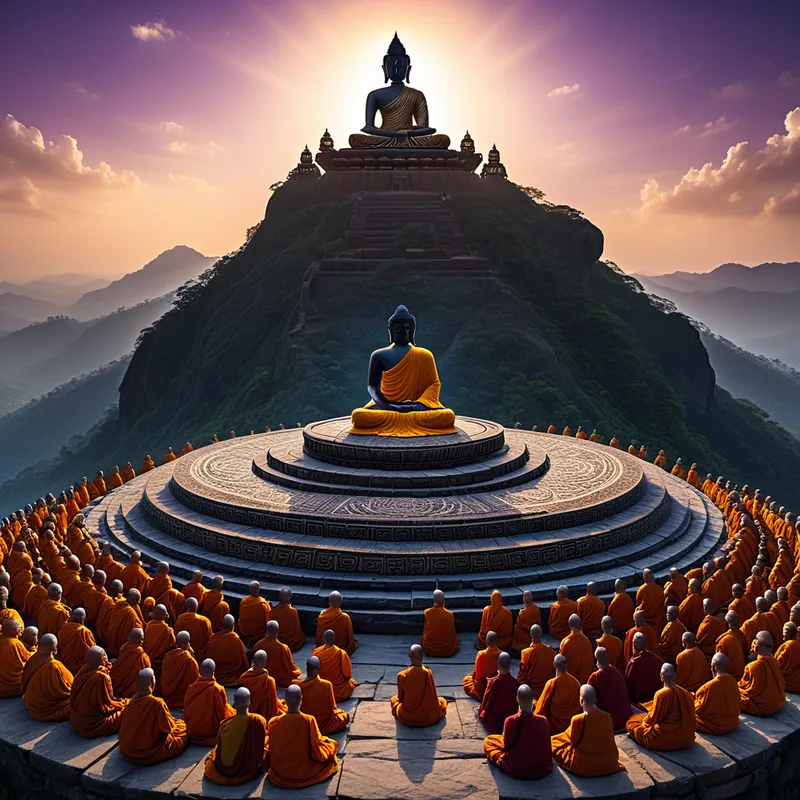
Gather close, and let the dust of the ordinary world settle. We are transported not to a battlefield of clashing steel, but to a silent peak where the very fabric of reality is challenged. The air on Vulture Peak is thin, sharp as a blade. The sun hangs low, painting the rocks in hues of gold and deep shadow. Here sits Shakyamuni Buddha, not upon a jeweled throne, but upon the bare earth, a mountain stone his seat. His presence is a still pool in the midst of a murmuring stream—the stream of twelve hundred and fifty great monks, and a gathering of Bodhisattvas whose compassion radiates like a subtle warmth.
The silence is not empty; it is full, pregnant with a question that has not yet been spoken. From the assembly rises the elder Subhuti. His robes are faded, his form humble, but his eyes hold the keenness of one who has seen through many veils. He approaches, bows deeply, and his voice, when it comes, cracks the silence like a single, clear bell.
“World-Honored One,” he begins, the honorific hanging in the air. “If sons and daughters of good family wish to give rise to the unexcelled mind of awakening, how should they dwell? How should they subdue their thoughts?”
This is the conflict. Not against monsters, but against the mind’s own relentless architecture—its clinging, its fearing, its ceaseless building of a self. The Buddha’s response is not a list of commandments. It is a dance, a relentless, gentle dismantling. He speaks of giving gifts of immeasurable kindness, but tells Subhuti that a true Bodhisattva gives without clinging to the concept of a gift, a giver, or a receiver. He speaks of liberating countless beings, yet concludes that no beings have been liberated.
Subhuti listens, and the ground of his understanding begins to tremble. The Buddha’s words are diamonds, each facet cutting away a assumption. “Subhuti,” the Buddha says, his voice both tender and inexorable, “all conditioned phenomena are like a dream, an illusion, a bubble, a shadow; like dew, and like a flash of lightning. Thus should you contemplate them.”
The rising action is internal—a quiet, seismic shift in perception. Subhuti, the wise elder, is brought to the precipice of a vast emptiness. He understands, and in that understanding, a profound sorrow and awe washes over him. He weeps. These are not tears of sadness, but of a burden millennia old finally being set down. “World-Honored One,” he whispers, shaken to his core, “from today, I have gained the eye of wisdom. Never before have I heard such teachings.”
The resolution is not a victory, but a dissolution. The Buddha smiles. He has given no thing. He has pointed, and in the pointing, the finger itself is forgotten. The teaching concludes with a famous verse, a spell against solidity: “So you should view all of the fleeting world: a star at dawn, a bubble in a stream, a flash of lightning in a summer cloud, a flickering lamp, a phantom, and a dream.” The assembly sits in a silence now utterly transformed. The myth ends not with a bang, but with the quiet, enduring resonance of a bell that has been struck, its sound fading into the infinite sky.
Cultural Origins & Context
The Diamond Sutra (Vajracchedikā Prajñāpāramitā Sūtra) is not a myth of gods and heroes in the classical sense, but a myth of consciousness itself. It emerged in India between the 1st and 5th centuries CE, a core text of the Prajñāpāramitā tradition that revolutionized Buddhist thought. Its transmission was oral, chanted and memorized by monks long before being committed to palm leaves. Its societal function was radical: to deconstruct not only the individual’s ego but the very ontological foundations of the Buddhist path. It was a tool for advanced practitioners, a “diamond cutter” designed to slice through subtle spiritual attachments—even to the Dharma itself. Its preservation and veneration, especially in East Asia where it became one of the most copied and printed sutras, speaks to its role as a sacred object and a direct transmission of the Buddha’s most penetrating wisdom.
Symbolic Architecture
The myth’s power lies in its symbolic demolition. The Vajra (diamond/thunderbolt) is the central symbol. It represents the ultimate wisdom (Prajñā) that is indestructible yet cuts through all illusion.
The diamond does not add; it subtracts. Its brilliance is the emptiness left after every concept is cleaved away.
The dialogue itself is the ritual. Subhuti represents the earnest seeker, the intellect that has mastered doctrine but is trapped by it. The Buddha, as the embodiment of Śūnyatā, does not provide answers but systematically incinerates the questions. Key symbols abound: the “dream, illusion, bubble, shadow” are the Samsara we mistake for solid. The act of giving without attachment is the archetype of selfless action, action purified of the actor. Psychologically, the myth represents the ego’s terrifying yet liberating encounter with the Self—the realization that the central character in our personal drama is, ultimately, a compelling fiction.

The Dreamer's Resonance
When this myth stirs in the modern dreamer, it manifests not as a clear narrative, but as a quality of experience—a somatic and psychological process of deconstruction. One might dream of their childhood home dissolving into sand, or of looking in a mirror to see no reflection, yet still being aware. Another may dream of trying to hold water, only for it to slip through their fingers no matter their effort. These are dreams of Anātman.
The psychological process is the unconscious beginning to metabolize the truth of impermanence and insubstantiality. It can feel like anxiety (the ground falling away) or profound relief (the dropping of a heavy mask). The body may feel weightless, ungrounded, or conversely, hyper-aware of its transient, fragile nature. The dreamer is undergoing the initial, often disorienting, stages of ego-relativization, where the psyche’s foundational structures are revealed to be contingent, not absolute.

Alchemical Translation
The alchemical work modeled by the Diamond Sutra is the opus contra naturam—the work against the ego’s natural tendency to solidify, claim, and identify. The modern individual’s journey of individuation is not merely about building a strong, well-adjusted ego (the “hero’s journey”), but about ultimately seeing through that construction.
Individuation’s final stage is not a richer personality, but the liberation of consciousness from identification with personality.
The “struggle” is to endure the dismantling without fleeing into new dogmas or identities. Subhuti’s question—“How should we dwell? How subdue our thoughts?”—is our own. The Buddha’s response is the alchemical formula: engage fully with life (give gifts, liberate beings), but do so while cultivating the diamond-like awareness that perceives the empty, dream-like nature of the engagement itself. The triumph is not a trophy, but a capacity: the ability to participate in the world with compassion and clarity, while inwardly abiding in the unshakeable, diamond-like peace of non-abiding. The self is transmuted from a fixed noun into a fluid, compassionate verb—an activity of awareness, free from the slag of attachment. This is the ultimate psychic freedom: to be in the world, but not of it; to have a form, yet know oneself as formless.
Associated Symbols
Explore related symbols from the CaleaDream lexicon: