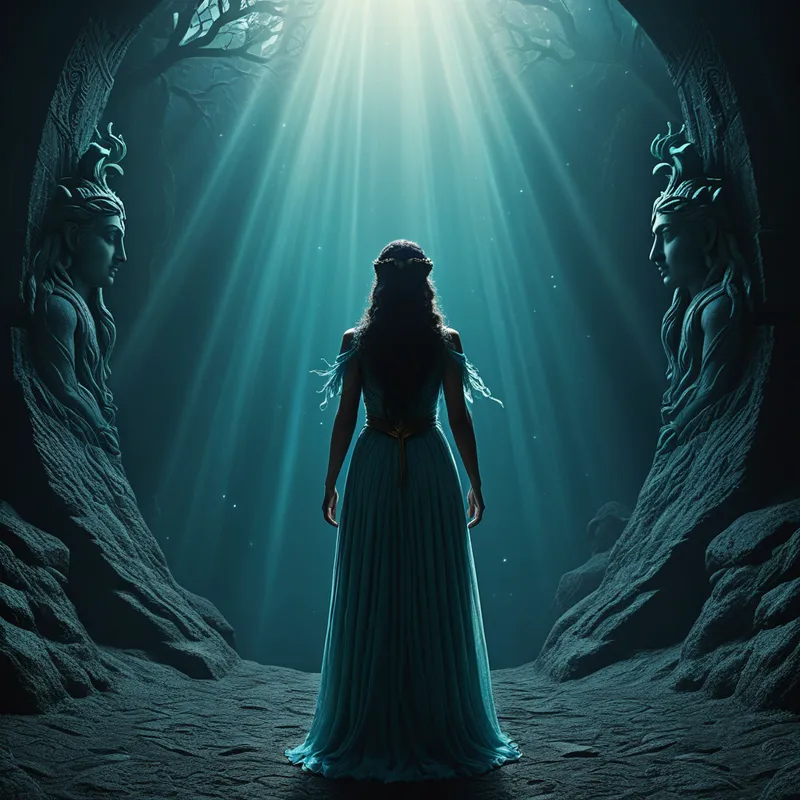
The Condor Puma and Serpent
An Incan myth where the condor, puma, and serpent symbolize the three realms of existence, guiding humanity's connection to the cosmos and earthly life.
The Tale of The Condor Puma and Serpent
In the beginning, before the first Sapa Inca walked the earth, the world was not one but three, layered like the strata of the Andes. Above soared the vast, luminous expanse of Hanan Pacha, the Upper World, realm of the sun, moon, and stars, of celestial order and future potential. Below stretched the deep, fertile mystery of Uku Pacha, the Inner World, realm of seeds, roots, the dead, and all that is unseen, the womb of the past. Between them, vibrant and tenuous, thrived Kay Pacha, the Middle World—the here and now of rivers, mountains, and human life.
To these realms, the great spirit Pachacamac, the world-maker, appointed sacred guardians, not as rulers but as embodiments. To Hanan Pacha, he gave the Condor. With wings that could embrace the sun, the condor became the celestial voyager, its flight a silent prayer, its perspective seeing the whole tapestry of the mountains from a place of divine detachment. It represented the spirit’s capacity to ascend, to seek vision beyond the immediate struggle.
To Kay Pacha, he gave the Puma. The great cat, sleek and powerful, moved through the mountain passes and high valleys with silent authority. It was the embodiment of the present moment—of strength, action, and territorial truth. The puma lived in the dynamic balance of power, the hunter who must also rest, the sovereign of the tangible world. It represented the human will and the courage required to navigate the physical journey of life.
To Uku Pacha, he gave the Serpent. It slipped into the cracks of the earth, into subterranean rivers and the dark soil. Without limbs, it moved with the wisdom of the underworld, connected to the cycles of death, decay, and regeneration. The serpent knew the secrets of the ancestors and the potent, often chaotic, energies of creation that precede form. It represented the instinctual, the subconscious, and the transformative power of shedding the old.
Humanity, the children of Inti the sun and Pachamama the earth, lived in Kay Pacha but felt pulls from both above and below. They felt the condor’s call to transcendence, the puma’s demand for grounded action, and the serpent’s whisper from the depths of dream and memory. Often, these pulls felt like conflict—the spiritual yearning clashing with earthly duty, the primal instinct unsettling social order.
The myth tells that true harmony, or Tawantinsuyu (the fourfold union), was not found by living in one world alone, but in learning their sacred dialogue. A shaman, in a vision, saw the three animals not as separate, but in a dynamic dance. The serpent, coiled at the base of the world tree, was the foundation. Around the trunk, the puma prowled, its energy giving form and force to the middle world. At the apex, the condor perched, ready to take flight, its vision encompassing all. The shaman understood: the serpent’s wisdom must rise to inform the puma’s heart; the puma’s strength must ground the condor’s flight; the condor’s vision must guide the serpent’s transformative power.
Thus, the sacred triad became the map of the complete human journey: to honor the serpent within (instinct, ancestry, the unconscious), to walk with the power of the puma (presence, action, community), and to periodically seek the perspective of the condor (vision, spirit, the greater cosmos). This was the path to becoming a runa—a fully integrated human being, in balance with all worlds.
Cultural Origins & Context
This tripartite cosmology is deeply embedded in the ayni and spatial understanding of the Inca Empire. The Inca did not perceive reality as a flat hierarchy but as an interlocking system of complementary opposites and mediating forces. The Condor, Puma, and Serpent schema is a profound symbolic articulation of this worldview, found in architecture, textiles, and ceremonial life.
The layout of the capital, Cusco, was said to be designed in the shape of a puma, a literal embedding of the Kay Pacha guardian into the heart of the empire. Coricancha, the Temple of the Sun, connected to the sacred cave of origin at Q'enqo, creating a vertical axis mirroring the triad: the cave (Uku Pacha/Serpent), the temple (Kay Pacha/Puma), and the celestial observations conducted there (Hanan Pacha/Condor). This was a civilization built upon the conscious mediation between worlds, where political and spiritual authority derived from maintaining this balance. The myth provided a psychic and social template for navigating a universe that was alive, sentient, and layered.
Symbolic Architecture
The triad is not a static symbol but a dynamic system of psychic orientation. Each creature governs a domain of consciousness and a mode of being.
The Condor (Hanan Pacha) symbolizes the superconscious—the realm of ideals, vision, and the future. It is the faculty of seeing one’s life path from above, detached from emotional entanglement. Its danger lies in dissociation, in becoming so spiritually aspirational that one loses connection to the earth and the body.
The Puma (Kay Pacha) symbolizes the conscious ego—the seat of will, identity, and directed action in the present. It is the principle of organization, courage, and territorial integrity (both literal and psychological). Its shadow is rigidity, aggression, and the inflation of the ego that cuts off both higher guidance and deeper instinct.
The Serpent (Uku Pacha) symbolizes the subconscious and the unconscious—the realm of instinct, memory, emotion, ancestral patterns, and primal life force. It is the source of creativity, healing, and transformation, but also of chaos, fear, and unbounded passion. Its peril is possession, being dragged into the depths without the structuring principle of the puma or the guiding light of the condor.
True wisdom in the Andean view arises from the chawpi—the center point that holds tension. The integrated self is the chawpi where the serpent’s depth, the puma’s strength, and the condor’s sight are in constant, respectful conversation.
The Dreamer's Resonance
For the modern psyche, this triad offers a powerful diagnostic and integrative tool. One may ask: Which realm am I over-identifying with, and which am I neglecting?
A life lived only in "Condor" mode may manifest as spiritual bypassing—using transcendence to avoid earthly pain, relationships, or responsibilities. Dreams might feature lofty but lonely landscapes, or a feeling of flying untethered.
A life dominated by the "Puma" may become aridly materialistic, competitive, and rigidly controlled. Dreams may feature battles, fortresses, or repetitive, purposeless striving in familiar landscapes.
A life ruled by the "Serpent" can feel swamped by moods, compulsions, unresolved past trauma, or chaotic creativity without manifestation. Dreams may be flooded with water, tangled roots, or encounters with shadowy, fascinating figures.
The healing is in the reconnection. The intellectual (Condor) must listen to the gut feeling (Serpent). The driven achiever (Puma) must make space for vision (Condor). The emotionally overwhelmed (Serpent) must call upon the discipline and boundaries of the ego (Puma). In dreams, the appearance of all three animals, or a harmonious movement between underground, earthly, and aerial scenes, can signal a movement toward profound inner integration.

Alchemical Translation
Psychologically, the triad maps onto the alchemical process of individuation—the journey toward wholeness. The Serpent represents the prima materia, the unconscious, shadowy base material filled with potential. The Puma represents the coagulatio stage, where material takes form, where the ego confronts and shapes the contents of the unconscious into something solid and lived. The Condor represents the sublimatio, the ascension and spiritualization, where the transformed material is viewed from a higher, more objective plane, granting meaning and purpose.
The Incan triad suggests that enlightenment is not an escape from the serpent or the puma, but their ultimate reconciliation under the condor’s gaze. The gold of the spirit is forged in the dark earth of the unconscious and tempered in the fires of earthly experience.
This is a non-linear process. One constantly cycles: descending into the Serpent’s realm for renewal and raw truth, engaging the Puma’s realm to build and act in the world, and ascending to the Condor’s realm for perspective and reorientation. A life in balance is a life in respectful motion between these three sacred centers of being.
Associated Symbols
Explore related symbols from the CaleaDream lexicon:
- Condor Flight — The aspiration of the spirit towards higher understanding and a panoramic view of one’s destiny, representing transcendence and vision.
- Puma Crouch — The poised, potent energy of the present moment, embodying focused strength, readiness for action, and grounded sovereignty.
- Serpent Coil — The latent, primal energy of the unconscious and the ancestral past, symbolizing potential, cyclicality, and transformative power waiting to unfold.
- Mountain — The sacred axis mundi connecting the three worlds, representing the challenging path of integration and the meeting point of earth and sky.
- Cave — The entrance to Uku Pacha, the inner world of the serpent, symbolizing the descent into the subconscious, the womb of rebirth, and contact with ancestral wisdom.
- Bridge — The mediating principle that allows passage between the realms, representing the ego’s capacity to facilitate dialogue between spirit, body, and instinct.
- Balance — The ultimate goal of the triad’s dynamic interplay, symbolizing the state of Tawantinsuyu where no single world dominates, creating holistic harmony.
- Journey — The essential process of moving between and integrating the three realms, representing the soul’s path toward becoming a complete runa.
- Dream — The native language of Uku Pacha and a bridge to Hanan Pacha, where the serpent’s wisdom and the condor’s visions can inform the waking puma.
- Death — Understood not as an end but as a return to Uku Pacha and potential rebirth, governed by the serpent’s transformative cycle within the cosmic order.
- Sun — The sovereign light of Hanan Pacha that illuminates Kay Pacha, representing consciousness, divine order, and the condor’s ultimate celestial source.
- Root — The subterranean connection of the serpent, symbolizing ancestry, foundational instincts, and the hidden support systems of psychic life.