Great Spirit Myth Meaning & Symbolism
The Great Spirit is the sacred, animating presence within all creation, a unifying consciousness that calls the soul to remember its place in the web of life.
The Tale of Great Spirit
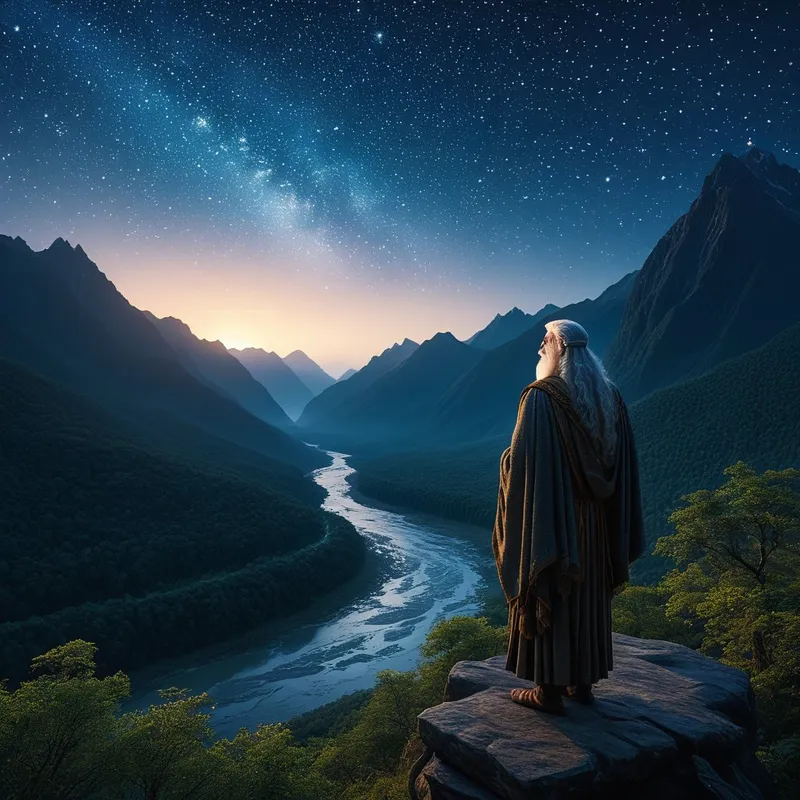
In the time before time, when the world was a dream waiting to be breathed into form, there was a silence so deep it hummed. From this silence, a knowing awoke. It was not a being with hands and feet, but a presence—a vast, tender attention that filled the dark. This was Wakan Tanka, the Great Mystery, the Great Spirit.
Its first thought was not a word, but a feeling: a longing for relationship. From this feeling, a breath stirred—Nilch’i—and it whispered across the void. Where it whispered, light sparked. The light gathered, swirling into a great, gentle fire that was the sun, Wi. The fire wept tears of joy, and its tears became the waters, the first rivers singing their way across the dreaming stone.
The Spirit’s attention then turned to the stone and water. “You shall be my bones,” it murmured to the land, and mountains rose, cradling valleys. “And you shall be my blood,” it sighed to the waters, and oceans pulsed with tide. But a stillness remained. The bones were strong, the blood flowed, but nothing moved to greet the sun.
So, the Spirit took a piece of its own dreaming—the green dream of growth—and breathed it into the mud beside the river. From that breath, the first tree reached for the sky, and from its roots, all plants unfurled. Still, the world waited. The Spirit then sang a complex song, a song with four legs, with wings, with fins, with countless beating hearts. The song took form as Buffalo, who taught sacrifice; as Eagle, who taught vision; as Salmon, who taught perseverance; and as the crawling, flying, burrowing nations, each a living note in the great harmony.
Finally, the Spirit gathered clay from the riverbank, warmed by the sun. Into this clay, it breathed not just life, but something of its own capacity to dream, to choose, and to wonder. “You are made of the same clay as the earth, watered by the same rain as the plants, and filled with the same breath as the animals,” the Spirit whispered to the first humans. “But to you, I give a special task: to remember. Remember that you are not above this web, but of it. Your hands can care for it or destroy it. Your heart can feel its joy or its sorrow. Walk gently, listen closely, and know that my voice is in the wind, my law is in the balance of life, and my face is in every creature you meet.”
And so, the people opened their eyes to a world alive, every rock, river, and rustling leaf a testament to the one, vast, and holy Spirit that dreamed it all into being.
Cultural Origins & Context
The concept of the Great Spirit is not a singular, monolithic myth from one tribe, but a profound, pan-tribal understanding of the divine that permeates hundreds of distinct Indigenous nations across North America. Known by many names—Wakan Tanka to the Lakota, Gitche Manitou to the Anishinaabe, the Great Mystery or simply the Creator—this principle was the bedrock of a lived spirituality.
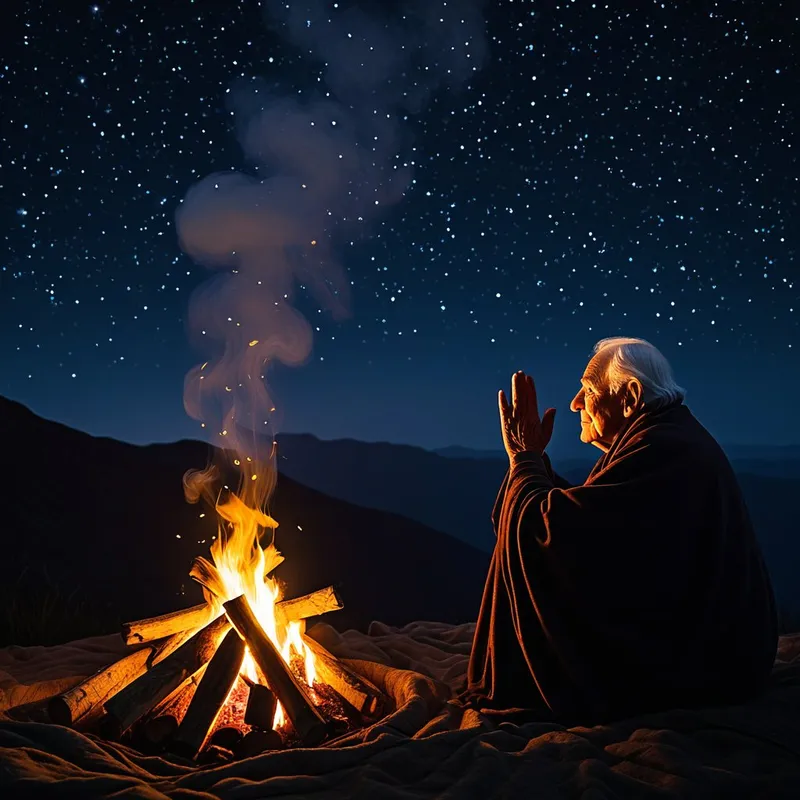
It was not a doctrine recited in temples, but a reality experienced daily. Knowledge of the Spirit was passed down not through sacred texts, but through oral tradition: in the stories told by elders by the winter fire, in the rituals of gratitude at dawn, in the guidance sought through vision quests, and in the practical ethics of hunting, gathering, and community life. The myth was less a story with a plot and more an ever-present context. Its societal function was foundational: it established a cosmology of radical reciprocity, where humans were junior partners in a sacred, animate universe. It provided the "why" behind every "how"—why one gives thanks before taking a plant, why one honors the spirit of the animal taken for food, why leadership is stewardship, not domination.
Symbolic Architecture
Psychologically, the myth of the Great Spirit represents the archetypal ground of being, the unified field of consciousness from which the psyche itself emerges.
The Great Spirit is the symbol of the Self, the central, ordering principle of the total personality that transcends the conscious ego.
The narrative is not a creation ex nihilo (out of nothing), but an emanation or unfolding from a state of potential (the humming silence) into differentiation (the manifested world). This mirrors the psyche's own development from the undifferentiated unconscious into the complex structures of consciousness, persona, and ego. Each element created—stone, water, plant, animal—symbolizes an aspect of the instinctual and natural psyche. The human, formed last and given the task of "remembering," symbolizes the emergence of the ego-consciousness, which carries the perilous and sacred responsibility of relating to the whole.
The core conflict is not a battle, but the inherent tension of the relationship: the risk that the conscious mind (humanity) will forget its origin and see itself as separate, exploiting rather than participating. The resolution is the ongoing practice of remembrance—the ritual, myth, and ethical action that re-weaves the conscious ego back into the fabric of the greater Self.
The Dreamer's Resonance
When this myth activates in the modern psyche, it often manifests in dreams of profound connection or devastating disconnection. A dreamer might find themselves in a vast, beautiful landscape where every tree communicates, or they might dream of a withering, gray world where all links are severed.
Somatically, this process can feel like a deep, homesick longing for a place one has never visited, or a sudden, overwhelming sense of peace and "rightness" in nature. Psychologically, it marks a crucial stage in what Jung called the transcendent function—the psyche's move toward greater wholeness. The ego, often inflated or isolated in modern life, is being confronted by the reality of the collective unconscious and the Self. The dream is an invitation to release the illusion of separateness. To dream of the Great Spirit is to feel the pull of individuation, where the center of one's identity begins to shift from the ego to the Self, prompting a re-evaluation of one's relationship to community, environment, and the very source of life.
Alchemical Translation
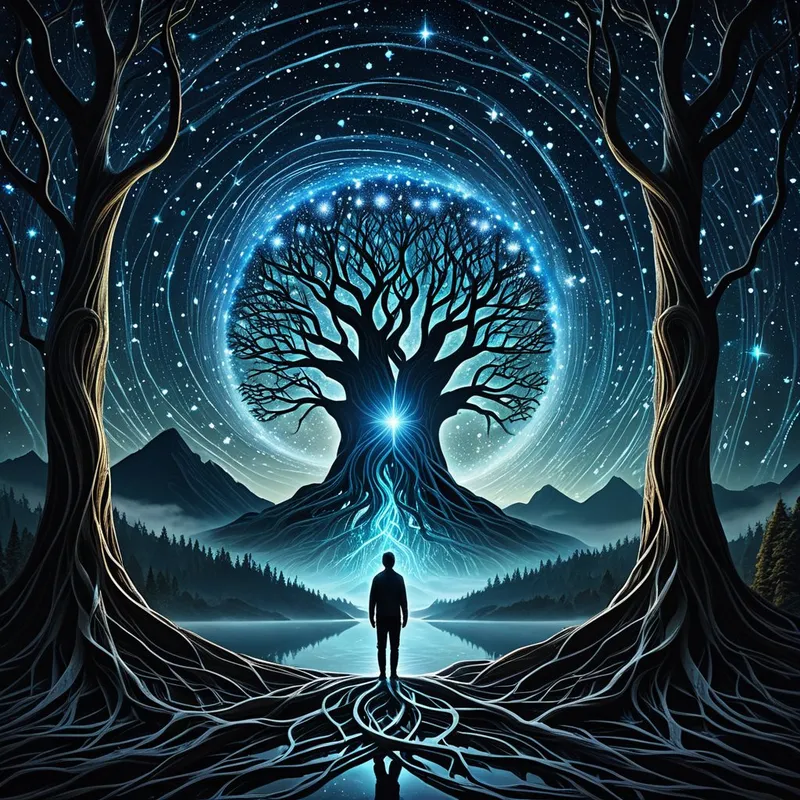
The alchemical work modeled here is the unio mentalis, the union of the mind, but extended to a union of the mind with the anima mundi—the soul of the world. The modern individual's path of psychic transmutation follows the same pattern as the myth.
The journey begins in the silence of neurosis or meaninglessness (the nigredo), moves through the differentiation of understanding one's complex parts (the albedo), and culminates in the remembering of one's place within a living, meaningful whole (the rubedo or citrinitas).
First, one must confront the "void"—the feeling of isolation, fragmentation, or spiritual aridity. This is the necessary first breath of Nilch’i, the stirring that initiates the work. The next phase is recognizing the "clay" of one's own being: acknowledging the instinctual, earthly, and animal aspects of the psyche (the shadow) without judgment, just as the Spirit formed the animals with a song. This is the integration of our natural selves.
The final and ongoing operation is the breathing of the "special task" into that integrated clay: the development of a consciousness that can hold paradox, that can see itself as both individual and part of a vast, intelligent system. This is the birth of the ethical, ecological, and spiritual human—the one who "walks gently." The triumph is not conquest, but the sustained, humble practice of relationship. The gold produced is not perfection, but a participatory consciousness, an ego that knows itself to be a vessel through which the Great Spirit experiences and cares for its own creation.
Associated Symbols
Explore related symbols from the CaleaDream lexicon: