
The Bardic Tradition Myth Meaning & Symbolism
The myth of the bardic tradition tells of the poet's sacred duty to remember, speak truth, and weave the world into being through the power of inspired word.
The Tale of The Bardic Tradition
Listen. The world is not made of stone and wood alone. It is woven from breath and memory, from the song that was sung before the first sunrise. In the time when the Sídhe walked openly with mortals, there was a man who had lost everything. His name is not remembered, for he became something else. His clan was scattered by the sword, his hills taken by a rival king. He wandered, a hollow man, through the mist-cloaked forests and across the whispering bogs, carrying only the ashes of his past.
He came to a pool, so still it was a mirror of the grey sky. In its depths, he saw not his own broken reflection, but a face of ancient, terrible beauty. It was the Cailleach, the Hag of Beara, she who remembers the birth of every mountain. "You carry a weight," her voice echoed, not from the water but from the stones themselves. "But it is not the weight of loss. It is the weight of unsung stories. Your people are gone from the land, but are they gone from here?" She touched a gnarled finger to his chest, where the heart beats a rhythm against the ribs.
He fell into a sleep that was not a sleep, a death that was not a death. In that twilight, he wandered the Tír na nÓg, the Land of Youth. There, he was given a cup to drink from by a lord with eyes like calm lakes. It was not wine, but the essence of the land itself—the taste of oak root, the sharpness of hawthorn berry, the sorrow of the west wind. When he drank, his mind shattered and reformed. He saw the true names of things. He heard the history of the land sung by the rivers and whispered by the stones.
He awoke by the pool, an old man in a young man's body. His first breath out was not a sigh, but a verse. It described the exact shade of green on the moss of the oak beside him, and in speaking it, the green became more vivid, more true. He understood his geis, his sacred duty. He traveled to the fort of the very king who had destroyed his people. He walked into the feasting hall, unarmed, and stood before the fire. The king demanded his name and purpose.
The man opened his mouth. He did not speak of revenge. He sang. He sang of the king's own grandfather, of his bravery and his folly. He sang of the lineage of the hills the king now ruled, naming every chieftain and hero buried within them. He sang a satire so precise and cutting about the king's recent unjust judgment that the man's face blushed as if slapped. Then, he sang a praise poem so devastatingly beautiful about the king's potential for wisdom that the hall fell into a silence deeper than any noise.
The king, shaken to his core, offered him gold. The man refused. "I am a fili," he said. "My price is memory. You will remember the truth of your actions, and you will remember the names of those you have wronged. You will rule by this memory, or my next song will unmake your name from the world." The king agreed, not out of fear, but out of a sudden, profound understanding. The poet had not brought a sword, but something far more powerful: the immutable record of what is. He had become the memory of the tribe, the voice of the land, the bridge between what was, what is, and what must be. The first true bard.
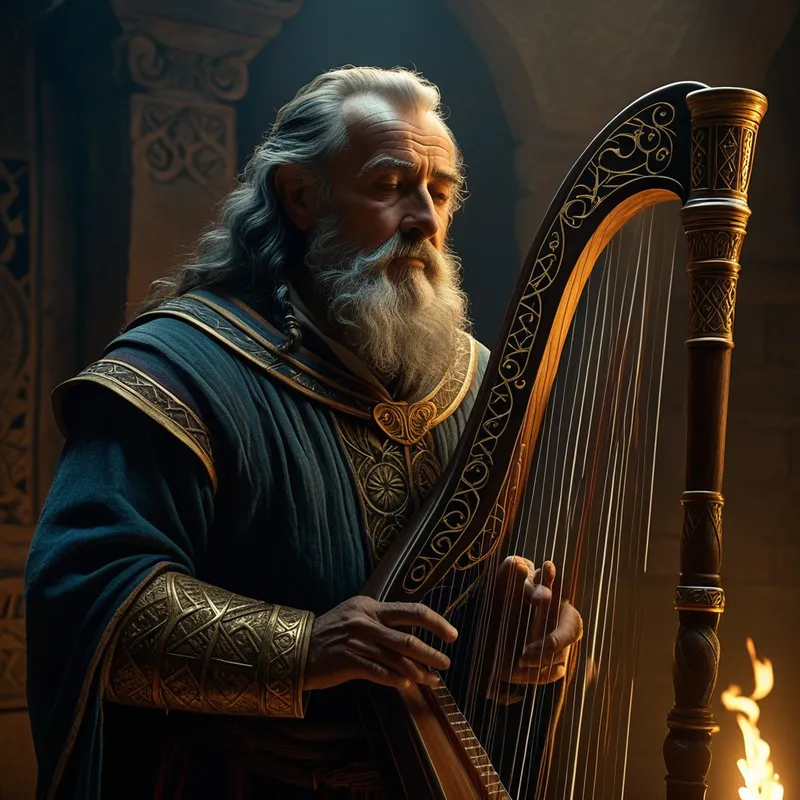
Cultural Origins & Context
The bardic tradition was not mere entertainment; it was the central nervous system of pre-Christian Celtic societies, particularly in Ireland, Scotland, and Wales. The fili (a higher-grade poet-seer) and the bard were custodians of senchas. They underwent rigorous training for up to twelve years, memorizing vast tracts of genealogies, mythic cycles, laws, and topographical lore.
This mythic conception of the bard’s origin speaks to their societal function. They were the living database, the legal witness, the political satirist whose verse could raise blisters on a king's face (glám dícenn), and the praise-poet whose words could solidify sovereignty. Their power was rooted in the belief that the spoken word, especially metered, inspired poetry (imbas), was a creative and destructive force. It could bless a reign or curse a lineage into oblivion. They stood outside the normal hierarchy, often immune from the law, because they served a higher law: the law of truth and memory, mediated through the sacred art of speech.
Symbolic Architecture
At its core, the myth symbolizes the transformation of personal, traumatic memory into collective, ordering wisdom. The bard’s journey is an initiation into the realm of objective consciousness, where the personal self is dissolved in the waters of the Cailleach to be reconstituted as a vessel for transpersonal truth.
The bard does not speak his own mind; he voices the mind of the landscape, the memory of the bloodline, and the judgment of time itself.
The loss of his clan represents the necessary death of ego-identification. The drink from the lord in Tír na nÓg is the infusion of Awen or Imbas—divine, inspired knowledge. His return to confront the king is the ultimate test: will he use this power for personal vengeance (the old self) or for restorative justice and the establishment of truthful order (the new, initiated self)? The choice to use satire and praise demonstrates that truth is not one-sided; it encompasses critique and potential, shadow and light.

The Dreamer's Resonance
When this mythic pattern stirs in the modern psyche, it often manifests in dreams of finding one's voice, or conversely, of being struck mute in a critical situation. You may dream of singing and causing physical changes in the environment—stones shifting, trees blooming. Or you may dream of standing before an authority figure (a boss, a parent, a judge) and needing to speak, but only strange, archaic, or impossibly truthful words come out.
Somatically, this can feel like a pressure in the chest or throat—the "unsung stories" seeking expression. Psychologically, this is the process of moving from being a passive carrier of personal and familial history ("the hollow man") to becoming an active, conscious witness and narrator of that history. The dreamer is being called to articulate a deep, perhaps painful truth that has been held in silence, not to blame, but to restore a fundamental order to their internal and external world.

Alchemical Translation
The alchemy of the bardic tradition is the transmutation of leaden, burdensome memory into the gold of conscious, creative truth. In Jungian terms, it is a supreme model for the individuation process. The personal unconscious (the lost clan, the personal grievance) is led to the pool of the collective unconscious (the Cailleach, the Sídhe). There, the ego is dissolved and the individual drinks from the waters of the archetypal Self.
The return is not with a weapon, but with a word—the Logos—that has the power to structure chaos.
For the modern individual, this translates to the arduous work of retrieving one's own story from the fog of trauma, family narratives, and societal expectations. It is to hold that story, examine it with the clear, unforgiving, yet compassionate eye of the fili, and then, crucially, to speak it or otherwise creatively express it in a form that is ordered, beautiful, and true. This act does not change the past, but it changes the past's power. It transforms the inner "tyrant king"—the complex that rules through silence and shame—by confronting it with the precise, resonant truth of its own existence. The result is not victory in a battle, but the establishment of a new, more authentic sovereignty in the psyche, ruled by the integrative power of conscious speech and deep memory. You become the bard of your own soul, singing the world of your life into coherent, meaningful being.
Associated Symbols
Explore related symbols from the CaleaDream lexicon: