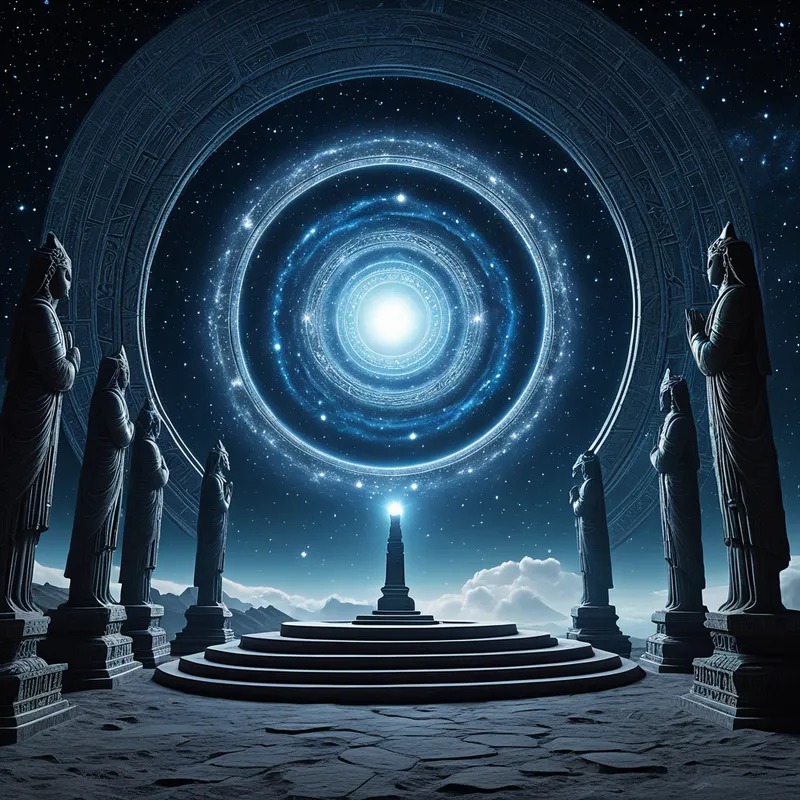
Stargate / Wormhole Myth Meaning & Symbolism
A universal motif of a cosmic portal, a threshold between worlds, representing the ultimate journey of transformation and the soul's passage through impossible spaces.
The Tale of Stargate / Wormhole
Listen, and hear the tale of the Unfolding Path, the story whispered by the stars themselves. In the time before time, when the world was raw and the sky was a tapestry still being woven, the gods walked the seams of reality. They were lonely in their vast, separate domains. The Sky Father, Dyēus, ruled the endless blue and the cold, distant lights. The Earth Mother, Gaia, held the deep green and the secret fires of the underworld. Between them stretched a gulf so profound, not even thought could cross it.
Their children, the first humans, were born into this separation. They looked up and felt longing. They looked down and felt rootless. A great silence, a cosmic loneliness, settled over all creation. The great trickster-smith, known by many names—Loki, Hermes, Ogun—saw this sorrow. He took the tears of the Sky Father, which were bolts of lightning frozen in mid-air, and the breath of the Earth Mother, which was the mist rising from the first deep cave. He stole a fragment of the void between worlds and a shard of the noonday sun. At the world's navel, the axis where all directions meet, he began to work.
The hammering was not a sound, but a vibration that shook the soul. The forging was not with fire, but with paradox and possibility. When he was done, there stood a Ring. It was not merely stone or metal; it was a wound in the fabric of "here" and "there," a circle that defined an elsewhere. It was inert, a silent monument, until the first true Seeker approached.
This was no warrior king, but a shaman, a dreamer stained with ochre and starlight. Driven by a longing he could not name, he placed his palm upon the cold rim. He did not speak a password of magic, but offered his own confusion, his yearning for the other side of the mountain, his question with no answer. The Ring drank his intention. The space within its circumference shimmered, dissolved, and then turned inside out. Where there was stone, there was now a tunnel of spiraling light, a throat of singing colors, a shortcut through the belly of eternity. The air hummed with the pressure of elsewhere. With a final breath of this world, the Seeker stepped through.
The journey was not a flight, but a falling upwards. He was unmade and remade, stretched across light-years and compressed into a single point. He saw the faces of his ancestors as constellations and heard the future as a distant echo. It was a death that was not an end, but a passage. And then, from chaos, form coalesced. He stumbled out, not onto another planet, but into the very court of the Sky Father, or the deepest grove of the Earth Mother—the destination shaped by the quality of his longing. The gate had read the signature of his soul and delivered him to the corresponding mystery. The great separation was healed, not for all, but for the one brave enough to let the journey dissolve them.
Cultural Origins & Context
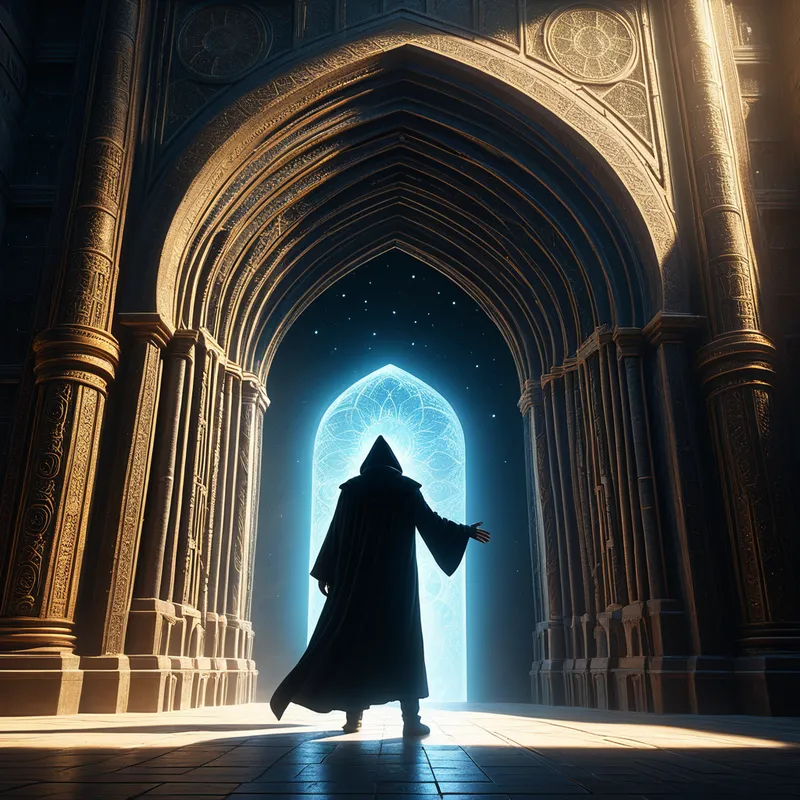
The motif of the stargate or wormhole is not the property of a single culture, but a universal human intuition etched into our oldest stories. It appears as the Bifröst, the shimmering, fragile bridge of the gods. It is the torii gate in Japan, which frames not just a shrine but an entire shift in consciousness. Australian Aboriginal Songlines describe pathways across the land that are also tunnels through the Dreamtime. The medicine wheel can be seen as a map of such a portal, with its center as the point of departure.
These stories were the province of shamans, mystics, and epic poets—the cartographers of the invisible world. They were told around fires that mirrored the stars, serving a crucial societal function: to map the interior. The stargate myth provided a cosmology that included escape, transcendence, and communion. It answered the human ache of limitation, offering a narrative template for radical change. It was a technology of hope, written not in code, but in symbol, explaining that the universe contains folds, and a courageous soul can step through them.
Symbolic Architecture
At its core, the Stargate is the archetypal symbol of the limen, the threshold. It is the ultimate "in-between." Its circular form represents wholeness, eternity, and the cyclical nature of existence, while its function as a tunnel represents linear, irreversible journey. This paradox is its power.
Psychologically, the Gate represents the psyche's own capacity for quantum leaps. It is the moment of insight that collapses a lifetime of confusion, the synchronicity that reroutes a destiny, the trauma that becomes a portal to a new level of being. The deities involved map our internal landscape: the separated Sky Father and Earth Mother represent the fragmented self—spirit divorced from instinct, intellect from emotion. The trickster-smith is the unconscious, mercurial intelligence that works with stolen and paradoxical materials (our repressed wounds and latent potentials) to forge the tool for integration.
The Gate does not appear on a well-trodden path; it manifests at the point of maximum tension between irreconcilable opposites, offering not a compromise, but a transcendence.
The Seeker who passes through is the ego, but not the ego as king. It is the ego as willing sacrifice. The journey of being unmade is the dissolution of the old, rigid personality structure. The destination—shaped by the Seeker's longing—reveals a profound law of the inner world: you arrive at the mystery you are prepared to meet. The gate is a mirror of intent.
The Dreamer's Resonance
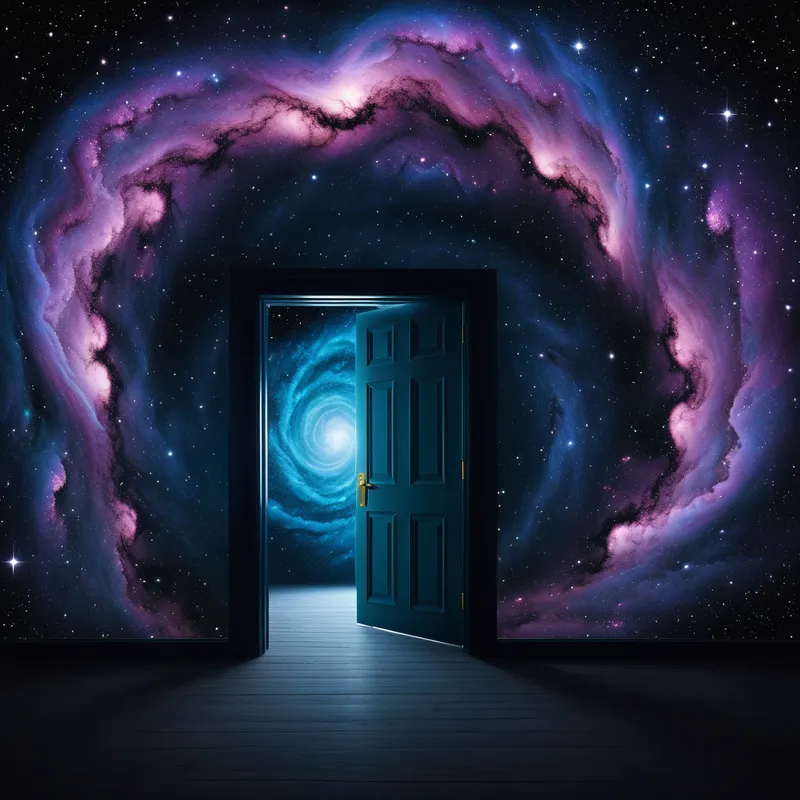
When the Stargate appears in a modern dream, it signals that the dreamer's psyche is negotiating a profound transition, often one that feels impossible or terrifyingly vast. It rarely appears in times of calm stability. You might dream of a familiar hallway ending in a vortex, a mirror that becomes a tunnel, or a manhole cover leading to a galaxy.
Somatically, this can correlate with feelings of vertigo, compression, or electric buzzing upon waking—the body registering the shock of the "transit." Psychologically, the dreamer is at an impasse. The conscious mind sees no logical way forward from a life circumstance, a relational dead-end, or an internal conflict. The Stargate is the unconscious presenting a third option: not a detour, but a dimensional shift.
The nature of the gate and the journey offers diagnosis. A crumbling, overgrown gate suggests an old, neglected potential for transition. A terrifying, chaotic vortex may point to resistance to a necessary dissolution. A calm, inviting passage indicates a readiness for transformation. The key is the feeling upon entering: is it with dread, awe, or surrender? That feeling charts the dreamer's true relationship to the change brewing in their depths.
Alchemical Translation
The myth of the Stargate is a perfect allegory for the alchemical process of individuation, the psychic transmutation of the lead of the fragmented self into the gold of the integrated Self. The initial state (separatio) is the painful awareness of inner division—our own Sky Father and Earth Mother at war. The longing this creates is the prima materia, the raw, suffering substance to be worked.
The forging of the gate is the conscious work of therapy, active imagination, or creative struggle—the coniunctio oppositorum (conjunction of opposites) where we hold our contradictions in tension without fleeing. The trickster-smith is the guiding function of the unconscious, the therapist, or the inner guide that facilitates this work.
The passage through the gate is the nigredo, the dark night of the soul. It is the voluntary dissolution of the ego's certainty, a descent into the chaotic, unformed potential of the self.
This is not destruction, but de-structuring. The traveler must trust the process enough to be unmade. The arrival on the "other side" is the albedo (whitening) and rubedo (reddening)—the emergence of a new perspective, a reconciled state where former opposites are seen as part of a new, more complex whole. The gate, once used, remains. It signifies that this capacity for radical transit is now a permanent feature of the individual's inner landscape. They have learned the soul's most crucial navigation: that to reach the farthest destination, one must sometimes be willing to cease being the person who began the journey. The universe, like the psyche, is not just a space to traverse, but a substance to be folded, and we are both the map and the point of origami.
Associated Symbols
Explore related symbols from the CaleaDream lexicon: