Soma / Ikshvaku Myth Meaning & Symbolism
The myth of the Moon-god Soma, his descent as King Ikshvaku, and the sacred quest to recover the stolen nectar of immortality.
The Tale of Soma / Ikshvaku
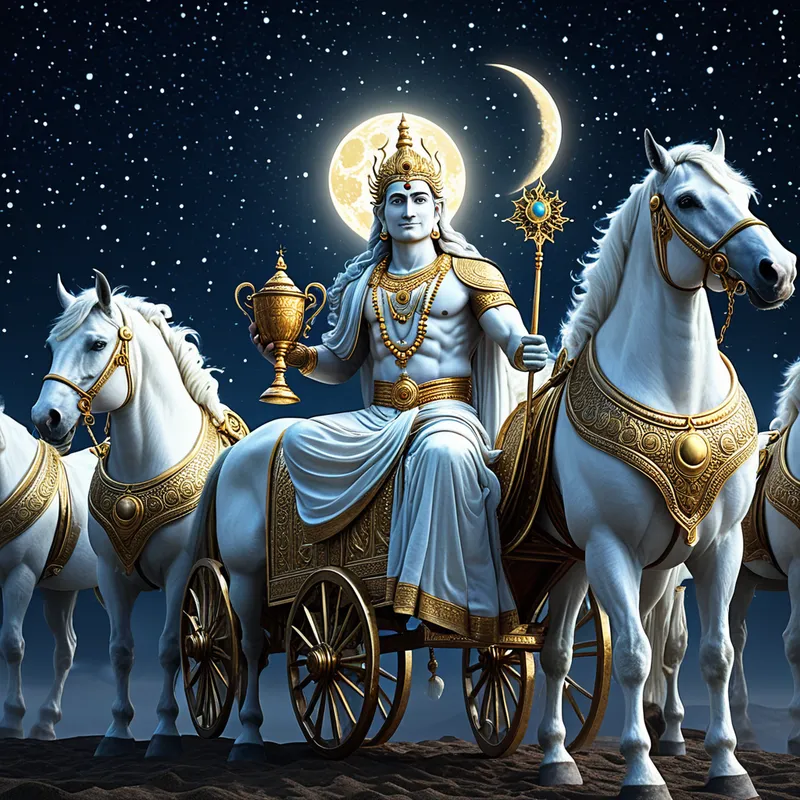
Listen, and let the ancient rhythm of the chant carry you back. Before time was counted in years, when the sky was a closer vault and the earth a raw, breathing thing, there shone a light that was not of the sun. It was the cool, silver radiance of Soma. He was not merely a celestial body, but a god, the lord of plants, the master of ecstasy and wisdom, the very essence of life distilled into a luminous nectar.
He dwelled in the highest heaven, Svarga, and from his being flowed the amrita, the draught of immortality. The gods themselves partook of it, and in its tasting, their powers were renewed, the cosmic order upheld. But the cosmos is a balance of giving and receiving. And so it was decreed that Soma, the giver, must also become the receiver. He must descend.
He chose as his vessel the noble lineage of the Ikshvakus. Taking mortal form, he was born as Ikshvaku, the first king of that glorious line. His palace was not of clouds but of stone and timber; his subjects were not devas but men. He ruled with a justice that mirrored the moon’s impartial glow, yet within his royal chest beat a heart that remembered the starry silence of his origin. He was a king, yet a stranger in his own kingdom—a god tasting the bitter salt of mortal limitation.
Then, the rupture. A shadow moved in the periphery of the world. The Gandharva named Visvavasu, covetous of the divine essence, performed a terrible theft. He seized the Soma, the very nectar of the god-king’s soul, and fled with it into the trackless, whispering depths of the earthly wilderness. The light in the palace dimmed. Ikshvaku felt it not as a political loss, but as a visceral draining, a fading of his vital core. The connection to his own divine source was severed.
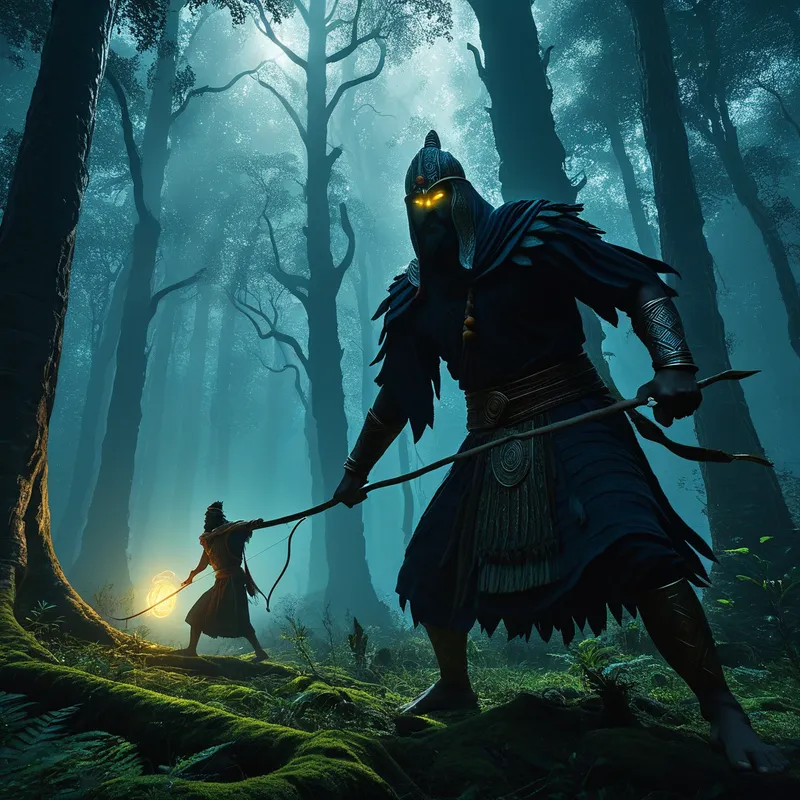
A lesser king might have despaired. But the lunar essence within Ikshvaku, though hidden, was not extinguished. It crystallized into a fierce, cold resolve. This was not a task for an army, but for a hero-king alone. Casting aside his royal diadem for the simple garb of a hunter, he took up his bow—not the jeweled scepter of rule, but the tool of focused will. He entered the forest, the aranya, which is both a place of chaos and the repository of all lost things.
The chase was an ordeal of the spirit. He tracked not just footprints, but the fading scent of divinity itself. He faced the seductive illusions of the wilderness, the whispers that urged him to forget his quest and lose himself in the earthly dream. Finally, in a clearing where the ancient trees stood like silent witnesses, he cornered Visvavasu. There was a confrontation, not merely of strength, but of essence—the embodied king versus the elusive spirit of possession. With the authority of his solar lineage and the desperate need of his lunar nature, Ikshvaku reclaimed what was his.
He did not destroy the thief. He mastered him. And in that act of recovery, a profound alchemy occurred. The Soma, returned, was no longer a purely celestial substance. It was now infused with the sweat, the striving, the earthly reality of the quest. Ikshvaku, the king, had become the vessel that redeemed and transformed the Soma. He raised the recovered nectar, and in drinking it, he was no longer a god in exile, but a sovereign fully integrated—a being of heaven who had earned his place on earth.
Cultural Origins & Context
This myth is woven into the earliest strands of Indian thought, found in the Vedas and elaborated in the Brahmanas. It is not a mere story for entertainment, but a mantra in narrative form, recited by priests during the elaborate yajna ceremonies. The Soma ritual was the pinnacle of Vedic practice, involving the pressing of a (now lost) plant, the filtering of its juice, and its offering into the fire as a libation to the gods.
The myth of Soma-Ikshvaku served as the divine prototype for this human ritual. The priests, in performing the ceremony, were re-enacting the king’s heroic recovery. The Gandharva Visvavasu represented the natural, chaotic forces that hide the sacred essence (the Soma plant in the mountains). The king’s quest symbolized the ritual effort—the pressing, the filtering, the precise recitation—required to extract and purify the divine from the clutches of the mundane. It was a map, showing that the sacred is not simply given; it must be courageously sought, confronted, and won back from the world of distraction and decay.
Symbolic Architecture
At its heart, this is a myth of descent and integration. Soma represents the pure, undifferentiated spiritual essence—the soul’s original, celestial state of bliss and potential. His incarnation as Ikshvaku is the necessary kenosis, the emptying of that pure spirit into the vessel of individual human life, with all its constraints, responsibilities, and loneliness.
The theft of the Soma is not a catastrophe, but the catalyst for the hero’s journey. Our deepest essence often feels stolen, hidden, or lost the moment we engage with the world.
The Gandharva Visvavasu is a crucial symbol. Gandharvas are liminal beings—musicians, lovers, tricksters. Visvavasu is not a demon of pure evil, but a personification of divine distraction, the enchanting power of earthly life and the unconscious that captivates and holds our core energy hostage. He does not destroy the Soma; he hoards it in the wilderness, representing how our vital spirit can become trapped in complexes, in worldly pursuits, or in the untamed thickets of our own psyche.
The forest, the aranya, is the wilderness of the unconscious, the realm of shadow and unintegrated potential. Ikshvaku’s solitary journey into it is the path of introspection and confrontation. His bow is the focused discipline of consciousness, the tapas (austerity) required to pursue the lost self.
The triumphant recovery signifies that the spiritual essence, once reclaimed through conscious effort, is transformed. It is no longer a passive inheritance; it is an earned wisdom. The king who drinks the recovered Soma is a fully realized individual—a ruler who has sovereignty because he has first recovered sovereignty over his own scattered soul.
The Dreamer's Resonance
When this myth stirs in the modern dreamer, it often manifests as a profound sense of loss of vitality or meaning. One might dream of a precious, glowing object being stolen; of a familiar room now feeling empty and dim; or of a once-beautiful garden overgrown and hiding a secret. There is a somatic feeling of depletion, of being "drained."
The dream may then shift to a quest narrative: searching through labyrinthine buildings (the modern aranya), confronting a charming but elusive figure who seems to have something of yours, or finally discovering a hidden, inner chamber where a source of light or nourishment is kept. This is the psyche’s enactment of the Ikshvaku journey. The psychological process is one of re-collection—gathering the parts of the self that have been captivated by various "Gandharvas": our careers, our relationships, our past traumas, or simply the numbing distractions of daily life. The dream signals that the time has come to stop lamenting the loss and to pick up the bow of conscious attention and go in search of oneself.
Alchemical Translation
The alchemical process mirrored here is the solve et coagula: dissolve and coagulate. First, the pure Soma (the prima materia of the soul) is dissolved into the mortal condition (Ikshvaku’s life). Then, through the heat of conflict and the pursuit in the forest (the nigredo, the dark night of the soul), it is separated from the clinging impurities of distraction and identification. Finally, it is re-coagulated into a new, more resilient form—the integrated king.
Individuation is not about ascending to a pure spiritual state, but about descending fully into one’s humanity to recover the divinity hidden there.
For the modern individual, the myth models the path of Individuation. We all begin with a sense of innate potential (Soma). Life inevitably "steals" this sense, scattering our energy (Visvavasu’s theft). The heroic task is not to reject the earthly life that facilitated this theft, but to engage with it courageously. We must enter our own wilderness—our unresolved past, our shadow aspects, our deepest fears—and confront what holds our power captive.
The recovery is the integration of the shadow (the Gandharva is not slain but mastered). The Soma we drink afterward is the elixir of self-knowledge. We are no longer naive spirits nor embattled victims, but sovereign beings. We become Ikshvaku, the king who rules his inner kingdom because he has journeyed to its farthest borders and reclaimed its stolen treasure. The light we then emit is not the distant, cool light of the moon alone, but the forged, tempered light of a consciousness that has faced the dark and returned, whole.
Associated Symbols
Explore related symbols from the CaleaDream lexicon: