Sinaa Spirit of Cliffs
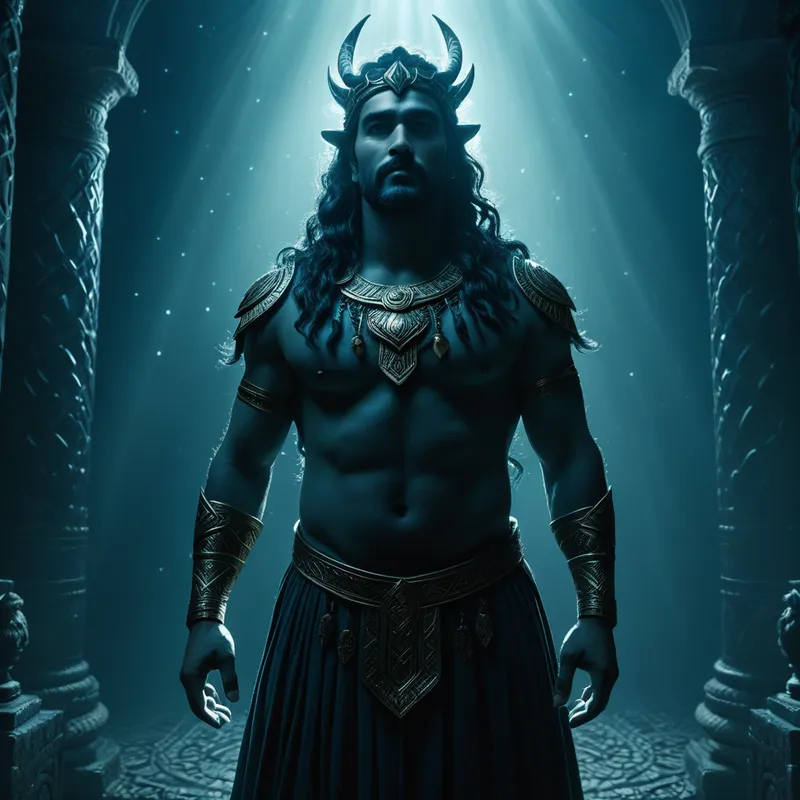
Sinaa is an Inuit spirit embodying the formidable cliffs, serving as both protector and challenger to those navigating the harsh Arctic environment.
The Tale of Sinaa Spirit of Cliffs
In the time when [the world](/myths/the-world “Myth from Tarot culture.”/) was still being spoken into shape by the songs of the first people, the great cliffs of the north were not silent stone. They were the ribs of [the earth](/myths/the-earth “Myth from Hindu culture.”/), holding back the endless sky and the restless sea. And within them lived Sinaa, the spirit of the cliffs, a being as ancient as the permafrost and as watchful as the midnight sun.
The people knew of Sinaa not through grand apparitions, but through the intimate language of survival. A hunter, desperate and lost in a sudden whiteout, would feel a subtle shift in [the wind](/myths/the-wind “Myth from Various culture.”/)’s song—a low hum that was not the gale. Following that hum, his feet would find purchase on a ledge invisible beneath the snow, a narrow path that led, step by cautious step, to the lee side of a vast stone face. There, sheltered from the killing wind, he would find a shallow overhang, and within it, perhaps, a cache of lichen or the faint, dry scent of a lemming’s nest, a sign of life and thus of possible sustenance. This was Sinaa’s providence: not a gift, but an opportunity for the clever and the respectful.
Yet, Sinaa was not merely a sheltering presence. The cliffs were also a place of testing. A young person seeking a vision or a name might be drawn to their base. They would sit for days, listening. At first, there would be only the groan of shifting ice and the cry of the fulmar. But if their heart was clear, the cliff would begin to speak. It spoke in echoes—the echo of a falling stone becoming the laughter of ancestors; the echo of the wind in a fissure forming words in the old tongue. The cliff mirrored the seeker’s own mind back to them, amplified and clarified by stone. To receive Sinaa’s secrets, one had to first face the echoes of one’s own fears and desires, etched as if in ice upon the inner wall of the soul. Many turned back, unable to bear the confrontation. Those who stayed might hear the secret of a new fishing ground whispered on the breeze, or see in the striations of the rock the pattern of a coming storm. This knowledge was Sinaa’s challenge met, a pact sealed not with words, but with endured silence and understood signs.
Cultural Origins & Context
Sinaa emerges from the Inuit worldview, where the landscape is sila made visible—intelligent, responsive, and densely populated by inua. Every hill, animal, and tool possesses an inua, a spiritual essence. The inua of a towering, immutable cliff face is necessarily vast and potent. Sinaa is not a deity to be worshipped in temples, but a proximate reality to be negotiated with daily. The Inuit relationship with the land is one of pragmatic spirituality; the spiritual is the practical.
In this context, cliffs are not scenic backdrops but vital features of the Arctic topography. They are navigational markers in a world often devoid of landmarks, places where seabirds nest (providing eggs and meat), and sanctuaries from predators and storms. They are also thresholds—vertical boundaries between the land of the living and [the sky](/myths/the-sky “Myth from Persian culture.”/)-world, and between the known shore and the fathomless ocean. A spirit governing such a space naturally embodies duality: protector and prohibitor, revealer and concealer. Sinaa’s role reflects the core Inuit value of ajuinnata—perseverance, the determination to overcome impossible odds. The spirit presents the cliff: an obstacle that can also be a salvation, demanding ajuinnata from those who would seek its boon.
Symbolic Architecture
Sinaa represents the [psyche](/myths/psyche “Myth from Greek culture.”/)’s own formidable [architecture](/symbols/architecture “Symbol: Architecture in dreams often signifies structure, stability, and the framing of personal identity or life’s journey.”/). The [cliff](/symbols/cliff “Symbol: Dreaming of a cliff often symbolizes a significant decision point or a transition, representing both the fear of failure and the potential for growth.”/) is the ultimate [boundary](/symbols/boundary “Symbol: A conceptual or physical limit defining separation, protection, or identity between entities, spaces, or states of being.”/), the stark line where one state of being meets another. Psychologically, it symbolizes the edge of the conscious self, the [precipice](/symbols/precipice “Symbol: A steep cliff edge representing a critical boundary between safety and danger, often symbolizing life transitions, fear of the unknown, or existential risk.”/) overlooking the unconscious. Sinaa, as the [guardian](/symbols/guardian “Symbol: A protector figure representing safety, authority, and guidance, often embodying parental, societal, or spiritual oversight.”/) of this edge, governs what passes between these realms.
To encounter Sinaa is to stand before the sheer face of one’s own limitations and potential. The spirit does not lift the seeker over the cliff; it reveals the hidden handholds in one’s own character.
The [spirit](/symbols/spirit “Symbol: Spirit symbolizes the essence of life, vitality, and the spiritual journey of the individual.”/)’s dual [nature](/symbols/nature “Symbol: Nature symbolizes growth, connectivity, and the primal forces of existence.”/)—[caregiver](/symbols/caregiver “Symbol: A spiritual or mythical figure representing nurturing, protection, and unconditional support, often embodying divine or archetypal parental energy.”/) and challenger—mirrors the function of a true caregiver in [depth](/symbols/depth “Symbol: Represents profound layers of consciousness, hidden truths, or the unknown aspects of existence, often symbolizing introspection and existential exploration.”/) [psychology](/symbols/psychology “Symbol: Psychology in dreams often represents the exploration of the self, the subconscious mind, and emotional conflicts.”/): one who provides the necessary shelter (the containing environment) but also the necessary confrontation (the interpretation, the challenge to grow). Sinaa offers the protective overhang, but the [seeker](/symbols/seeker “Symbol: A person actively searching for meaning, truth, or a higher purpose, often representing the dreamer’s own quest for identity or fulfillment.”/) must still build their own fire. It whispers a secret, but the seeker must have the courage to decipher and act upon it. This is spiritual ecology: support is always coupled with the demand for resourcefulness and respect.
The Dreamer’s Resonance
To dream of Sinaa is to dream of standing before a great, sheer wall. The emotional tone defines the encounter. Dreaming of finding a hidden cave in the cliff speaks to discovering inner resources and resilience during a time of external pressure. [The cave](/myths/the-cave “Myth from Platonic culture.”/) is a natural sanctuary within the psyche, a place of introspection and recovery that the dreamer’s own spirit has carved out.
Conversely, dreaming of clinging to the cliff face, fearing a fall, points to a felt precariousness in waking life—a situation demanding immense balance and effort, where one feels exposed and the stakes of a misstep are high. Sinaa here is the cold, impersonal reality of the challenge itself. To dream of the cliff crumbling may signal a collapse of a long-held defensive structure or a rigid belief, terrifying but potentially liberating.
The echoing voice of the cliff in dreams is particularly significant. It represents the amplified voice of intuition, conscience, or ancestral wisdom. Is the echo guiding or mocking? The dreamer’s reaction reveals their relationship to their own inner authority and the older, wiser layers of [the self](/myths/the-self “Myth from Jungian culture.”/).
Alchemical Translation
In the alchemy of the soul, Sinaa presides over the stage of [separatio](/myths/separatio “Myth from Alchemical culture.”/) and [coagulatio](/myths/coagulatio “Myth from Alchemical culture.”/)—separation and re-forming. The cliff itself is a perfect image of [separatio](/myths/separatio “Myth from Alchemical culture.”/): a stark division between above and below, solid and air, known and unknown. The seeker’s journey involves a voluntary submission to this separating force, allowing non-essential aspects of [the ego](/myths/the-ego “Myth from Jungian culture.”/) to be scoured away by the wind of circumstance and the cold light of truth.
The alchemy of the cliff is one of pressure and revelation. Just as geologic pressure reveals a seam of quartz, the pressure of survival against an immovable object reveals the crystalline core of the human spirit.
The subsequent coagulation happens in the shelter Sinaa provides. In that temporary haven, the fragmented self, tested and purified, begins to re-form. It integrates the hard-won knowledge from the edge into a new, more resilient structure. The secret whispered by Sinaa is the [lapis philosophorum](/myths/lapis-philosophorum “Myth from Alchemical culture.”/)—the philosopher’s stone—for that individual: not a literal stone, but the transformative insight that allows them to navigate their world with renewed wisdom and strength. The spirit translates the raw, intimidating fact of the cliff into the personal, lived experience of endurance and insight.
Associated Symbols
Explore related symbols from the CaleaDream lexicon:
- Cliff — The ultimate symbol of a precipice, representing a decisive boundary, a moment of risk, and the stark division between one state of being and another.
- Protective Spirit Animal — A guiding spiritual essence that offers guardianship, wisdom, and specific strengths to those who respect its presence and domain.
- Survival Instinct — The primal, intelligent drive to persevere through adversity, finding creative pathways to sustenance and safety against formidable odds.
- Ancestral Spirits — The collective wisdom and presence of forebears, often communicated through the land itself, providing guidance and a sense of continuity.
- Cave — A natural sanctuary within a larger form, representing [the womb](/myths/the-womb “Myth from Various culture.”/) of the earth, a place of introspection, hidden knowledge, and regenerative solitude.
- Echo — A returning sound that transforms and clarifies, symbolizing reflection, the voice of the unconscious, and the wisdom that comes back to those who listen.
- Stone — The essence of permanence, patience, and silent memory; the bedrock of reality that holds and records the passage of epochs.
- Spirit Guide — A non-physical entity that offers direction, protection, and teaching to those on a spiritual or perilous physical journey.
- Threshold — A point of entry or transition, marking the space between two realms and demanding a change in consciousness to cross.
- Mountain — A colossal, enduring natural form that represents a supreme challenge, spiritual aspiration, and a vantage point granting broader perspective.
- Silence — The fertile void from which meaning emerges; a state of receptive listening necessary to hear the subtle communications of the spirit world and the inner self.
- Destiny — The hidden pattern or calling woven into one’s life, often revealed through encounters with profound challenges and the choices made at crucial junctures.