Shoji Myth Meaning & Symbolism
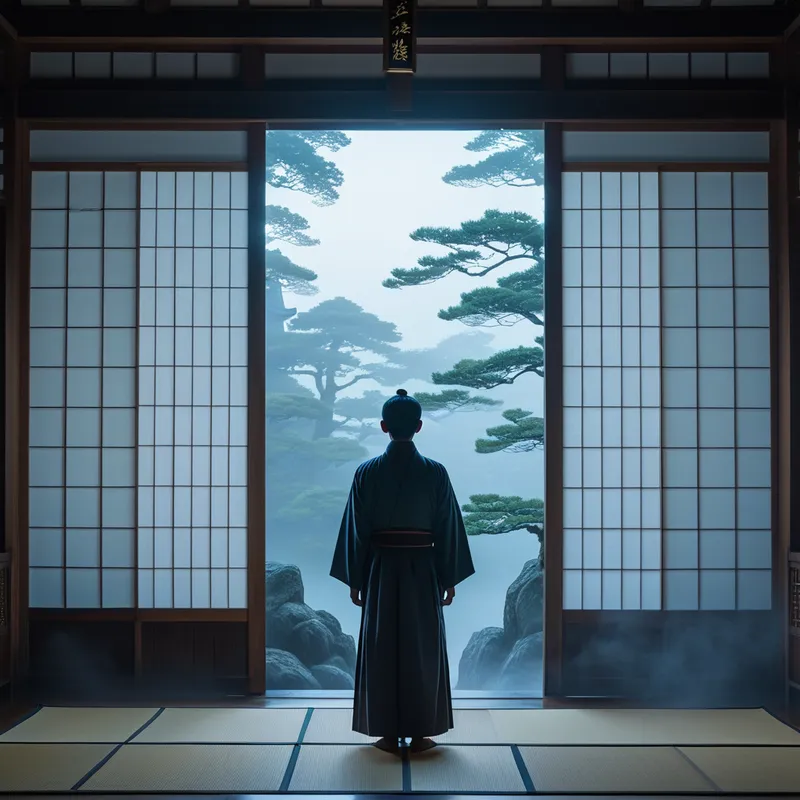
A myth of a humble artisan who crafts a translucent screen, becoming the guardian of the fragile boundary between the human world and the spirit realm.
The Tale of Shoji
Listen, and let the tale settle in the space between your breath and the silence that follows.
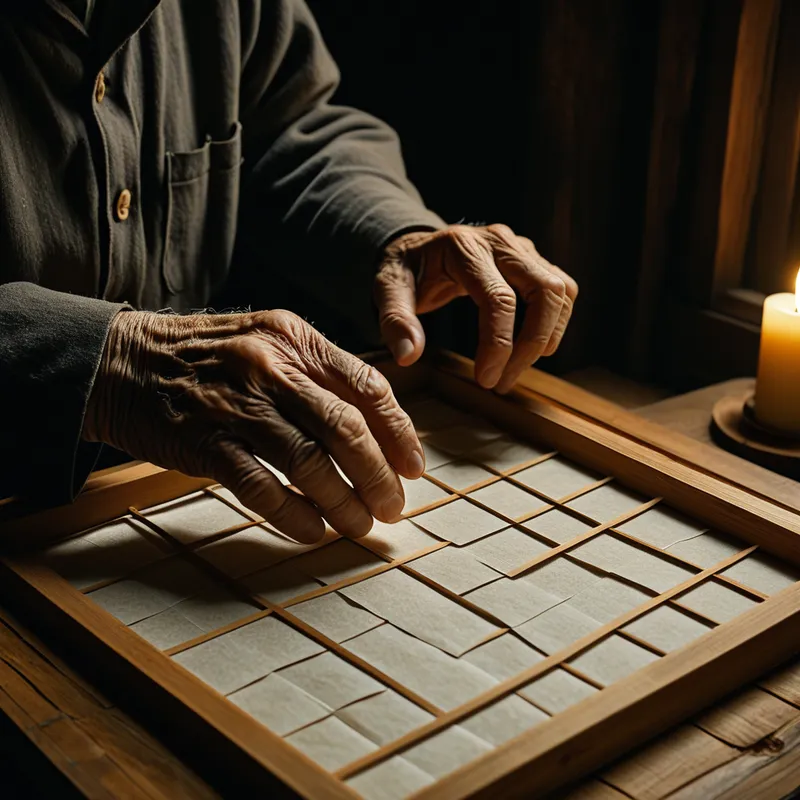
In a time when the world was still soft at the edges, when the rustle in the bamboo grove was just as likely to be a fox as the wind, there lived an artisan of unparalleled quietude. His name was Shoji. While others built fortresses of wood and stone, Shoji worked with the most fragile of materials: slender ribs of cedar, joints as fine as bird bones, and skin made of washi, paper so thin it held the light like a whisper holds sound.
His life was one of serene repetition, until the night the boundaries wept. The kami of the deep forests and the restless spirits of the departed had grown weary of the crude, solid walls humanity was raising. These walls did not filter; they denied. They created a world of shouting separation, where the subtle communications of the unseen realm—the sigh of a mountain, the memory-laden chill of a stream—could no longer be heard. The realms were tearing, not from conflict, but from silence.
A great council of the most ancient kami came to Shoji not with thunder, but with a profound stillness that filled his humble workshop. They did not speak in words, but in a shared vision: a barrier that was not a barricade. A boundary that respected both sides. They showed him the agony of a world split into absolute light and absolute dark, with no gentle twilight in between.
Shoji understood. He took up his tools, not to build, but to listen with his hands. He fashioned a frame that was a lattice of possibilities, a grid that ordered chaos without suppressing it. Then, with reverence that was a form of prayer, he stretched the washi. This was no ordinary paper; it was infused with the essence of the mulberry, a plant that knows both earth and sky, and sized with the milk of the ume blossom, which braves the late winter cold to flower.
As the first panel was completed and placed in an empty doorway facing the east, the dawn did not simply arrive; it transformed. The harsh, blinding spear of sunlight became a soft, diffuse glow that filled the room without conquering it. The shadows within ceased to be pockets of fear and became pools of cool rest. That evening, Shoji saw the shapes of the forest kami not as frightening apparitions, but as beautiful, shifting patterns of light and shadow on the paper, their presence acknowledged but gently held at bay.
He became the eternal guardian of this principle. Shoji did not battle monsters or claim treasures. His heroism was one of vigilant maintenance. He traveled, teaching others to craft these screens, these sacred filters. He became the living embodiment of the threshold itself—the man who stood at the door, ensuring it remained a place of meeting, not a slammed gate. His final act was to fade into the very fabric of the screens he championed, his consciousness becoming the attentive silence that inhabits a truly liminal space.
Cultural Origins & Context
The myth of Shoji is not found in the canonical texts of Kojiki or Nihon Shoki, but in the oral tradition of miyadaiku (shrine carpenters) and paper-making artisans. It is a mukashibanashi (tale of long ago) that functioned as a sacred technology manual, encoding profound spiritual and aesthetic principles into a narrative form.
Passed down in workshops lit by charcoal braziers, the story served multiple societal functions. Primarily, it sacralized the act of craftsmanship. It taught that to build was to engage in a cosmological act; the placement of a post, the tension of paper, directly affected the relationship between the human and spirit worlds (kenkai and yūkai). Secondly, it was a narrative foundation for the core Shinto and later Buddhist-infused aesthetic principles of mono no aware, wabi-sabi, and the reverence for ma. The shoji screen was the physical manifestation of ma—the dynamic, breathing space between interior and exterior, self and other, seen and unseen.
Symbolic Architecture
The myth of Shoji is a masterclass in the symbolism of conscious boundaries. Shoji himself is the archetype of the liminal guardian. He does not seek to destroy boundaries—an impossible and destructive task—but to make them intelligent, permeable, and respectful.
The wooden lattice represents the structures of the ego and conscious mind. It is necessary; it provides order, shape, and distinction. Without it, there is only formless blur. The washi paper, however, is the critical element. It symbolizes the permeable membrane of the psyche—the semi-permeable barrier between the conscious ego and the vast unconscious.
A wall declares, "You are not me." A shoji screen whispers, "I sense you, and in sensing, I define myself."
The light is the central actor. It is spirit, insight, the raw energy of the outer world and the inner Self. The shoji does not block this light; it tempers it. It transforms the glaring, overwhelming sun of pure unconscious content (which can lead to psychosis) into the gentle, illuminating glow of integrated insight. Conversely, it transforms the terrifying, formless shadows of the inner world into recognizable, manageable shapes. The screen allows for a relationship based on filtered perception, not fusion or annihilation.
The Dreamer's Resonance
When the pattern of the Shoji myth arises in modern dreams, it signals a profound psychological process at the threshold of awareness. The dreamer is not facing a problem to be solved, but a boundary to be renegotiated.
Dreaming of a broken or torn shoji screen often coincides with feelings of being psychologically overwhelmed or invaded—where the boundaries between personal and professional life, or between one's own emotions and those of others, have failed. The unconscious is flooding in, or the outside world is demanding too much. Conversely, dreaming of a shoji screen that is opaque, solid, or nailed shut speaks to a defensive rigidity, a walling-off that is causing spiritual and emotional stagnation. The dreamer may feel isolated, disconnected from intuition or authentic feeling.
The healing dream is one where the dreamer is repairing a shoji screen, carefully applying new paper, or quietly observing the beautiful, shifting patterns cast upon it. This somaticizes the process of rebuilding a healthy, permeable ego-structure after a period of rupture or rigidity. It is the psyche practicing the art of discernment—learning what to let in, what to filter, and how to transform raw experience into integrated understanding.

Alchemical Translation
The alchemical journey modeled by Shoji is the transmutation of the crude, leaden wall of unconscious defense into the golden, translucent screen of conscious discrimination. This is the heart of the individuation process.
We all begin by building walls. The persona is a wall. Our intellectual defenses are walls. They are necessary for survival in childhood. But in adulthood, these solid barriers become our prisons. The first step of the Shoji process is the "weeping of the boundaries"—the neurosis, the depression, the sense of meaninglessness that arises when the psyche can no longer tolerate the absolute separation the walls enforce.
The work of the soul is not to demolish the house of the self, but to replace its solid walls with intelligent windows.
The "latticework" we must craft is the conscious framework we choose—our values, our commitments, our intellectual disciplines. This is the active, masculine principle of the work. The "paper" we apply is the development of a permeable sensitivity—mindfulness, emotional literacy, active imagination, and somatic awareness. This is the receptive, feminine principle. Together, they create a structure that can hold the tension of opposites.
The ultimate alchemical goal is to become, like Shoji, the guardian of our own threshold. Not to become one with the unconscious (psychosis), nor to reject it (inflation), but to stand vigilantly at the point of contact. To allow the light of the Self to illuminate our inner world softly, and to allow the shadows of our depths to be seen as patterns of potential, not monsters. In doing so, we cease to be inhabitants of a fortress and become curators of a sacred, liminal space—a space where transformation is not a violent revolution, but a constant, gentle, and awe-inspiring diffusion of light.
Associated Symbols
Explore related symbols from the CaleaDream lexicon: