Railroad Hobos Myth Meaning & Symbolism
A myth of wanderers who rode the rails, trading security for freedom, becoming spirits of the liminal spaces between destinations.
The Tale of Railroad Hobos
Listen. Can you hear it? The low, mournful whistle cutting through the deep velvet of a prairie night. It is the call. It does not speak in words, but in a vibration that travels up through the iron rails into the soles of the feet, into the very marrow of the bone. It is the siren song of the Iron Road.
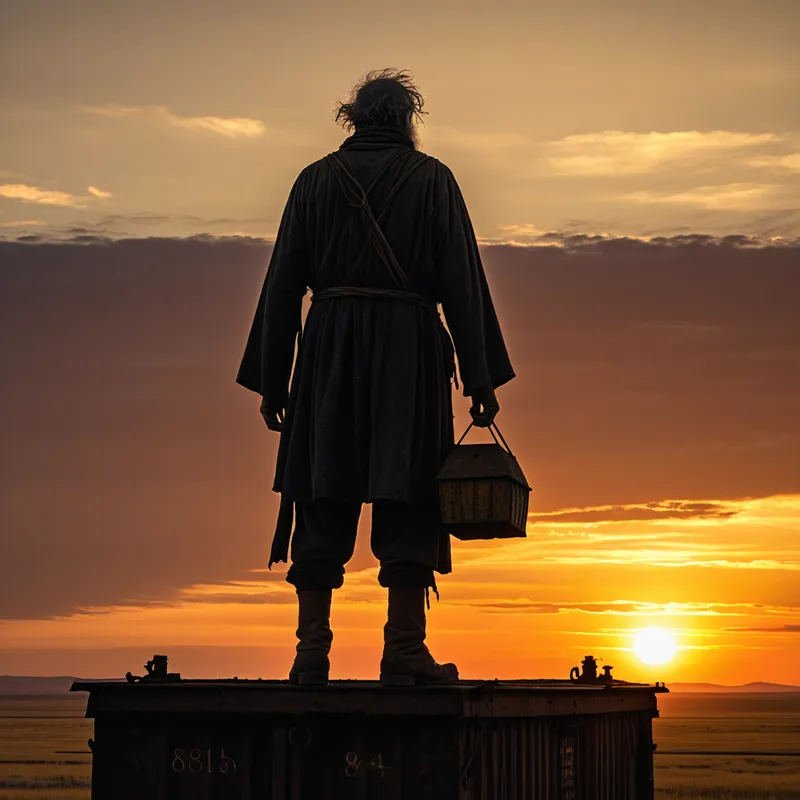
In the time between times—after the great closing of the frontier but before the world became a web of concrete and light—they walked. They were the children of dust and displacement, born from the cracked earth of the Dust Bowl and the cold silence of shuttered factories. They were not one, but a legion of singular souls. Their names were lost to the wind, replaced by monikers like "Steam Shovel" or "The Oklahoma Kid". Their kingdom was not of soil, but of motion. Their palace was the rattling, open-sided boxcar, smelling of creosote and old timber; their throne, a bundle of clothes tied to a stick—the bindle.
The conflict was eternal and internal: the war between the longing for a warm hearth and the terror of its cage. The open road promised freedom, but its price was etched in hunger, in the bone-deep cold of a Montana winter, in the watchful, hostile eye of the "bull". The hero’s journey was not to slay a dragon, but to outrun the specter of stillness. To leap onto a moving train was an act of faith—a prayer offered to momentum. The hands gripped the cold iron ladder, the feet found purchase on the shuddering step, and for a heart-stopping moment, the body hung between the solid, known earth and the rushing, unknown future.
They spoke in a secret language, a code of symbols chalked on fence posts and water towers: a circle with two arrows meant “a kindhearted woman lives here”; a cross with a smile, “food available for work”; a crude cat, “a mean man owns this place.” This was their scripture, written not in ink but in transient marks, a map of mercy and danger for the next wanderer.
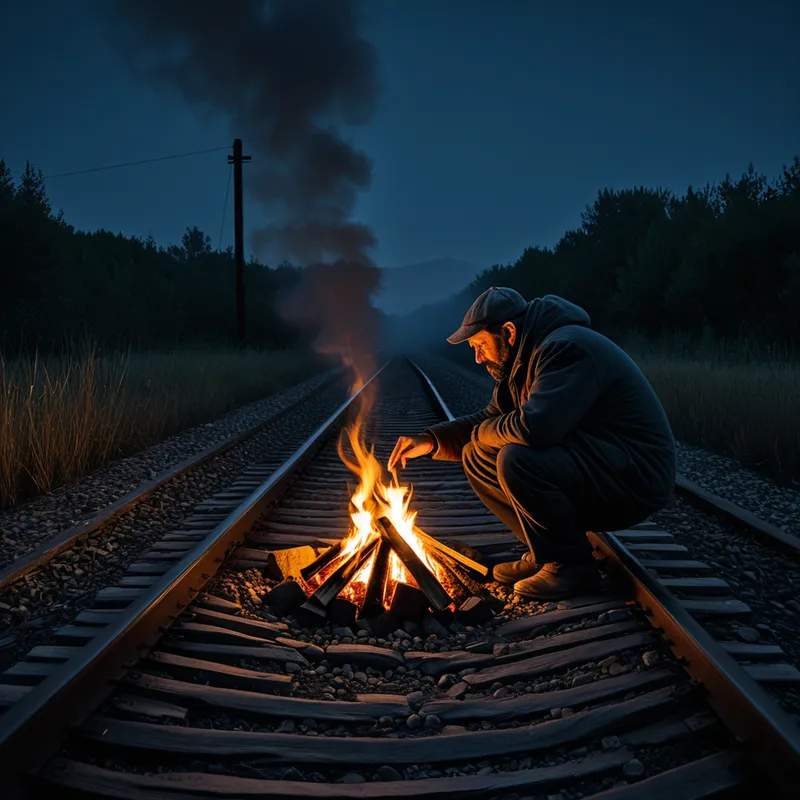
The resolution was never an arrival. It was the journey itself. It was the communion of strangers around a "jungle" campfire, sharing a stew of potatoes and stolen vegetables, swapping stories that were half-truth, half-legend. It was the profound silence of watching a continent unfold from a boxcar door—endless fields giving way to towering mountains, sleepy towns blinking by in the night. Their triumph was in the witnessing, in remaining unclaimed by any plot of land, belonging instead to the rhythm of the wheels and the expanse of the sky. They became spirits of the in-between, their essence woven into the sound of the whistle fading into the distance, a haunting proof that for some, to be free is to be forever almost gone.
Cultural Origins & Context
This myth did not spring from ancient temples but from the soot and grit of the American industrial age, roughly from the post-Civil War period through the Great Depression. It is a distinctly modern folklore, born of economic catastrophe, technological expansion, and social rupture. The myth was not passed down by bards in halls, but by the hobos themselves in their jungle camps, and later, by folk singers, labor organizers, and writers like Jack London and John Steinbeck, who translated the raw experience into narrative.
Its primary societal function was twofold. For the culture at large, the hobo served as a cautionary tale and a romanticized rebel—a shadow figure who embodied both the fear of failure and the secret desire for absolute liberty. For the men (and some women) who lived it, the mythos provided a crucial structure. It turned a desperate, often humiliating act of survival into a vocation with its own codes, ethics, and hierarchy. The "hobo code" was a moral compass for the stateless, creating a thin veneer of order and fraternity in a life defined by chaos and solitude. This mythologizing was a psychological survival tool, transforming a "bum" into a "Knight of the Road".
Symbolic Architecture
Psychologically, the Railroad Hobo is the archetype of the Explorer in its most raw and uncompromising form. He represents the soul's imperative to move beyond the confines of the known, even when—especially when—the known is security itself.
The bindle is not just a pack; it is the portable psyche, containing only what is essential for the journey, a radical editing of the self.
The railroad track is the ultimate symbol of liminality. It is not the destination (the town) nor the origin (the city); it is the threshold between them. To live on the rails is to inhabit the transitional space, the "betwixt and between," where transformation is possible precisely because one is unmoored. The "rattler" is the force of destiny or unconscious impulse itself—powerful, directioned, and dangerous to board or leave. The act of "catching out" is a leap of faith into the arms of fate.
The conflict between the warm, promised "kindhearted woman" (the anima of nourishment and rest) and the relentless call of the whistle (the animus of purpose and motion) stages the central human tension between the need for attachment and the need for autonomy.

The Dreamer's Resonance
When this myth surfaces in modern dreams, it rarely appears as a historical reenactment. Instead, it manifests as a profound somatic and psychological signal of a liminal state. Dreaming of riding a train you cannot control, of searching for a hidden jungle camp, or of packing a bindle with strange, symbolic objects points to a psyche in transit.
The body in the dream often feels the sensations: the vibration of the rails, the rush of wind, the anxiety of the leap. This is the somatic echo of a life transition—a career change, the end of a relationship, a spiritual awakening—where the old structures have dissolved, but the new ones have not yet formed. The dream hobo is the part of you that must endure this uncomfortable, in-between homelessness of the soul. He does not offer comfort, but a model of endurance. He suggests that the way forward is not through frantic planning, but through attentive listening to the "call" and the courage to move with the momentum of your own unfolding life, even without a clear ticket.

Alchemical Translation
The alchemical process modeled by the hobo myth is the separatio and solutio, leading to a peculiar form of coagulatio. The individual must first separate from the collective expectations of security, stability, and rooted identity (the prima materia of conventional life). This is a voluntary descent into insecurity, into the nigredo of the open road.
The jungle campfire is the alchemical furnace in the wilderness, where the raw experiences of the day (fear, hunger, beauty) are cooked in the vessel of shared story, slowly transmuting trauma into wisdom.
The long solutio—the dissolution—occurs through the endless motion, the breaking down of fixed personality by wind, weather, and anonymity. One is dissolved into the journey itself. The final coagulatio, the creation of the new substance, is not a stationary "self" but a moving one. The Philosopher's Stone of this process is not a static enlightenment, but a resilient, adaptable consciousness that can find home nowhere and thus can find it anywhere. The individuated self that emerges is not a castle-dweller, but a sovereign wanderer. It carries its center within the bindle of its own awareness, capable of engaging deeply with the world precisely because it is ultimately tethered to nothing but the truth of its own journey. The triumph is not in settling the frontier, but in becoming, eternally, its explorer.
Associated Symbols
Explore related symbols from the CaleaDream lexicon: